
Compare estimated RAP and IBR student loan payments and see the next RAP income cliff before it surprises you.
Advanced options
Table of contents
How to use our Student Loan RAP vs IBR Calculator
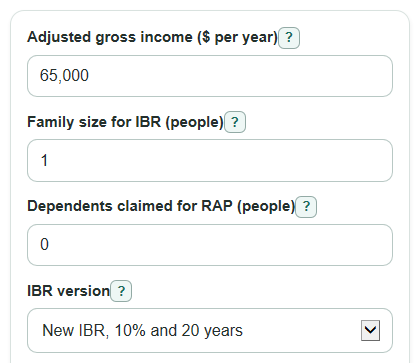
- Enter Adjusted gross income ($ per year), Family size for IBR, and Dependents claimed for RAP from your tax and household information.
- Choose IBR version, then enter Loan balance used for the IBR cap ($) and Interest rate (percent per year) for the loans you want to compare.
- Open Advanced options only if you need to change Poverty guideline area or include Qualifying payments already made (months).
- Select Calculate and compare Lower monthly payment, Plan with lower payment, and Monthly gap between the plans first.
- Sanity-check the result by reviewing RAP minus IBR, Next RAP income cliff, and Next RAP income-cliff jump, especially if your income is near a $10,000 RAP bracket boundary.
Definitions
Adjusted gross income (AGI): Your income number from your federal tax return before some deductions and credits; the calculator uses it for both RAP and IBR estimates.
Family size for IBR: The number of people used to find the poverty guideline amount for the IBR protected income calculation.
Dependents claimed for RAP: The number of dependents used for RAP's $50 per month dependent reduction; it can differ from Family size for IBR.
Discretionary income: The part of AGI that IBR counts after subtracting 150% of the poverty guideline.
10-year standard cap: The estimated fixed 10-year payment that limits the IBR monthly payment in this calculator.
RAP income cliff: A RAP AGI threshold where the RAP rate can rise when income moves to the next bracket.
Qualifying payments: Months that count toward the forgiveness term for a repayment plan, subject to servicer and program rules.
Common mistakes and quick fixes
Mistake: Using take-home pay in Adjusted gross income ($ per year).
Fix: Use AGI from your federal tax return, usually Form 1040 line 11, before comparing RAP monthly payment and IBR monthly payment.
Mistake: Entering the same number for Family size for IBR and Dependents claimed for RAP without checking the rules.
Fix: Use Family size for IBR for the poverty guideline calculation and Dependents claimed for RAP for the $50 per month RAP reduction.
Mistake: Picking the wrong IBR version.
Fix: Choose New IBR, 10% and 20 years only if that version applies to your loans; otherwise choose Old IBR, 15% and 25 years.
Mistake: Leaving Loan balance used for the IBR cap ($) or Interest rate (percent per year) at a guess.
Fix: Use the balance and weighted average rate for the loans being compared because they affect the 10-year standard cap estimate.
Mistake: Ignoring Poverty guideline area when you live in Alaska or Hawaii.
Fix: Change Poverty guideline area in Advanced options because higher poverty guidelines can lower Income counted by IBR.
Mistake: Treating Qualifying payments already made (months) as a payment amount.
Fix: Enter a count of months, not dollars, so Estimated IBR months left and Estimated RAP months left stay meaningful.
Limitations & Key Assumptions / Boundary Conditions
- RAP rules and plan availability are treated as the formula inputs described in the calculator. Future federal guidance, servicer programming, or court action could change real payments.
- The IBR estimate uses 2026 federal poverty guideline amounts for the selected area and family size. A different tax year or guideline year can change IBR protected income.
- The 10-year standard cap estimate uses the entered Loan balance used for the IBR cap ($), Interest rate (percent per year), and a 120-month amortization formula. It does not rebuild a servicer's exact loan-by-loan schedule.
- RAP interest help and matching principal help are simplified monthly estimates. They ignore fees, unpaid interest from before RAP, capitalization events, rounding rules, and whether a payment is full and on time.
- Qualifying payments already made (months) only reduces the displayed months left. The calculator cannot verify whether past months qualify.
- Lower monthly payment is a monthly cash-flow comparison only. It does not decide total lifetime cost, tax treatment of forgiveness, eligibility, credit reporting, or the best legal choice for your loans.
Methodology
RAP payment estimate
The RAP estimate applies the bracketed RAP AGI rate, subtracts the dependent reduction after converting to a monthly amount, and keeps the $10 minimum monthly payment [1].
If AGI <= 10000, RAP base annual payment = 120.
If AGI > 10000, RAP base annual payment = AGI x RAP rate.
RAP rate = 1% for 10000 < AGI <= 20000, 2% for 20000 < AGI <= 30000, and so on up to 10% for AGI > 100000.
RAP monthly payment = max(10, RAP base annual payment / 12 - 50 x dependents)
IBR payment estimate
IBR first protects 150% of the poverty guideline for the selected family size and area, then uses either 10% or 15% of the remaining income before applying the 10-year standard payment cap [3][4].
IBR protected income = poverty guideline at 100% x 1.5
Income counted by IBR = max(0, AGI - IBR protected income)
IBR uncapped monthly payment = Income counted by IBR x IBR percent / 12
If monthly interest rate = 0, 10-year standard cap = loan balance / 120.
If monthly interest rate > 0, 10-year standard cap = loan balance x monthly interest rate / (1 - (1 + monthly interest rate)^(-120))
IBR monthly payment = min(IBR uncapped monthly payment, 10-year standard cap)
Comparison and cliff check
The calculator compares the RAP and IBR monthly payments directly, keeps the sign on RAP minus IBR, and calculates the absolute monthly gap.
Lower monthly payment = min(RAP monthly payment, IBR monthly payment)
Monthly gap between the plans = abs(RAP monthly payment - IBR monthly payment)
RAP minus IBR = RAP monthly payment - IBR monthly payment
The next RAP income cliff is the next RAP threshold at or above AGI, up to $100,000. The jump is the estimated RAP payment at one dollar above that threshold minus the payment at the threshold, floored at $0 for the jump output only.
Next RAP income-cliff jump = max(0, payment_at_AGI(threshold + 1) - payment_at_AGI(threshold))
RAP help estimates and months left
Monthly interest is estimated from the entered balance and annual rate. RAP interest help is unpaid monthly interest, and matching principal help is limited by the simplified matching formula used by the calculator.
Monthly interest = loan balance x annual interest rate percent / 100 / 12
Estimated RAP interest help = max(0, monthly interest - RAP monthly payment)
Borrower principal paid = max(0, RAP monthly payment - monthly interest)
Estimated RAP matching principal help = max(0, min(50, RAP monthly payment) - borrower principal paid)
Estimated principal drop under RAP = borrower principal paid + estimated RAP matching principal help
Estimated IBR months left = max(0, IBR term months - qualifying payments already made)
Estimated RAP months left = max(0, 360 - qualifying payments already made)
Mini-example
With $65,000 AGI, family size 1, 0 RAP dependents, New IBR, a $50,000 balance, 6% interest, and the 48 states and DC poverty area, the RAP rate is 6%. RAP is $65,000 x 6% / 12 = $325 per month. The 2026 poverty guideline for one person in the 48 states and DC is $15,960, so IBR protected income is $23,940 and income counted by IBR is $41,060. New IBR is $41,060 x 10% / 12 = $342.17 per month, below the 10-year cap estimate of about $555.10. In that example, RAP is lower by about $17.17 per month, and the next RAP income cliff is $70,000.