
Compare a HELOC with a cash-out refinance using your mortgage balance, rates, cash needed, fees, and home value.
Advanced options
Timing
HELOC details
Refinance details
Home debt check
Table of contents
How to use our HELOC vs Cash-Out Refinance Calculator
- Enter Home value ($), Current mortgage balance ($), Current mortgage rate (percent), Years left on current mortgage, and Cash you want to borrow ($).
- Open Advanced options if you want to change Compare costs over (years), HELOC rate (percent), HELOC draw period (years), HELOC payback period (years), loan terms, fees, or LTV warning level (percent).
- Select Calculate and read Lower cost choice first, then compare HELOC path interest plus fees with Cash-out refinance interest plus fees.
- Check HELOC path first-month payment against HELOC path payment after draw period so the interest-only draw payment does not hide a later payment jump.
- Sanity-check Cash room at chosen LTV warning level, HELOC path CLTV, and Cash-out refinance LTV against your lender's actual limits before relying on the comparison.
Definitions
HELOC: A home equity line of credit, which is a credit line secured by your home [1]. In this calculator, the HELOC path keeps your current mortgage and adds the HELOC.
Cash-out refinance: A new mortgage that replaces your current mortgage and gives you extra cash from home equity [2]. In this calculator, the new loan equals Current mortgage balance ($) plus Cash you want to borrow ($).
Draw period: The HELOC stage when the calculator assumes interest-only payments on the borrowed cash.
Payback period: The HELOC stage after the draw period when the calculator spreads the HELOC balance across principal-and-interest payments.
LTV: Loan-to-value. It is home debt compared with Home value ($), shown as a percent.
CLTV: Combined loan-to-value. It compares all home debt, such as a first mortgage plus a HELOC, with Home value ($).
Interest plus fees: The interest paid during Compare costs over (years), plus the closing costs entered for that loan path.
Common mistakes and quick fixes
Mistake: Entering the full new loan amount in Cash you want to borrow ($).
Fix: Enter only the extra cash you want, because the calculator already adds Current mortgage balance ($) for the refinance path.
Mistake: Using a guess for Home value ($) that is far above what a lender may accept.
Fix: Use a recent estimate or appraisal, then review HELOC path CLTV and Cash-out refinance LTV.
Mistake: Comparing only HELOC path first-month payment with Cash-out refinance monthly payment.
Fix: Also review HELOC path payment after draw period because the HELOC can switch from interest-only to principal-and-interest payments.
Mistake: Leaving Compare costs over (years) at 5 when you expect to sell or refinance much sooner or later.
Fix: Change Compare costs over (years) to the time you actually want to test.
Mistake: Setting Refinance closing costs (percent of new loan) to 0 just to compare rates.
Fix: Enter a realistic fee estimate so Cash-out refinance interest plus fees includes both interest and closing costs.
Mistake: Ignoring Cash room at chosen LTV warning level when Cash you want to borrow ($) is high.
Fix: If Cash room at chosen LTV warning level is below your requested cash, expect the LTV warning note and verify lender limits.
Limitations & Key Assumptions / Boundary Conditions
- Monthly payments are principal and interest only. They do not include property taxes, homeowners insurance, mortgage insurance, HOA dues, or escrow changes.
- The HELOC rate is treated as fixed for the comparison, even though many HELOC rates can change.
- The calculator assumes the HELOC balance equals Cash you want to borrow ($), with no extra draws and no extra principal payments during the draw period.
- Refinance closing costs are treated as paid out of pocket, not rolled into the new refinance loan.
- The LTV warning level (percent) is only a math warning. Real lender approval can depend on credit score, income, property type, liens, reserves, and program rules.
- If Compare costs over (years) ends during the HELOC draw period, the calculator leaves the HELOC balance as debt instead of pretending it was paid off.
- Tax effects, prepayment penalties, rate locks, points, appraisal differences, and future home value changes are not included.
Methodology
How the comparison is built
The HELOC path keeps the current mortgage, adds the HELOC, and counts current mortgage interest, HELOC interest, and HELOC closing costs over Compare costs over (years). The cash-out refinance path replaces the current mortgage with one new loan equal to Current mortgage balance ($) plus Cash you want to borrow ($), then counts refinance interest and refinance closing costs over the same period.
monthly_rate = annual_rate_percent / 100 / 12
number_of_months = years * 12
payment = principal * monthly_rate / (1 - (1 + monthly_rate)^(-number_of_months))
If monthly_rate is 0, the amortized loan payment is principal divided by number_of_months. This payment formula is used for the current mortgage, the cash-out refinance, and the HELOC payback period.
Balances and interest
For each amortized loan, the calculator steps through the comparison months. Each month, interest is the starting balance times monthly_rate. Principal paid is the payment minus that month's interest, with the final payment capped so the balance cannot go below 0.
balance_after_m = principal * (1 + monthly_rate)^m - payment * (((1 + monthly_rate)^m - 1) / monthly_rate)
If monthly_rate is 0, balance_after_m is principal minus payment times m. If the comparison period is longer than a loan term, later months use a 0 payment, 0 interest, and 0 remaining balance for that loan.
HELOC timing
During the HELOC draw period, the calculator uses an interest-only HELOC payment.
heloc_draw_payment = cash_needed * heloc_monthly_rate
After the draw period, any HELOC balance is paid over HELOC payback period (years) using the amortized loan payment formula. The HELOC path first-month payment equals the current mortgage payment plus the draw-period HELOC payment. The HELOC path payment after draw period equals the HELOC repayment payment plus any current mortgage payment still owed at that time.
Cost, savings, and debt left
The primary choice is based on interest plus fees, not on the first monthly payment alone.
heloc_interest_fees = current_mortgage_interest_during_period + heloc_interest_during_period + heloc_closing_costs
refi_loan_amount = current_mortgage_balance + cash_needed
refi_closing_costs = refi_loan_amount * refi_closing_cost_percent / 100
refi_interest_fees = refi_interest_during_period + refi_closing_costs
cost_savings = absolute_value(heloc_interest_fees - refi_interest_fees)
Lower cost choice is HELOC if HELOC path interest plus fees is lower, Cash-out refinance if Cash-out refinance interest plus fees is lower, and Tie if the rounded costs match. Debt left at end of comparison is the HELOC path remaining debt minus the cash-out refinance remaining debt, so a positive value means the HELOC path leaves more debt.
LTV and CLTV checks
The calculator uses the same starting total home debt for both paths because both use the same requested cash amount.
heloc_cltv_percent = (current_mortgage_balance + cash_needed) / home_value * 100
refi_ltv_percent = (current_mortgage_balance + cash_needed) / home_value * 100
max_cash_by_ltv = home_value * max_ltv_percent / 100 - current_mortgage_balance
If Cash you want to borrow ($) is greater than Cash room at chosen LTV warning level, the calculator still shows the cost comparison but adds an LTV warning note.
Mini example
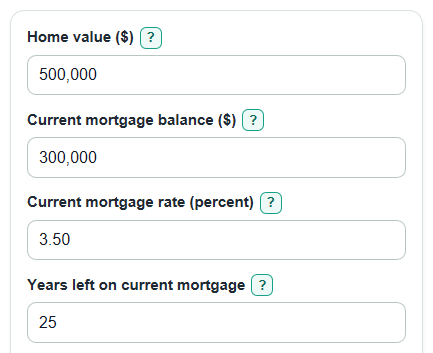
With Home value ($) of $500,000, Current mortgage balance ($) of $300,000, Current mortgage rate (percent) of 3.50, Years left on current mortgage of 25, and Cash you want to borrow ($) of $75,000, the default 5-year comparison estimates the HELOC path at about $83,300 of interest plus fees and the cash-out refinance path at about $138,900. The HELOC path is lower by about $55,600, starts near $2,064 per month, and has a later HELOC repayment-period payment near $2,176. Both starting HELOC path CLTV and Cash-out refinance LTV are 75% because total starting home debt is $375,000 on a $500,000 home.