
Compare two fixed-rate mortgage offers by APR, payment, and cost through the time you expect to keep the loan.
Table of contents
How to use our Mortgage APR Comparison Calculator
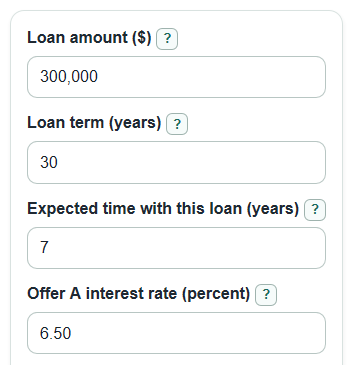
- Enter the Loan amount ($), Loan term (years), and Expected time with this loan (years) from your plan or Loan Estimate.
- Enter Offer A interest rate (percent) and Offer A APR costs or credit ($), using a negative number for a lender credit.
- Enter Offer B interest rate (percent) and Offer B APR costs or credit ($) the same way, then select Calculate.
- Read Lower cost through your chosen time first if you expect to sell, refinance, or pay off early; then compare Offer A estimated APR and Offer B estimated APR for the full-term view.
- Sanity-check the results: a lower interest rate should usually lower Monthly principal and interest, while higher APR costs or credit ($) can make that offer worse early on.
Definitions
Interest rate: The note rate used to calculate the monthly principal and interest payment. It does not include upfront loan costs.
APR: Annual percentage rate. For this calculator, it is an estimated yearly cost rate that spreads entered upfront APR costs over the full loan term.
APR costs or credit: Points and lender fees entered as positive dollars, or a lender credit entered as negative dollars.
Amount financed: The loan amount minus the APR costs or credit. This is the amount used in the APR estimate equation.
Monthly principal and interest: The mortgage payment part that pays interest and reduces the loan balance. It excludes taxes, homeowners insurance, HOA dues, and escrow items.
Cost gap: Offer A cost through your chosen time minus Offer B cost through your chosen time. Negative means Offer A costs less; positive means Offer A costs more.
Break-even month: The first month when the offer with higher upfront cost becomes cheaper because its lower interest cost has caught up.
Common mistakes and quick fixes
Mistake: Entering the home price instead of the Loan amount ($).
Fix: Use the amount borrowed, not the purchase price or down payment.
Mistake: Leaving Offer A interest rate (percent) or Offer B interest rate (percent) blank because the rate is 0 percent.
Fix: Type 0 when the interest rate is truly zero; blank rate fields are treated as errors.
Mistake: Putting a lender credit as a positive number in Offer A APR costs or credit ($) or Offer B APR costs or credit ($).
Fix: Enter credits as negative numbers, such as -1500, and fees or points as positive numbers.
Mistake: Using Expected time with this loan (years) as the full loan term even though you may refinance or sell sooner.
Fix: Enter your realistic expected time, because the lower APR offer may not be cheaper before the break-even month.
Mistake: Reading Offer A minus Offer B cost gap as an absolute savings number.
Fix: Use the sign: a negative gap means Offer A costs less, and a positive gap means Offer B costs less.
Limitations & Key Assumptions / Boundary Conditions
- This calculator is for fixed-rate, fully amortizing mortgages. Do not use it for adjustable-rate, balloon, interest-only, construction, or reverse mortgage offers.
- The APR values are estimates, not legal APR disclosures. A lender's official APR may use detailed rules and fee classifications that are not entered here.
- Only Loan amount ($), interest rates, loan term, and APR costs or credit are included. Taxes, homeowners insurance, mortgage insurance, HOA dues, escrow deposits, prepaid daily interest, and third-party fees not entered as APR costs are excluded.
- Expected time with this loan (years) is converted to the nearest whole month and capped at the full loan term.
- Cost through your chosen time is a borrowing-cost comparison. It includes entered upfront APR costs or credit plus interest paid, but it does not treat principal repayment as a cost because principal reduces debt or builds equity.
- The break-even month is found by scanning whole months, so it is a practical month estimate rather than an exact day-by-day payoff date.
Methodology
Payment calculation
The calculator uses Loan amount ($) as the principal. The interest rate, not APR, is used for the monthly principal and interest payment. The CFPB describes mortgage interest rate and APR as different measures, with APR including costs beyond the interest rate [3].
monthly_note_rate = interest_rate_percent / 100 / 12
term_months = loan_term_years * 12
monthly_payment = principal * monthly_note_rate / (1 - (1 + monthly_note_rate)^(-term_months))
If the monthly note rate is 0, the payment is principal divided by term_months.
monthly_payment = principal / term_months
APR estimate
APR costs or credit are used to estimate an amount financed. Positive costs reduce the amount financed. A lender credit is negative, so it increases the amount financed in the equation.
amount_financed = principal - upfront_apr_costs
The calculator solves for the monthly APR rate that makes the present value of all monthly payments equal the amount financed. It uses a stable bisection search, then converts the monthly APR rate to an annual percentage.
amount_financed = monthly_payment * (1 - (1 + apr_monthly_rate)^(-term_months)) / apr_monthly_rate
estimated_apr_percent = apr_monthly_rate * 12 * 100
Cost through your chosen time
The Expected time with this loan (years) is converted to comparison months, then capped at the full loan term.
k = min(round(expected_years * 12), term_months)
For each offer, the remaining balance after k months is calculated from the original principal, the note rate, and the monthly payment.
remaining_balance = principal * (1 + monthly_note_rate)^k - monthly_payment * ((1 + monthly_note_rate)^k - 1) / monthly_note_rate
If the monthly note rate is 0, the remaining balance is calculated with simple principal paydown.
remaining_balance = principal - monthly_payment * k
Interest paid is total payments through the chosen month minus principal repaid. Borrowing cost is the interest paid plus the entered APR costs or credit.
interest_paid = k * monthly_payment - (principal - remaining_balance)
cost_through_time = upfront_apr_costs + interest_paid
The signed cost gap keeps the direction clear.
cost_gap_a_minus_b = cost_through_time_a - cost_through_time_b
savings = abs(cost_gap_a_minus_b)
Break-even month
The calculator scans month 0 through the full term. It returns the first month when the offer with higher upfront cost has cost less than or equal to the other offer. If the offers start with the same upfront cost and have the same running cost, the break-even month is 0. If no crossing happens within the term, the result says there is no break-even within the loan term.
Mini-example
For a $300,000 loan over 30 years, compare 7 years with the loan. Offer A has a 6.50 percent rate and $6,000 in APR costs. Offer B has a 6.75 percent rate and $1,500 in APR costs. The monthly principal and interest payments are about $1,896.20 for Offer A and $1,945.79 for Offer B. The estimated APRs are about 6.6953 percent for Offer A and 6.7990 percent for Offer B. Through 84 months, Offer A costs about $779 less, and the higher upfront cost catches up at about month 72.
Sources
- What is the difference between a loan interest rate and the APR? | Consumer Financial Protection Bureau - Consumerfinance
- What happens if my mortgage is sold? Is my loan safe? | Consumer Financial Protection Bureau - Consumerfinance
- What is the difference between a mortgage interest rate and an APR? | Consumer Financial Protection Bureau - Consumerfinance