
Estimate a house flip's profit, cautious downside, cash needed, break-even sale price, and 70% rule gap from your deal numbers.
Table of contents
How to use our House Flipping Calculator
- Enter the Purchase price, Repair budget, After-repair value, Holding time, and Monthly carrying cost for the flip.
- Open Advanced options if you want to change Buying costs, Selling costs, financing, loan points, Repair buffer, or Sale price cushion.
- Click Calculate to see Expected profit first, then Cautious profit, return measures, cash needed before sale, break-even sale price, and the 70% rule check.
- Sanity-check the result by comparing Cautious profit with Expected profit. If a small resale drop or repair overrun wipes out the profit, the deal has little room for mistakes.
- Use Break-even sale price to test your resale estimate. If your After-repair value is close to break-even, review repair quotes, sale comps, and holding time before relying on the number.
Definitions
Purchase price: The price you expect to pay for the property before buyer closing costs.
Repair budget: The expected cost of labor, materials, permits, cleanup, and other work needed before resale.
After-repair value: The expected resale price after the work is complete. Investors often shorten this to ARV.
Holding time: The number of months from purchase closing to resale closing.
Monthly carrying cost: Ongoing monthly costs such as taxes, insurance, utilities, yard care, security, and similar expenses.
Buying costs: Buyer-side closing costs entered as a percent of Purchase price.
Selling costs: Sale-side costs entered as a percent of the sale price, often including agent commission and seller closing costs.
Repair buffer: A percent added to Repair budget in the cautious scenario.
Sale price cushion: A percent subtracted from After-repair value in the cautious scenario.
70% rule max offer: A quick screening number equal to 70% of After-repair value minus the cautious repair budget.
Common mistakes and quick fixes
Mistake: Putting the full improved home value into Purchase price instead of the amount you pay to buy the property.
Fix: Use Purchase price for the buy price only, and put the expected resale number in After-repair value.
Mistake: Leaving labor, permits, cleanup, or surprise items out of Repair budget.
Fix: Put your full expected repair cost in Repair budget, then use Repair buffer to test an overrun.
Mistake: Treating After-repair value as a guaranteed sale price.
Fix: Enter your best resale estimate in After-repair value, then use Sale price cushion to see Cautious profit if the sale price slips.
Mistake: Entering Holding time as only the rehab work time.
Fix: Use Holding time for the full time from purchase closing to resale closing, including listing and closing delays.
Mistake: Mixing Selling costs with Monthly carrying cost.
Fix: Put agent commission and seller closing costs in Selling costs, and put monthly taxes, insurance, utilities, and similar items in Monthly carrying cost.
Mistake: Reading Room versus 70% rule as profit.
Fix: Use Expected profit for projected dollars made or lost. Room versus 70% rule only compares Purchase price with the shortcut max offer.
Limitations & Key Assumptions / Boundary Conditions
- The calculator estimates project profit before income taxes and does not calculate depreciation, capital gains, ordinary income treatment, or entity-level costs.
- The loan model is simplified. It treats financing as interest-only during the hold and calculates loan amount from Purchase price only, not from Repair budget.
- Selling costs are modeled as a percent of the sale price. Real closing statements can include fixed fees, credits, prorations, repairs after inspection, and payoff details.
- Cash needed before sale excludes Selling costs because they are usually paid from sale proceeds in this model. Some deals may require seller-paid items earlier.
- The cautious scenario changes Repair budget and sale price only. It does not extend Holding time, change Monthly carrying cost, or change the loan amount.
- Negative Expected profit, Cautious profit, Return on total cost, Return on cash before sale, and Room versus 70% rule are valid results. A negative value means the entered numbers point to a loss or gap.
- The 70% rule is only a shortcut. Local prices, financing terms, risk, repair scope, and investor goals can make a real offer higher or lower than that number.
Methodology
How the main estimate is calculated
The calculator builds an expected project cost, subtracts that cost from After-repair value, then shows return measures and deal checks. Percent inputs are divided by 100 before they are used.
loan_amount = purchase_price * financed_percent / 100
loan_cost = loan_amount * (annual_interest_rate / 100) / 12 * hold_months + loan_amount * loan_points_percent / 100
total_project_cost = purchase_price + rehab_cost + purchase_price * purchase_closing_percent / 100 + hold_months * monthly_carrying_cost + loan_cost + after_repair_value * selling_cost_percent / 100
net_profit = after_repair_value - total_project_cost
Cautious scenario
The cautious scenario raises Repair budget by the Repair buffer and lowers After-repair value by the Sale price cushion. Selling costs in this scenario are based on the lowered sale price.
cautious_net_profit = after_repair_value * (1 - sale_price_cushion_percent / 100) - (purchase_price + rehab_cost * (1 + rehab_buffer_percent / 100) + purchase_price * purchase_closing_percent / 100 + hold_months * monthly_carrying_cost + loan_cost + after_repair_value * (1 - sale_price_cushion_percent / 100) * selling_cost_percent / 100)
Return and cash checks
Return on total cost compares Expected profit with all expected project costs. Yearly pace of return scales that return to a 12-month pace, so Holding time must be greater than 0. Return on cash before sale uses cash needed before sale as the denominator; if that cash amount is zero or less, the calculator shows N/A instead of dividing.
total_roi_percent = net_profit / total_project_cost * 100
annualized_roi_percent = total_roi_percent * 12 / hold_months
cash_needed_before_sale = purchase_price * (1 - financed_percent / 100) + purchase_price * purchase_closing_percent / 100 + rehab_cost + hold_months * monthly_carrying_cost + loan_cost
cash_on_cash_percent = net_profit / cash_needed_before_sale * 100
Break-even and 70% rule checks
Break-even sale price solves for the sale price where profit is zero after percentage-based Selling costs. Selling costs must be less than 100% because the formula divides by the part of the sale price left after selling costs. The 70% rule check is a quick screen, not a full valuation.
break_even_sale_price = (purchase_price + rehab_cost + purchase_price * purchase_closing_percent / 100 + hold_months * monthly_carrying_cost + loan_cost) / (1 - selling_cost_percent / 100)
max_offer_70_rule = after_repair_value * 0.70 - rehab_cost * (1 + rehab_buffer_percent / 100)
offer_gap_to_70_rule = max_offer_70_rule - purchase_price
Mini-example
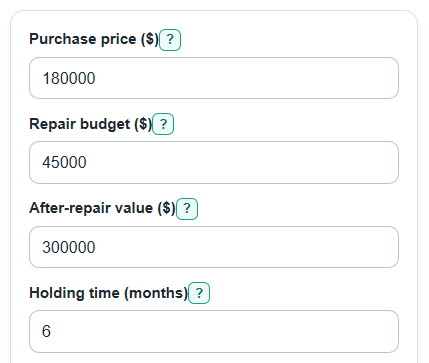
With a $180,000 Purchase price, $45,000 Repair budget, $300,000 After-repair value, 6 months of Holding time, $1,200 Monthly carrying cost, 2% Buying costs, 7% Selling costs, 80% financing at 10% interest, 2 loan points, a 10% Repair buffer, and a 3% Sale price cushion, the loan cost is $10,080 and Expected total project cost is $266,880. Expected profit is $33,120. Cautious profit is $20,250 because the resale price is lowered and repairs are increased. The 70% rule max offer is $160,500, so Room versus 70% rule is -$19,500 against the entered Purchase price.