
Estimate gross and net rental yield from price, rent, vacancy, operating costs, purchase costs, and a target return.
Table of contents
How to use our Rental Yield Calculator
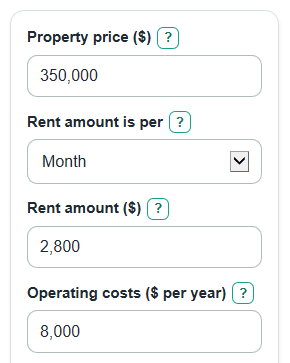
- Enter the Property price, using the purchase price or the current value you want to compare.
- Choose Rent amount is per, then enter the Rent amount before vacancy and costs.
- Enter Operating costs for one year and your expected Vacancy rate.
- Open Advanced options if you want to include Purchase costs or change the Target net yield.
- Click Calculate, then sanity-check the output by comparing Rent left after operating costs with your real bills and checking whether Vacancy cushion left is positive.
Definitions
Gross yield: Scheduled yearly rent divided by Property price, before vacancy, purchase costs, or operating costs.
Net yield on total cost: Rent left after vacancy and Operating costs, divided by Property price plus Purchase costs.
Net operating income (NOI): Rent left after vacancy and normal operating costs, before loan payments and income tax [3].
Vacancy rate: The percent of the year the property is expected to be empty or unpaid.
Operating costs: Regular costs to run the rental, such as property taxes, insurance, repairs, management, HOA dues, and owner-paid utilities.
Purchase costs: One-time buying costs added to Property price for the net yield calculation.
Percentage points: The direct gap between two percent values. For example, 6.6 percent minus a 6.0 percent target is 0.6 percentage points.
Common mistakes and quick fixes
Mistake: Putting loan payments in Operating costs.
Fix: Use Operating costs for normal property costs only, such as taxes, insurance, repairs, management, HOA dues, and owner-paid utilities.
Mistake: Mixing up Rent amount is per with Rent amount.
Fix: If Rent amount is monthly, choose Month; if it is weekly, choose Week.
Mistake: Leaving Purchase costs out when comparing deals bought with high closing costs.
Fix: Enter Purchase costs so Net yield on total cost is based on the full amount spent to buy the property.
Mistake: Reading Gross yield before costs as the real return.
Fix: Use Net yield on total cost for the main decision because it subtracts Vacancy rate and Operating costs.
Mistake: Ignoring a negative Vacancy cushion left.
Fix: A negative Vacancy cushion left means your Vacancy rate is already past the point where Rent left after operating costs reaches zero.
Mistake: Treating Rent needed for target yield as guaranteed market rent.
Fix: Compare Rent needed for target yield with realistic local rent before assuming the Target net yield is possible.
Limitations & Key Assumptions / Boundary Conditions
- The calculator measures rental yield before loan payments, income tax, depreciation, and sale proceeds.
- Operating costs are treated as a yearly total. Large one-time repairs or capital improvements can make real cash flow lower in a specific year.
- Vacancy rate is applied evenly to scheduled rent. Actual unpaid rent, tenant turnover, and leasing delays may not happen evenly.
- Rent amount uses 12 periods per year for Month and 52 periods per year for Week.
- Net yield on total cost uses Property price plus Purchase costs. It does not track down payment, financing, or cash-on-cash return.
- Break-even vacancy can be negative when full-year rent is not enough to cover Operating costs.
- Rent needed for target yield is a math target, not a rent forecast. Local market rent may be higher or lower.
Methodology
Calculation steps
The calculator first turns the entered Rent amount into scheduled yearly rent. It uses 12 periods for Month and 52 periods for Week.
scheduled_annual_rent = rent_amount * periods_per_year
It then reduces scheduled rent by Vacancy rate.
annual_effective_rent = scheduled_annual_rent * (1 - vacancy_rate / 100)
Net operating income is the rent left after vacancy and normal operating costs, before debt payments and income tax [3]. Negative values are kept because they show that costs are higher than collected rent.
annual_noi = annual_effective_rent - annual_operating_expenses
Gross yield is a quick screening number because it ignores vacancy and costs [1].
gross_yield_pct = scheduled_annual_rent / purchase_price * 100
Net yield on total cost is the main result. It divides net operating income by Property price plus Purchase costs.
net_yield_pct = annual_noi / (purchase_price + purchase_costs) * 100
The target check compares the net yield with Target net yield.
yield_gap_to_target_pct = net_yield_pct - target_net_yield
The vacancy cushion check finds the highest vacancy rate where rent after vacancy would still cover Operating costs, then compares it with your entered Vacancy rate.
break_even_vacancy_pct = (1 - annual_operating_expenses / scheduled_annual_rent) * 100
vacancy_margin_pct = break_even_vacancy_pct - vacancy_rate
Rent needed for target yield solves for the rent per selected period needed to reach the target after vacancy and Operating costs.
needed_rent_for_target = ((target_net_yield / 100) * (purchase_price + purchase_costs) + annual_operating_expenses) / ((1 - vacancy_rate / 100) * periods_per_year)
Operating cost share shows how much of rent after vacancy is used by Operating costs. If rent after vacancy is zero, the calculator does not divide by zero.
expense_ratio_pct = annual_operating_expenses / annual_effective_rent * 100
Mini-example
For a $350,000 property, $10,000 in Purchase costs, $2,800 monthly rent, $8,000 in Operating costs, 5 percent Vacancy rate, and a 6 percent Target net yield: scheduled yearly rent is $33,600, rent after vacancy is $31,920, and rent left after operating costs is $23,920. Net yield on total cost is $23,920 divided by $360,000, or about 6.64 percent. The property is about 0.64 percentage points above the 6 percent target, and the rent needed for the target is about $2,596.49 per month.