
Calculate how much to save each deposit to reach a future goal using current savings, interest, timing, and price growth.
Table of contents
How to use our Sinking Fund Calculator
- Enter the Goal amount ($) you want available when the bill, purchase, or savings goal is due.
- Enter Current savings ($), then enter the Number of deposits you will make before the goal date.
- Enter Annual return (% per year) and choose How often you deposit so the calculator can convert yearly growth into growth per deposit period.
- Open Advanced options only if you need Deposits happen or Price growth (% per year) to match your plan more closely.
- Check Save this much each deposit against your real budget, then review Extra cushion at the goal date and Target amount at the goal date to make sure the result fits the goal you meant to enter.
Definitions
Sinking fund: Money set aside over time for a future cost, such as insurance, a trip, a car repair, or a planned purchase [3].
Goal amount ($): The amount you want available by the goal date. If Price growth (% per year) is used, this should be today's price.
Current savings ($): Money already saved for this same goal.
Number of deposits: The count of deposits you will make before the money is needed, not the number of years.
Annual return (% per year): The expected yearly growth rate of the money, such as a savings APY or an investment return [1].
Return per deposit period: The annual return converted to one weekly, biweekly, monthly, quarterly, or yearly deposit period.
Deposits happen: Whether each deposit is made at the start or end of each deposit period. Start deposits have one extra period to grow.
Price growth (% per year): The expected yearly rise in the goal cost. Use 0 when the Goal amount ($) is already the amount you need on the goal date.
Extra cushion at the goal date: Planned ending balance minus the adjusted target. A positive amount means the plan ends above the goal.
Common mistakes and quick fixes
Mistake: Entering a future price in Goal amount ($) and also adding Price growth (% per year).
Fix: If Goal amount ($) is already the future price, leave Price growth (% per year) at 0.
Mistake: Typing years instead of deposits in Number of deposits.
Fix: Count each planned deposit. For one year of monthly saving, Number of deposits is 12.
Mistake: Entering 0.04 in Annual return (% per year) when you mean 4%.
Fix: Enter 4 for 4%. Enter 0 only when the money earns no growth.
Mistake: Choosing How often you deposit as Monthly while actually saving every 2 weeks.
Fix: Match How often you deposit to the real schedule so Save this much each deposit is the right size.
Mistake: Putting unrelated cash in Current savings ($).
Fix: Include only money already set aside for this same sinking fund goal.
Mistake: Leaving Deposits happen at the end of each period when each deposit is made at the start.
Fix: Change Deposits happen to the start option if the money is added right away and gets one extra period to grow.
Limitations & Key Assumptions / Boundary Conditions
- The Annual return (% per year) is treated as effective yearly growth, similar to APY. The calculator does not ask for a separate compounding schedule.
- Current savings ($) and all future deposits are assumed to earn the same return.
- The deposit amount is fixed. The calculator does not model skipped deposits, changing deposits, early withdrawals, taxes, fees, or account minimums.
- Price growth (% per year) is applied at a constant yearly rate. Real prices may rise unevenly or fall.
- Weekly, every 2 weeks, monthly, quarterly, and yearly use 52, 26, 12, 4, and 1 deposits per year.
- Save this much each deposit is floored at $0 when Current savings ($) already grows enough to cover the target. Extra cushion at the goal date shows the overage.
- Displayed dollars are rounded for readability, so Extra cushion at the goal date can show a tiny difference from $0 after rounding.
Methodology
Calculation steps
The calculator first turns How often you deposit into deposits per year:
weekly = 52, every 2 weeks = 26, monthly = 12, quarterly = 4, and yearly = 1.
years = number_of_deposits / payments_per_year
Price growth, if entered, raises the Goal amount ($) to the estimated Target amount at the goal date.
target_at_goal = goal_amount * (1 + price_growth_decimal)^years
The Annual return (% per year) is converted to a Return per deposit period so weekly, monthly, and yearly plans are handled consistently.
periodic_return = (1 + annual_return_decimal)^(1 / payments_per_year) - 1
Current savings are grown for the full number of deposit periods.
future_value_current_savings = current_savings * (1 + periodic_return)^number_of_deposits
The new deposits use the future value of an annuity accumulation factor, which is the standard sinking fund setup for equal deposits [2]. If the periodic return is 0, the factor is just the number of deposits, avoiding division by 0.
factor_end = number_of_deposits when periodic_return = 0
factor_end = ((1 + periodic_return)^number_of_deposits - 1) / periodic_return when periodic_return is not 0
deposit_factor = factor_end for end timing
deposit_factor = factor_end * (1 + periodic_return) for start timing
The required deposit is the remaining future need divided by that deposit factor. It is floored at $0 because this calculator answers how much to save, not how much to withdraw.
required_deposit = max(0, (target_at_goal - future_value_current_savings) / deposit_factor)
The supporting outputs come from the planned ending balance after current savings and new deposits grow to the goal date.
planned_ending_balance = future_value_current_savings + required_deposit * deposit_factor
cushion_at_goal = planned_ending_balance - target_at_goal
total_deposited = required_deposit * number_of_deposits
growth_earned = planned_ending_balance - current_savings - total_deposited
Mini-example
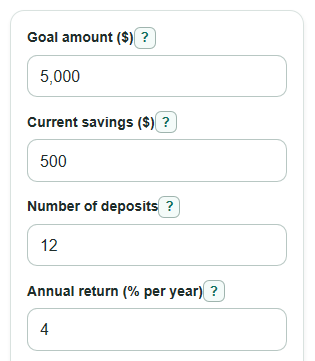
Suppose Goal amount ($) is $5,000, Current savings ($) is $500, Number of deposits is 12, Annual return (% per year) is 4%, How often you deposit is Monthly, Deposits happen at the end, and Price growth (% per year) is 0. Monthly deposits per year are 12, so the plan lasts 1 year. The return per deposit period is about 0.3274%. Current savings grow to about $520. The required fixed deposit is about $366.66 per month. Total you add is about $4,399.91, and Growth earned is about $100.09.