
Compare your current debt plan with a new consolidation loan to estimate savings, payment change, fees, and payoff time.
Advanced options
Table of contents
How to use our Debt Consolidation Savings Calculator
- Enter the Current debt total ($), Current average rate (%), and Current monthly payment ($) for only the debts you plan to consolidate.
- Enter the New loan rate (%) and New loan length (months) from the consolidation loan offer.
- Open Advanced options if you know the One-time fee ($), need to choose How the fee is paid, or want to test an Extra paid each month on new loan ($).
- Click Calculate and read Total savings after fees first. A negative number means the new plan costs more overall.
- Sanity-check the result by comparing Monthly payment change with Payoff time change. A lower monthly payment can still be a bad trade if the payoff time gets much longer.
Definitions
Debt consolidation: Replacing several debts with one new loan or account, usually to get one payment, a different rate, or a different payoff schedule.
APR: Annual percentage rate. It is a yearly borrowing cost used here to estimate monthly interest [1].
Current average rate (%): The average APR on the debts you are comparing. A balance-weighted average is best when debts have different balances.
New loan length (months): The number of monthly payments in the consolidation loan term.
One-time fee ($): A fee charged at the start, such as an origination fee or balance transfer fee.
How the fee is paid: Added to new loan means the fee is borrowed and can create interest. Paid now means it is counted as cash cost at the start.
Planned new monthly payment: Required new loan payment plus Extra paid each month on new loan ($).
Total savings after fees: Current payoff cost minus new loan payoff cost, including the one-time fee. Positive is savings. Negative is extra cost.
Common mistakes and quick fixes
Mistake: Entering only one card in Current debt total ($) when the Current monthly payment ($) covers several debts.
Fix: Make Current debt total ($) and Current monthly payment ($) cover the same debts.
Mistake: Using a simple guess for Current average rate (%) when most of the balance is on a higher-rate debt.
Fix: Use a balance-weighted Current average rate (%) if you can, so larger balances count more.
Mistake: Leaving One-time fee ($) at 0 when the new loan has an origination fee or balance transfer fee.
Fix: Enter the fee and choose the correct How the fee is paid option.
Mistake: Choosing Added to new loan under How the fee is paid when you will actually pay the fee out of pocket.
Fix: Choose Paid now if the fee is paid at the start and not borrowed.
Mistake: Comparing only Planned new monthly payment and ignoring Total savings after fees.
Fix: Check Total savings after fees and Payoff time change before deciding whether the lower payment is worth it.
Mistake: Entering Extra paid each month on new loan ($) as the whole new payment instead of only the extra amount.
Fix: Enter only the amount above the Required new loan payment.
Limitations & Key Assumptions / Boundary Conditions
- The calculator assumes no new charges are added to the current debt or the new loan.
- APR is treated as a fixed yearly rate split into 12 equal monthly periods. Real lenders may use daily interest or different timing.
- The current debt is modeled as one combined balance with one average rate, so separate debts with different minimum payments may not match exactly.
- The current monthly payment is assumed to stay the same until payoff.
- The new loan is treated as a fixed-payment loan with the fee either paid now or added to the starting loan balance.
- If a payment does not cover the first month's interest, the calculator returns an error because the balance would not pay off under the fixed-payment setup.
- Taxes, late fees, prepayment penalties, rate changes, credit score effects, and lender approval rules are not included.
Methodology
How the comparison is built
The calculator compares two cash-cost paths: keeping the current debt payment and taking the new consolidation loan. It includes the One-time fee ($) once, either as part of the new loan balance or as a paid-now cash cost.
monthly_rate = apr_percent / 100 / 12
For the new loan, the required payment uses the standard fixed-payment loan formula. This is the same type of amortization math used for loans that are paid down over time.
payment = principal * monthly_rate / (1 - (1 + monthly_rate)^(-term_months))
if monthly_rate = 0, payment = principal / term_months
If How the fee is paid is Added to new loan, principal is Current debt total ($) plus One-time fee ($). If How the fee is paid is Paid now, principal is only Current debt total ($).
new_planned_payment = new_required_payment + extra_new_payment
Payoff simulation
Both the current debt and the new loan are paid down month by month. Each month, interest is added first. If the planned payment is enough to cover the balance plus that month's interest, the calculator uses a smaller final payment and stops.
interest = balance * monthly_rate
if planned_payment >= balance + interest, final_payment = balance + interest
else balance = balance + interest - planned_payment
This simulation avoids overstating the last payment and lets Extra paid each month on new loan ($) shorten the payoff time.
Cost and savings formulas
After the payoff loops finish, the calculator totals the cash paid in each path.
current_interest = current_total_paid - current_balance
new_interest_and_fees = new_total_cash_paid - current_balance
total_savings_after_fees = current_total_paid - new_total_cash_paid
monthly_payment_change = current_payment - new_planned_payment
payoff_time_change_months = current_payoff_months - new_payoff_months
Mini-example
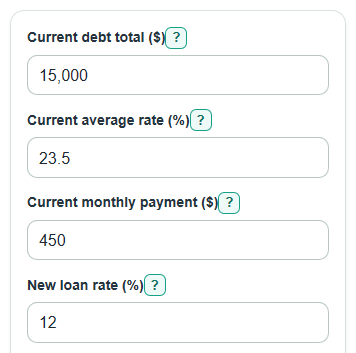
Suppose Current debt total ($) is 15000, Current average rate (%) is 23.5, and Current monthly payment ($) is 450. A new loan at 12% for 60 months has a Required new loan payment of about $333.67 with no fee and no extra payment. The current payoff takes about 55 months and costs about $9544.99 in interest. The new loan takes 60 months and costs about $5020.00 in interest and fees. Total savings after fees is about $4524.98, but Payoff time change is -5 months, so the new plan is cheaper but slower.