
Estimate whether a balance transfer fee is worth paying based on your balance, APR, lower-rate period, and monthly payment.
Advanced options
Table of contents
How to use our Balance Transfer Break-Even Calculator
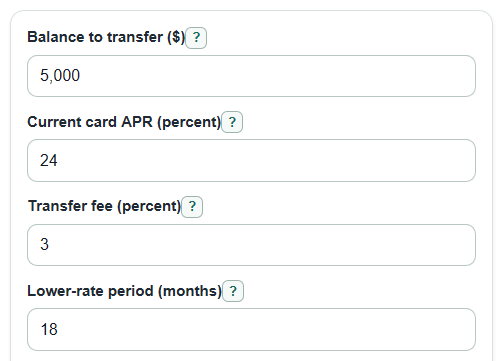
- Enter the Balance to transfer ($), the Current card APR (percent), the Transfer fee (percent), the Lower-rate period (months), and your Monthly payment ($).
- Open Advanced options only if your offer has a nonzero Balance-transfer APR during lower-rate period (percent), a different APR after lower-rate period (percent), a Minimum transfer fee ($), or a Maximum transfer fee ($).
- Click Calculate and read Estimated savings with the transfer first. A positive amount means the transfer is estimated to save money; a negative amount means it is estimated to cost more.
- Check Break-even month and Balance left after lower-rate period. If there is no break-even or a balance remains after the lower-rate period, look closely at the regular APR and your payment plan.
- Sanity-check the result by comparing Payment to finish during lower-rate period with your real budget. If that payment is much higher than you can afford, the transfer may still leave you paying regular APR later.
Definitions
Balance to transfer ($): The credit card debt you are thinking about moving to a balance-transfer card, before any fee is added.
APR: APR means annual percentage rate, or the yearly interest rate used to describe credit card interest [2]. This calculator turns APR into a simple monthly rate for the estimate.
Lower-rate period (months): The number of months the lower balance-transfer rate lasts before the regular APR starts.
Transfer fee (percent): A fee charged as a percent of the balance you move. The calculator treats it as added to the new card balance.
Minimum transfer fee ($): The smallest dollar fee the offer may charge, even if the percent fee would be lower.
Maximum transfer fee ($): A dollar cap on the transfer fee. Leave it blank if the card offer does not list a cap.
Break-even month: The first month when the interest avoided on the current card is at least as large as the transfer fee plus transfer interest so far.
Payment to finish during lower-rate period: The estimated monthly payment needed to pay the transferred balance and fee to zero before the lower-rate period ends.
Common mistakes and quick fixes
Mistake: Entering the full credit limit instead of the actual Balance to transfer ($) .
Fix: Use only the amount of debt you plan to move before the transfer fee is added.
Mistake: Typing a monthly rate in Current card APR (percent) instead of the yearly APR.
Fix: Enter the yearly APR shown by your card, such as 24 for 24% per year.
Mistake: Leaving Transfer fee (percent) at 0 when the offer charges a 3% or 5% fee.
Fix: Enter the fee percent from the balance transfer offer, then use Minimum transfer fee ($) if the offer has one.
Mistake: Putting the total payoff time in Lower-rate period (months) .
Fix: Enter only the number of months the lower balance-transfer rate lasts, such as 12, 15, or 18.
Mistake: Using the card's required minimum as Monthly payment ($) when you plan to pay more.
Fix: Enter the steady payment you expect to make each month, because the payoff month and savings depend on that amount.
Mistake: Ignoring APR after lower-rate period (percent) when Balance left after lower-rate period is above $0.
Fix: Enter the regular APR from the new card offer so the months after the promo are counted realistically.
Limitations & Key Assumptions / Boundary Conditions
- The estimate uses a simple monthly interest rate from APR. Real credit cards often calculate interest with daily balance rules and statement-cycle timing.
- The model assumes you make the same Monthly payment ($) each month until the final smaller payment.
- It does not model late fees, annual fees, returned-payment fees, reward effects, credit score effects, taxes, or changes to your APR.
- It assumes the transfer fee is added to the new card balance and paid down with the transferred balance.
- It does not model new purchases. New purchases on a balance-transfer card can create extra interest costs when you carry a balance.
- If your payment is too low to cover the first month's interest on either path, that path will not pay down under this estimate.
- The simulation stops at 600 months, which is 50 years. Plans that do not pay off by then should be treated as not workable in this calculator.
Methodology
How the estimate is built
The calculator compares two month-by-month payoff paths: keeping the balance on the current card, and moving it to a balance-transfer card. Each path adds that month's interest, applies your Monthly payment ($), and uses a smaller final payment when the balance is almost paid off.
monthly_rate = annual_apr_percent / 100 / 12
The transfer fee is calculated from the percent fee, the optional minimum fee, and the optional cap.
raw_fee = balance * transfer_fee_pct / 100
fee_before_cap = max(raw_fee, minimum_fee)
transfer_fee = fee_before_cap if fee_cap is blank, else min(fee_before_cap, fee_cap)
The starting transfer balance is the balance moved plus the fee.
transfer_start_balance = balance + transfer_fee
For each month, the calculator applies the APR for that path. The current-card path uses Current card APR (percent). The transfer path uses Balance-transfer APR during lower-rate period (percent) through the lower-rate period, then APR after lower-rate period (percent).
interest = balance_start * monthly_rate
amount_due = balance_start + interest
payment_used = min(monthly_payment, amount_due)
balance_end = amount_due - payment_used
Break-even and savings
The Break-even month is based on cumulative interest, not a shortcut from one month of interest.
break_even_month = first month where cumulative_current_interest >= transfer_fee + cumulative_transfer_interest
Total paid is the sum of the payments actually used in each path. The final month may be lower than your regular monthly payment.
total_paid_current = sum(payment_used_current_path)
total_paid_transfer = sum(payment_used_transfer_path)
net_savings = total_paid_current - total_paid_transfer
A positive Estimated savings with the transfer means the transfer path costs less. A negative value means the transfer path costs more.
Payment needed during the lower-rate period
The payment needed to finish before the regular APR starts is calculated from the transferred balance plus fee and the promo APR.
if promo_monthly_rate = 0: payment_to_finish_intro = transfer_start_balance / promo_months
else: payment_to_finish_intro = transfer_start_balance * promo_monthly_rate / (1 - (1 + promo_monthly_rate)^(-promo_months))
Mini-example
For a $5,000 balance, 24% current APR, 3% transfer fee, 18-month lower-rate period, $300 monthly payment, 0% promo APR, and $5 minimum fee, the fee is $150 and the transfer starts at $5,150. The transfer path pays off in 18 months with total paid of $5,150. The current-card path pays off in about 21 months with total paid of about $6,143.34. The estimated savings is about $993.34, and the break-even point is month 2.
Sources
- Credit card contract definitions | Consumer Financial Protection Bureau - Consumerfinance
- Do I pay interest on new purchases after I get a zero or low rate balance transfer? | Consumer Financial Protection Bureau - Consumerfinance
- 1026.14 Determination of annual percentage rate. | Consumer Financial Protection Bureau - Consumerfinance