
Estimate balance transfer savings after the fee, promo period, monthly payment, and possible post-intro interest are included.
Table of contents
How to use our Balance Transfer Savings Calculator
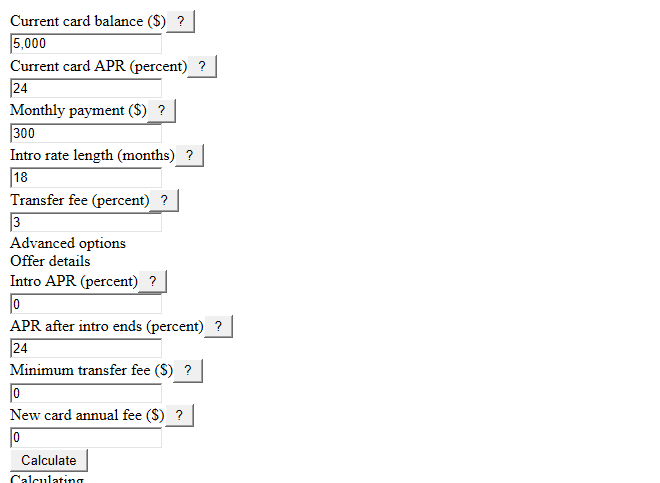
- Enter your Current card balance ($), Current card APR (percent), and the Monthly payment ($) you plan to make.
- Enter the Intro rate length (months) and Transfer fee (percent) from the balance transfer offer.
- Open Advanced options only if the offer has an Intro APR (percent), APR after intro ends (percent), Minimum transfer fee ($), or New card annual fee ($) that differs from the defaults.
- Select Calculate and read Estimated savings first. A positive number favors the transfer, and a negative number means the transfer costs more with these inputs.
- Sanity-check Payment needed to finish during intro against your planned Monthly payment ($). If the needed payment is higher, review Balance left when intro ends before assuming the promo solves the debt.
Definitions
Balance transfer: Moving debt from one credit card to another card, usually to use a lower promo rate.
APR: Annual percentage rate. It is the yearly interest rate used to estimate monthly interest.
Intro APR: The promo interest rate during the Intro rate length (months). It is often 0%, but not always.
Transfer fee: A fee charged for moving the balance. It can apply even on a 0% balance transfer offer [1].
Minimum transfer fee: A dollar floor for the transfer fee. If the percent fee is smaller than this amount, the calculator uses the minimum.
Estimated savings: Cost if you keep the current card minus Cost with the transfer. Positive means the transfer saves money; negative means it costs more.
Break-even month: The first month when avoided current-card interest has covered the transfer fee, annual fee, and transfer-card interest so far.
Common mistakes and quick fixes
Mistake: Entering new purchases in Current card balance ($).
Fix: Use only the balance you plan to transfer, not future spending.
Mistake: Leaving Current card APR (percent) blank or typing it as a monthly rate.
Fix: Enter the yearly APR from your statement, such as 24 for 24%.
Mistake: Using a lower Monthly payment ($) for the transfer than for the current card.
Fix: Enter the same planned payment so Estimated savings is a fair comparison.
Mistake: Ignoring APR after intro ends (percent) when Balance left when intro ends is above $0.
Fix: Enter the regular transfer APR from the offer so post-intro interest is counted.
Mistake: Entering only Transfer fee (percent) when the offer also has a Minimum transfer fee ($).
Fix: Add the minimum fee in Advanced options so Transfer fee added uses the larger amount.
Mistake: Treating Payment needed to finish during intro as optional if you want a no-interest payoff.
Fix: Compare it with Monthly payment ($) and raise the payment if you want to finish before the promo ends.
Limitations & Key Assumptions / Boundary Conditions
- The estimate assumes no new purchases on either card. New purchases can create extra interest and change the payoff order.
- The Monthly payment ($) is treated as the same fixed amount in both choices until the final smaller payoff payment.
- Interest is estimated monthly from APR divided by 12. Real card billing can vary because of daily balances, statement dates, grace periods, and payment timing.
- The Transfer fee added is assumed to become part of the new card balance, while New card annual fee ($) is counted as a cost but not added to the payoff balance.
- The calculator does not include rewards, credit score effects, late fees, missed payments, penalty APRs, or whether you will qualify for the offer.
- If a payoff would take more than 600 months, the calculation should be treated as unsupported. Raise the payment or check the APR.
- Always compare the calculator inputs with the card issuer's actual disclosures or agreement before applying.
Methodology
How the comparison is calculated
The calculator compares two payoff paths using the same Monthly payment ($): keeping the balance on the current card, or moving it to the transfer card. Principal is not counted as a cost because the original debt must be repaid in both paths.
monthly_rate = apr_percent / 100 / 12
The transfer fee is the larger of the percent fee and the minimum dollar fee.
transfer_fee = max(current_balance * transfer_fee_percent / 100, minimum_transfer_fee)
transfer_start_balance = current_balance + transfer_fee
Each path is then run month by month. For the transfer path, months 1 through Intro rate length (months) use Intro APR (percent). Later months use APR after intro ends (percent).
interest_m = balance_before_payment * monthly_rate
balance_after_payment = balance_before_payment + interest_m - payment
If the balance plus that month's interest is less than the regular payment, the final payment is reduced so the balance ends at $0 instead of going negative.
current_total_cost = sum(current_interest_each_month)
transfer_total_cost = transfer_fee + new_card_annual_fee + sum(transfer_interest_each_month)
net_savings = current_total_cost - transfer_total_cost
Payoff time saved keeps its sign, so a positive value means the transfer pays off sooner and a negative value means it takes longer.
months_saved = current_payoff_months - transfer_payoff_months
Intro payoff target
The calculator also estimates the payment needed to finish the transferred balance before the intro period ends. If the intro APR is 0%, it divides the transfer starting balance by the number of intro months. If the intro APR is above 0%, it uses the standard fixed-payment payoff formula.
if intro_months > 0 and intro_monthly_rate = 0, needed_payment = transfer_start_balance / intro_months
else needed_payment = transfer_start_balance * intro_monthly_rate / (1 - (1 + intro_monthly_rate)^(-intro_months))
Balance left when intro ends is the transfer balance after the smaller of Intro rate length (months) or Transfer payoff time. If the transfer is paid off before the intro period ends, this value is $0.
Break-even month
The break-even month is found by tracking cumulative savings month by month.
break_even_month = first month where cumulative_current_interest - (transfer_fee + new_card_annual_fee + cumulative_transfer_interest) >= 0
If that point is never reached before payoff, the calculator displays that the fee was not earned back.
Mini-example
Suppose Current card balance ($) is $5,000, Current card APR (percent) is 24, Monthly payment ($) is $300, Intro rate length (months) is 18, and Transfer fee (percent) is 3 with a 0% Intro APR (percent). The transfer fee is $150, so the transfer starting balance is $5,150. The current-card path pays about $1,143.34 in interest over 21 months. The transfer path pays $150 in transfer cost and $0 transfer interest over 18 months. Estimated savings is $993.34, and Payment needed to finish during intro is about $286.11 per month.
Sources
- What is a balance transfer fee? Can a balance transfer fee be charged on a zero percent interest rate offer? | Consumer Financial Protection Bureau - Consumerfinance
- Do I pay interest on new purchases after I get a zero or low rate balance transfer? | Consumer Financial Protection Bureau - Consumerfinance
- Credit card agreement database | Consumer Financial Protection Bureau - Consumerfinance
- CFPB - Consumer Credit Card Market Report (2025) [PDF] - Consumerfinance