
Compare two fixed-rate mortgage offers by monthly payment, upfront lender costs, planned keep time, and break-even timing.
Advanced options
Table of contents
How to use our Mortgage Comparison Calculator
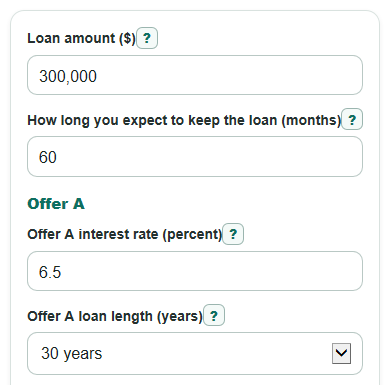
- Enter the same Loan amount ($) for both offers, then enter How long you expect to keep the loan (months).
- Fill in Offer A interest rate (percent), Offer A loan length (years), and Offer A upfront lender costs ($) from the Loan Estimate.
- Fill in the same fields for Offer B, then use Advanced options only if either offer has Offer A monthly mortgage insurance ($) or Offer B monthly mortgage insurance ($).
- Click Calculate and start with Better deal for your time frame, then check Savings by choosing the better offer and Break-even month.
- Sanity-check the result by comparing Monthly payment gap with the difference in upfront costs. A lower rate with much higher upfront costs may need many months to catch up.
Definitions
Loan amount ($): The amount borrowed, not the home price or down payment.
Interest rate: The yearly rate used to calculate the monthly principal and interest payment. It is different from APR.
Loan length: The full time allowed to repay the loan, such as 15 or 30 years.
Upfront lender costs: Dollar costs from the lender side of the deal, such as origination charges, points, and lender fees.
Lender credit: Money the lender gives toward costs. In this calculator, enter it as a negative upfront cost.
Monthly mortgage insurance: An added monthly cost some loans require. This calculator treats it as the same amount each month during the comparison period.
Remaining balance: The estimated loan amount still owed after the months you entered.
Break-even month: The first month when the offer that starts out more expensive becomes equal to or cheaper than the other offer.
Common mistakes and quick fixes
Mistake: Using APR in Offer A interest rate (percent) or Offer B interest rate (percent) .
Fix: Enter the interest rate, not APR, because the payment formula uses the note rate.
Mistake: Mixing taxes, homeowners insurance, and escrow amounts into Offer A upfront lender costs ($) or Offer B upfront lender costs ($) .
Fix: Enter lender costs you want to compare, such as origination charges, points, lender fees, or lender credits.
Mistake: Leaving How long you expect to keep the loan (months) at 60 when you already expect to sell or refinance sooner.
Fix: Enter your best estimate in whole months, because the main answer is based on that time frame.
Mistake: Treating Monthly payment gap as the same thing as total savings.
Fix: Use Savings by choosing the better offer for the total cost gap at your selected month.
Mistake: Entering a lender credit as a positive number in Offer A upfront lender costs ($) or Offer B upfront lender costs ($) .
Fix: Enter a lender credit as a negative dollar amount, such as -1000.
Mistake: Adding Offer A monthly mortgage insurance ($) or Offer B monthly mortgage insurance ($) when the Loan Estimate does not show mortgage insurance.
Fix: Leave monthly mortgage insurance at 0 unless that offer actually has it.
Limitations & Key Assumptions / Boundary Conditions
- This calculator is for fixed-rate mortgage offers. It does not model adjustable-rate mortgage rate changes.
- Both offers must use the same Loan amount ($). If loan amounts differ, the comparison is not apples to apples.
- Property tax and homeowners insurance are excluded because they are usually house costs, not lender deal costs. They may still appear in escrow on a Loan Estimate.
- Monthly mortgage insurance is treated as a constant amount for the months compared. Real mortgage insurance can change or end later.
- Upfront lender costs are entered as dollars. If you are comparing points, convert them to dollars before entering them.
- If the keep time is longer than a loan term, that offer is treated as paid off at the end of its term for balance and interest calculations.
- The calculator does not include taxes, investment returns on cash, prepayment penalties, late fees, refinancing costs, or the time value of money.
Methodology
How payments are calculated
The calculator uses the standard fixed-rate amortizing mortgage payment method for principal and interest [1]. For each offer, the annual interest rate is converted to a monthly rate, and loan length in years is converted to months.
monthly_rate = annual_interest_rate_percent / 100 / 12
term_months = loan_length_years * 12
If monthly_rate = 0, payment = loan_amount / term_months
If monthly_rate > 0, payment = loan_amount * monthly_rate * (1 + monthly_rate)^term_months / ((1 + monthly_rate)^term_months - 1)
How the planned-time cost is calculated
The main comparison focuses on the number of months you expect to keep the loan. For each offer, the calculator uses k, which is the smaller of your keep months or that offer's full term months.
If monthly_rate = 0, remaining_balance = loan_amount - payment * k
If monthly_rate > 0, remaining_balance = loan_amount * (1 + monthly_rate)^k - payment * (((1 + monthly_rate)^k - 1) / monthly_rate)
Interest paid during the time frame is total principal and interest paid minus principal paid. Principal paid is not counted as a cost because it lowers the balance and builds equity.
principal_paid = loan_amount - remaining_balance
interest_paid = payment * k - principal_paid
cost_at_keep_month = upfront_costs + interest_paid + monthly_mortgage_insurance * k
monthly_total = payment + monthly_mortgage_insurance
How the winner and break-even month are found
The lower cost_at_keep_month is the better deal for the selected time frame. Savings is the absolute difference between the two costs. The break-even check compares month 1 first, then searches month by month through the shorter supported term. The break-even month is the first month when the offer that was more expensive at month 1 becomes equal to or cheaper than the other offer.
savings_at_keep_month = absolute_value(cost_A_at_keep_month - cost_B_at_keep_month)
full_interest_plus_costs = upfront_costs + payment * term_months - loan_amount
Worked mini-example
Suppose both offers borrow $300,000 for 30 years, and you expect to keep the loan for 60 months. Offer A has a 6.5 percent rate and $3,000 in upfront lender costs. Offer B has a 6.0 percent rate and $6,000 in upfront lender costs. With no mortgage insurance, Offer A's monthly total is about $1,896.20 and Offer B's monthly total is about $1,798.65. After 60 months, Offer A's cost is about $97,605.18 and Offer B's cost is about $93,082.17, so Offer B is cheaper by about $4,523.01. The break-even month is 24, meaning the higher upfront cost of Offer B is recovered by the lower payment and interest cost around month 24.
Calculation notes
Full-loan interest plus upfront costs is shown as a long-term reference. Mortgage insurance is excluded from that full-loan output because cancellation timing can vary. The planned-time result is usually the better decision point if you expect to sell or refinance before the loan ends. CFPB comparison tools also encourage comparing loan offers over a chosen period, such as five years [2].
Sources
- How do mortgage lenders calculate monthly payments? | Consumer Financial Protection Bureau - Consumerfinance
- Compare and negotiate your loan offers | Consumer Financial Protection Bureau - Consumerfinance
- CFPB: Loan Estimate sample - Consumerfinance
- How should I use lender credits and points (also called discount points)? | Consumer Financial Protection Bureau - Consumerfinance