
Estimate your unpaid mortgage principal after posted monthly payments, with optional extra principal and lender statement comparison.
Table of contents
How to use our Mortgage Remaining Balance Calculator
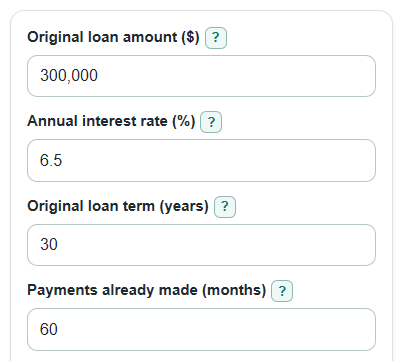
- Enter the Original loan amount ($), Annual interest rate (%), Original loan term (years), and Payments already made (months) from your loan records.
- Open Advanced options only if you need Known principal and interest payment ($), Regular extra principal ($ per month), or Lender statement balance ($).
- Click Calculate to see Estimated remaining balance first, then Principal paid so far, Original balance paid, Estimated payments left, Interest paid so far, and the payment used.
- Sanity-check the result by comparing Principal and interest payment used with your mortgage statement's principal and interest line, not the total monthly payment with escrow.
- If Statement gap appears, read the sign: a positive gap means the Lender statement balance ($) is higher than the estimate, and a negative gap means it is lower.
Definitions
Original loan amount ($): The starting mortgage principal, not the home purchase price.
Annual interest rate (%): The fixed yearly rate used to calculate monthly interest. It is divided by 12 in this calculator.
Principal and interest payment: The loan payment before taxes, homeowners insurance, mortgage insurance, HOA dues, and escrow.
Regular extra principal ($ per month): Extra money applied to reduce the loan balance each month, on top of the regular principal and interest payment.
Estimated remaining balance: The estimated unpaid principal after the completed payments have been applied.
Original balance paid: The percent of the starting principal that has been paid down.
Statement gap: Lender statement balance minus the calculator's Estimated remaining balance. Positive means the statement is higher; negative means it is lower.
Common mistakes and quick fixes
Mistake: Entering the home price in Original loan amount ($).
Fix: Use the starting principal from your loan papers, after any down payment.
Mistake: Putting a total mortgage payment with taxes and insurance into Known principal and interest payment ($).
Fix: Enter only the principal and interest part, or leave Known principal and interest payment ($) blank.
Mistake: Counting scheduled bills instead of posted payments in Payments already made (months).
Fix: Count only full monthly payments that have already been applied to the loan.
Mistake: Using Regular extra principal ($ per month) for a one-time extra payment.
Fix: Use that field only when the same extra principal was paid every month from the first payment through the payment count.
Mistake: Expecting Lender statement balance ($) to match exactly when the statement includes timing differences or fees.
Fix: Use Statement gap as a clue, then check escrow, fees, late payments, one-time extra payments, rate changes, and posting dates.
Limitations & Key Assumptions / Boundary Conditions
- This calculator is for fixed-rate mortgages with monthly payments and monthly interest calculations.
- It estimates principal and interest only. It does not include escrow, property taxes, homeowners insurance, mortgage insurance, HOA dues, late fees, or other servicing charges.
- It is not a payoff quote. A real payoff quote can include daily interest through a payoff date and lender-specific fees.
- Regular extra principal ($ per month) is treated as the same extra amount paid every month from the first payment through Payments already made (months).
- Known principal and interest payment ($) should be the actual principal and interest amount only. If it is too low to cover interest on a positive-rate loan, the balance will not shrink and the calculator should show an error.
- If the loan had rate changes, recasting, skipped payments, one-time extra payments, forbearance, payment reversals, or servicing corrections, the estimate can differ from your lender's balance.
- Displayed dollar results are rounded to cents, so small penny differences can happen even when the math pattern is correct.
Methodology
How the monthly payment is set
The calculator first converts the entered yearly rate into a monthly decimal rate and the original term into monthly payments.
r = annual_interest_rate_percent / 100 / 12
n = original_loan_term_years * 12
If Known principal and interest payment ($) is blank, the calculator uses the standard fixed-payment mortgage formula. In the formulas, P means Original loan amount ($), r means monthly interest rate, n means total scheduled payments, and M means the monthly principal and interest payment used.
if r = 0, M = P / n
if r > 0, M = P * r * (1 + r)^n / ((1 + r)^n - 1)
If Known principal and interest payment ($) is entered, that amount becomes M. It must be greater than 0, and for a positive-rate loan M plus Regular extra principal ($ per month) must be greater than the first month's interest.
How each posted payment is applied
The calculator runs a month-by-month loan schedule. This is used instead of only a shortcut formula so extra principal, a known payment override, and a final smaller payoff month are handled the same way.
interest_i = balance_(i-1) * r
available_i = M + extra
principal_i = min(available_i - interest_i, balance_(i-1))
balance_i = balance_(i-1) - principal_i
At 0 percent interest, every dollar of M plus extra reduces principal until the balance reaches 0.
if r = 0, principal_i = min(M + extra, balance_(i-1))
The loop stops early if the loan pays off before the entered Payments already made (months). The balance is never allowed to go below 0.
How the outputs are found
Estimated remaining balance is the balance after the posted payments have been simulated. Principal paid so far is the starting principal minus that balance.
principal_paid = P - remaining_balance
Original balance paid is the principal paid divided by the starting principal.
original_balance_paid_percent = principal_paid / P * 100
Interest paid so far is the total of each month's interest charge through the completed payments or payoff month.
interest_paid_so_far = sum(interest_i)
Estimated payments left starts from the remaining balance and repeats the same monthly update until the balance reaches 0, using the same payment and regular extra principal pattern.
statement_balance_gap = lender_statement_balance - remaining_balance
Statement gap is shown only when Lender statement balance ($) is entered. A positive gap means the statement balance is higher than the estimate. A negative gap means it is lower.
Mini-example
For a $300,000 loan at 6.5 percent for 30 years with 60 posted payments and no extra principal, the monthly principal and interest payment used is about $1,896.20. The estimated remaining balance is about $280,832.93. That means about $19,167.07 of principal has been paid down, or about 6.39 percent of the original balance. Estimated interest paid so far is about $94,605.18, which is much larger than principal paid because early fixed-rate mortgage payments are mostly interest.
Sources
- How does paying down a mortgage work? | Consumer Financial Protection Bureau - Consumerfinance
- On a mortgage, what's the difference between my principal and interest payment and my total monthly payment? | Consumer Financial Protection Bureau - Consumerfinance
- Unpaid Principal Balance - Definition - Fixnotes
- How Remaining Mortgage Balance Is Calculated - everycalc Wiki - Everycalc