
Estimate a solar breaker size for an AC inverter backfeed or a DC PV circuit, then check key panel limits.
Advanced options
Table of contents
How to use our Solar Panel Breaker Size Calculator
- Choose What are you sizing? based on where the breaker goes: your home panel for AC inverter breaker, or the PV side for DC panel circuit.
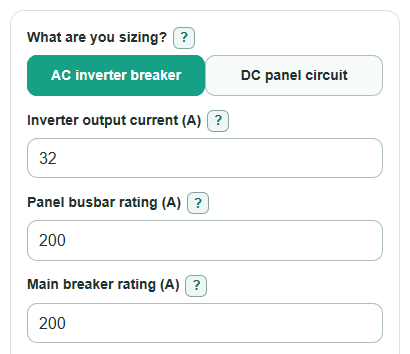
- For AC mode, enter Inverter output current (A), Panel busbar rating (A), Main breaker rating (A), and Solar breaker location rule from the labels or panel plan.
- For DC mode, enter Module short-circuit current, Isc (A) and Parallel strings on this circuit (strings). Count only strings that are in parallel on that circuit.
- Open Advanced options if you have Other solar or battery source breakers (A), an Equipment max breaker rating (A), or want to change the Breaker size list.
- After Calculate, compare Recommended breaker size with Panel fit check or Equipment label warning. If a result barely passes, verify the equipment label, wire size, breaker type, and local inspection rule before buying parts.
Definitions
Breaker: A protective switch that opens the circuit when current is too high. It protects wires and equipment when it is correctly matched to the circuit.
Inverter output current (A): The continuous AC current the inverter or microinverter combiner can send to the panel.
Panel busbar rating (A): The amp rating of the metal busbar inside the electrical panel. It is not always the same as the main breaker size.
Main breaker rating (A): The amp rating of the breaker that protects the panel busbar from the utility side.
Isc: Short-circuit current. This is a solar panel label value used for PV circuit sizing, not the normal running current.
Parallel strings: Solar panel strings connected so their currents add together. Panels in series raise voltage, not current.
Backfeed: Power flowing into a panel from a solar inverter, battery inverter, or generator breaker instead of from the utility main only.
Standard breaker size: A listed breaker amp size used for rounding up from the calculated minimum.
Common mistakes and quick fixes
Mistake: Using solar panel watts for Inverter output current (A).
Fix: Enter the continuous AC output current from the inverter or combiner label.
Mistake: Mixing up Panel busbar rating (A) and Main breaker rating (A).
Fix: Read both values separately. A panel can have a 225 A busbar with a 200 A main breaker.
Mistake: Choosing Opposite end from main breaker under Solar breaker location rule when the planned breaker is not actually at the opposite end.
Fix: Choose Not opposite end or not sure unless the layout and code method support the 120% check.
Mistake: Entering normal operating current instead of Module short-circuit current, Isc (A).
Fix: Use the Isc value printed on the solar panel label.
Mistake: Counting series panels in Parallel strings on this circuit (strings).
Fix: Count only parallel strings, because series panels add voltage, not current.
Mistake: Leaving Equipment max breaker rating (A) blank when the label gives a maximum breaker size.
Fix: Enter that label value so the calculator can show an Equipment label warning if the rounded breaker is too large.
Limitations & Key Assumptions / Boundary Conditions
- This is a planning estimate. The final breaker must match the installed equipment label, wire size, voltage rating, AC or DC rating, panel listing, local code, and the electrician or inspector's requirements.
- AC panel fit is a simplified load-side busbar check using Panel busbar rating (A), Main breaker rating (A), Solar breaker location rule, and Other solar or battery source breakers (A).
- The opposite-end option uses a 120% busbar factor. If the breaker location, panel type, center-fed layout, supply-side tap, feeder tap, or energy management method is different, the answer can change.
- DC PV mode does not choose wire size, voltage rating, fuse holder type, combiner listing, charge controller limits, or temperature correction details.
- Recommended breaker size is rounded up to the selected Breaker size list. A real product also has to be available, listed for the panel, and rated for the circuit voltage and current type.
- A negative Largest solar breaker allowed by panel check means the existing main breaker and other source breakers already leave no room under the selected panel rule.
Methodology
How the calculator sizes the breaker
For AC inverter mode, the calculator treats Inverter output current (A) as a continuous output current and multiplies it by 1.25 before rounding up to the next selected standard breaker size. Solar load-side panel checks commonly compare source breakers, main breaker rating, busbar rating, and breaker placement under the 120% rule method [1].
minimum_breaker_a = inverter_output_current_a * 1.25
For DC panel circuit mode, the calculator first finds the PV current used for DC sizing from Module short-circuit current, Isc (A), the number of Parallel strings on this circuit (strings), and a 1.25 PV current factor. It then applies the overcurrent-device 1.25 factor and rounds up.
pv_max_circuit_current_a = module_isc_a * parallel_strings * 1.25
minimum_breaker_a = pv_max_circuit_current_a * 1.25
Rounding uses the selected Breaker size list.
recommended_breaker_a = first standard_size where standard_size >= minimum_breaker_a
How the AC panel fit check works
In AC mode, the calculator finds the largest solar breaker allowed by the selected panel rule. The opposite-end option uses a 1.20 busbar factor. The not-sure option uses a stricter 1.00 factor.
max_allowed_solar_breaker_a = panel_bus_rating_a * busbar_factor - main_breaker_rating_a - other_source_breakers_a
panel_fit_status = pass if recommended_breaker_a <= max_allowed_solar_breaker_a, else fail
breaker_load_percent = inverter_output_current_a / recommended_breaker_a * 100
Mini examples
AC example:
a 32 A inverter output gives a 40 A minimum because 32 * 1.25 = 40. On a 200 A busbar with a 200 A main breaker and the opposite-end rule, the panel room is 200 * 1.20 - 200 - 0 = 40 A, so a 40 A recommended breaker passes.
DC example:
one string with module Isc of 10 A gives PV current used for DC sizing of 10 * 1 * 1.25 = 12.5 A. The minimum breaker is 12.5 * 1.25 = 15.625 A, so the next standard size is 20 A.
Equipment label check
If Equipment max breaker rating (A) is entered and Recommended breaker size is larger, the calculator still shows the math result but adds Equipment label warning. That warning matters because a breaker that passes the formula may still be too large for the listed equipment.