
Estimate DC voltage drop for a solar wire run, compare a wire size, or find a planning length before you buy cable.
Table of contents
How to use our Solar Wire Voltage Drop Calculator
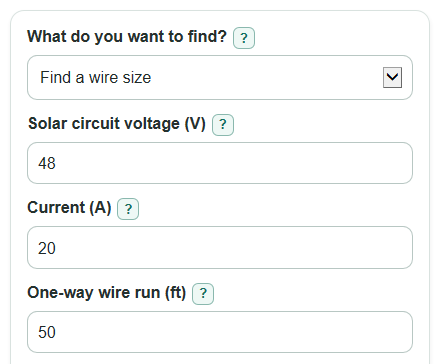
- Choose What do you want to find?: Find a wire size, Check a wire, or Find max one-way distance.
- Enter Solar circuit voltage (V), Current (A), Max voltage drop (percent), and the needed distance or Wire size for your mode.
- Use One-way wire run (ft) as the one-way distance from the source to the equipment; the calculator counts the out-and-back DC wire path.
- Open Advanced options if you need Wire material, Wire temperature for resistance (degrees C), a 25 percent Current used in the math cushion, or Average full-sun hours per day.
- Sanity-check the result: Voltage drop should be much smaller than Solar circuit voltage (V), and Current used in the math should match your choice before you use the wire size for planning.
Definitions
Solar circuit voltage (V): The working DC voltage used for the drop estimate, such as battery voltage or a PV string's operating voltage.
Current (A): The amps expected to flow through the wire before any optional planning cushion is added.
One-way wire run (ft): The distance from the source to the equipment in one direction. The voltage-drop formula doubles this distance for the out-and-back conductor path.
Max voltage drop (percent): Your chosen planning limit for how much of the starting voltage can be lost in the wire.
Wire size: The AWG or kcmil conductor size used in the wire table. For AWG, smaller numbers usually mean larger wire until the 1/0 sizes.
Circular mils: A wire area unit used in voltage-drop math. Larger circular mils means lower resistance for the same material and temperature.
K value: A conductor resistance constant used with circular mils and feet. The calculator adjusts it for Wire material and Wire temperature for resistance (degrees C).
Voltage at the far end: Solar circuit voltage (V) minus Voltage lost in the wire. If it is too low, connected equipment may not behave as expected.
Common mistakes and quick fixes
Mistake: Entering the full round-trip distance in One-way wire run (ft).
Fix: Enter the one-way distance only; the calculator doubles it for the positive and negative DC conductors.
Mistake: Using open-circuit voltage for Solar circuit voltage (V) when you mean normal operating voltage.
Fix: Use the working voltage for planning, such as battery voltage or PV Vmp string voltage.
Mistake: Leaving Current (A) as the panel nameplate value without checking whether you want a cushion.
Fix: Set Current used in the math to Use current as entered or Add 25 percent planning cushion on purpose.
Mistake: Treating Meets your drop limit? as final approval for the wire.
Fix: Use it only for voltage-drop planning; ampacity, fusing, terminals, conduit fill, rooftop temperature, and local code still need separate checks.
Mistake: Picking Wire material as Copper when the actual conductor is aluminum.
Fix: Set Wire material to the conductor you plan to install, because aluminum has higher resistance for the same Wire size.
Mistake: Entering a large Average full-sun hours per day and reading Rough yearly energy lost as exact.
Fix: Use a realistic average and treat Rough yearly energy lost as a simple estimate, because solar current changes during the day.
Limitations & Key Assumptions / Boundary Conditions
- This is a planning calculator for DC voltage drop. It is not an ampacity, fuse, breaker, terminal, conduit, rooftop, or local code approval tool.
- The math assumes a two-conductor DC path with the same Wire size, Wire material, and temperature for the full run.
- One-way wire run (ft) is entered once. The calculator doubles it in the formula to count both conductors.
- Wire temperature for resistance (degrees C) changes resistance only. It is not an ampacity derating calculation.
- The supported Wire size list stops at 500 kcmil. Larger designs may need parallel conductors or a design review that this tool does not size.
- Rough yearly energy lost uses constant Power lost as heat, Average full-sun hours per day, and 365 days. Real PV current changes with sun, temperature, shading, and equipment operation.
- A result that passes Max voltage drop (percent) can still fail other electrical rules, and a result that fails may still be changed by using a higher system voltage, shorter run, lower current, or larger conductor.
Methodology
Core math
The calculator first sets Current used in the math. If the 25 percent planning cushion is selected, it multiplies Current (A) by 1.25.
current_used_a = current_a * current_factor
Next it adjusts the conductor K value for Wire material and Wire temperature for resistance (degrees C). The reference K values used are 12.9 for copper and 21.2 for aluminum at 75 degrees C. The temperature coefficients used are 0.00393 per degree C for copper and 0.00403 per degree C for aluminum.
K_temp = K_ref * (1 + alpha * (conductor_temp_c - 75))
For a checked or recommended wire, voltage drop uses the two-wire DC path. The 2 in the formula counts the positive and negative conductors.
voltage_drop_v = (2 * K_temp * current_used_a * one_way_length_ft) / circular_mils
voltage_drop_pct = (voltage_drop_v / system_voltage_v) * 100
end_voltage_v = system_voltage_v - voltage_drop_v
power_loss_w = current_used_a * voltage_drop_v
yearly_energy_loss_kwh = power_loss_w * sun_hours_per_day * 365 / 1000
Finding a wire size
In Find a wire size mode, the calculator computes the minimum circular mil area needed to stay at or below Max voltage drop (percent), then chooses the smallest supported Wire size with at least that area.
required_circular_mils = (2 * K_temp * current_used_a * one_way_length_ft) / (system_voltage_v * target_drop_pct / 100)
It scans this supported table from smaller area to larger area: 14 AWG 4110, 12 AWG 6530, 10 AWG 10380, 8 AWG 16510, 6 AWG 26240, 4 AWG 41740, 3 AWG 52620, 2 AWG 66360, 1 AWG 83690, 1/0 AWG 105600, 2/0 AWG 133100, 3/0 AWG 167800, 4/0 AWG 211600, 250 kcmil 250000, 300 kcmil 300000, 350 kcmil 350000, 400 kcmil 400000, and 500 kcmil 500000 circular mils.
Finding max distance
In Find max one-way distance mode, the calculator rearranges the voltage-drop formula to solve for the longest one-way run that meets the target for the selected Wire size.
max_one_way_length_ft = (system_voltage_v * target_drop_pct / 100 * circular_mils) / (2 * K_temp * current_used_a)
Worked example
For the default planning case, use 48 V, 20 A, 50 ft one-way, copper at 75 degrees C, and a 3 percent target. The maximum allowed drop is 48 * 3 / 100 = 1.44 V. The required area is 25800 / 1.44 = 17916.67 circular mils, so 8 AWG is too small and 6 AWG is the smallest supported size that meets the target. With 6 AWG, voltage drop is 0.983 V, voltage drop percent is 2.05 percent, far-end voltage is 47.017 V, and power loss is about 19.7 W.