
Estimate a PV-rated DC fuse size for solar strings and the combined array output, then check it against key amp limits.
Advanced options
Table of contents
How to use our Solar Panel Fuse Size Calculator
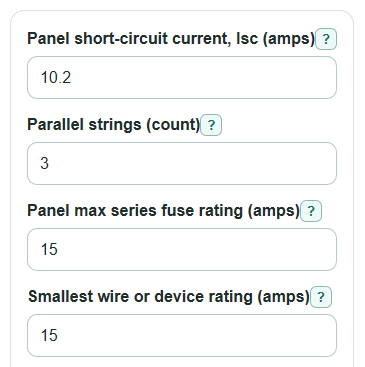
- Enter the panel short-circuit current, Isc (amps) from the solar panel label or datasheet.
- Enter Parallel strings (count), remembering that series panels raise voltage, while parallel strings raise current.
- Enter Panel max series fuse rating (amps) and Smallest wire or device rating (amps) so the calculator can flag an oversized fuse.
- Open Advanced options only if you need to change the sizing factors or check PV circuit max voltage (volts DC) against Fuse voltage rating (volts DC).
- After you click Calculate, sanity-check the result: Recommended string fuse size should be at least Calculated string fuse need and should not exceed Lowest entered limit for string fuse.
Definitions
Panel short-circuit current, Isc (amps): The current a solar panel can produce in a short-circuit test. It is usually printed as Isc on the panel label or datasheet.
Parallel strings (count): The number of series strings connected side by side. Parallel strings add current.
Panel max series fuse rating (amps): The largest fuse rating the panel maker allows in series with that module; the string fuse should not be above this limit [2].
Smallest wire or device rating (amps): The lowest amp rating of any part in the protected circuit, such as wire, connector, fuse holder, breaker, or combiner input.
OCPD: Overcurrent protective device. In this calculator, it means a fuse or breaker that protects wiring from too much current.
Calculated string fuse need: The unrounded amp value for one string fuse before choosing the next standard fuse size.
Recommended string fuse size: The next built-in standard fuse size at or above the calculated string fuse need.
PV circuit max voltage (volts DC): The highest possible direct-current voltage for the PV circuit, usually after cold-weather correction.
Common mistakes and quick fixes
Mistake: Using operating current instead of Panel short-circuit current, Isc (amps).
Fix: Use the Isc value from the panel label or datasheet, not Imp, rated current, or charge controller current.
Mistake: Counting panels in series as Parallel strings (count).
Fix: Count only strings connected in parallel; panels in series do not add current.
Mistake: Leaving Panel max series fuse rating (amps) higher than the datasheet allows.
Fix: Enter the panel datasheet maximum series fuse rating so Does the string fuse fit the limits? can catch an unsafe rounded fuse.
Mistake: Entering only the wire ampacity and ignoring a smaller Smallest wire or device rating (amps).
Fix: Use the lowest rating in that circuit, including connectors, fuse holders, breakers, combiner inputs, and wire.
Mistake: Treating Recommended combined array OCPD size as the same thing as Recommended string fuse size.
Fix: Use the string result for each protected string, and use the combined array result for the output circuit after strings join.
Mistake: Skipping Fuse voltage rating (volts DC) when the PV array voltage is high.
Fix: If you know PV circuit max voltage (volts DC), enter both voltage fields and check Voltage rating check before choosing hardware.
Limitations & Key Assumptions / Boundary Conditions
- This calculator sizes current using the entered Isc, string count, and factors. It does not replace the NEC, local code, equipment listings, or an inspection.
- The built-in standard fuse size list may not match every product line. The installed device still must be a listed DC-rated PV fuse or breaker suitable for the circuit.
- For mixed panels, unequal strings, shaded strings, or unusual combiner designs, one Isc value may not describe every source circuit.
- The voltage check runs only when both PV circuit max voltage (volts DC) and Fuse voltage rating (volts DC) are entered.
- A passing amp check does not prove the wire is correctly sized for temperature, conduit fill, terminal temperature rating, rooftop correction, or voltage drop.
- Single-string and two-string systems may not always need separate string fuses, but the final design still depends on equipment instructions and code rules.
Methodology
Calculation steps
The calculator first turns the two percent factors into one current multiplier. The default is 125% times 125%, or 1.5625.
multiplier = (extra_sun_factor_percent / 100) * (long_run_factor_percent / 100)
For one protected string, it multiplies the panel short-circuit current by that multiplier.
calculated_string_fuse_need = panel_isc * multiplier
It then rounds up to the first built-in standard size that is at least as large as the calculated need.
recommended_string_fuse_size = first_standard_size_at_or_above(calculated_string_fuse_need)
Next, it finds the smaller of the panel fuse limit and the smallest wire or device rating. The rounded string fuse passes only if it is not above either entered limit.
lowest_entered_limit_for_string_fuse = min(panel_max_series_fuse_rating, smallest_wire_or_device_rating)
string_fuse_passes = recommended_string_fuse_size <= panel_max_series_fuse_rating and recommended_string_fuse_size <= smallest_wire_or_device_rating
The combined array output is calculated separately because all parallel strings add together after they join.
calculated_combined_array_need = panel_isc * parallel_strings * multiplier
recommended_combined_array_ocpd_size = first_standard_size_at_or_above(calculated_combined_array_need)
Voltage check
If both voltage fields are entered, the calculator checks whether the fuse DC voltage rating is at least the PV circuit max voltage.
voltage_check_passes = fuse_voltage_rating >= pv_circuit_max_voltage
Mini-example
Suppose a panel has Isc = 10.2 amps, there are 3 parallel strings, the panel max series fuse rating is 15 amps, and the smallest wire or device rating is 15 amps. With the default multiplier of 1.5625, the calculated string fuse need is 10.2 * 1.5625 = 15.9375 amps, so the next built-in standard size is 20 amps. Because 20 amps is above the 15 amp panel and circuit limit, the fit check says fix needed. The combined array need is 10.2 * 3 * 1.5625 = 47.8125 amps, so the recommended combined array OCPD size is 50 amps.