
Estimate PV combiner input count, output current rating, voltage rating, and string fuse size from your panel label values.
Table of contents
How to use our Solar Combiner Box Size Calculator
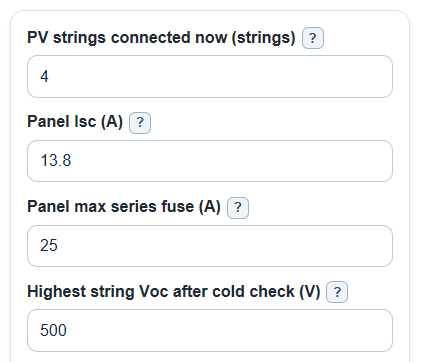
- Enter PV strings connected now, which means the number of parallel series chains landing in the combiner.
- Enter Panel Isc, Panel max series fuse, and Highest string Voc after cold check from the panel label, datasheet, or your cold-weather string check.
- Open Advanced options only if you want to add Future strings to leave room for or check a Chosen box input spaces, Chosen box output current rating, or Inverter max input current.
- Click Calculate and read Recommended combiner input size first, then check Minimum output current rating, Minimum combiner voltage rating, and String fuse size to review.
- Sanity-check the result: Panel fuse rating margin should be zero or positive, and any negative chosen-box or inverter margin means that entered product rating is too small for the plan.
Definitions
PV string: One chain of solar panels wired in series. Several PV strings can be connected in parallel at a combiner box.
Panel Isc: The short-circuit current from one panel's label or datasheet, in amps. For matched panels in one series string, the string current is the same as one panel's Isc.
Highest string Voc after cold check: The highest open-circuit voltage for the full series string after adjusting for cold weather, in volts.
Panel max series fuse: The largest series fuse size allowed by the panel datasheet, in amps.
Minimum output current rating: The calculated continuous-current planning rating for the combined output path, before extra local derating.
String fuse size to review: The next common fuse size at or above the calculated per-string continuous-current rating. It is a review size, not a final approval.
Margin: A signed difference between an entered product rating and a calculated need. Positive means room remains. Negative means the entered rating is short.
Common mistakes and quick fixes
Mistake: Entering the number of panels in PV strings connected now instead of the number of parallel strings.
Fix: Count each series chain as one PV strings connected now value.
Mistake: Using operating current instead of Panel Isc.
Fix: Use the short-circuit current labeled Isc on the panel label or datasheet for Panel Isc.
Mistake: Leaving Highest string Voc after cold check as one panel's Voc.
Fix: Use the open-circuit voltage for the full series string after the cold-weather voltage check.
Mistake: Treating String fuse size to review as safe even when Panel fuse rating margin is negative.
Fix: If Panel fuse rating margin is negative, review the string count, panel choice, and listed PV fuse options before choosing hardware.
Mistake: Ignoring Future strings to leave room for when buying a box.
Fix: Enter planned added strings so Recommended combiner input size has enough input spaces from the start.
Mistake: Comparing Chosen box output current rating to Maximum output circuit current instead of Minimum output current rating.
Fix: Use Chosen box output current margin to see whether the box output rating clears the continuous-current planning minimum.
Limitations & Key Assumptions / Boundary Conditions
- This calculator is a planning aid for PV combiner box sizing. Final equipment must be listed for PV DC use and checked against the applicable electrical code, product manuals, and local inspection rules.
- The current math uses 1.25 times Panel Isc, then another 1.25 continuous-current multiplier. It does not replace conductor ampacity, terminal temperature, conduit-fill, ambient temperature, rooftop, or local derating checks.
- Recommended combiner input size rounds to common planning counts: 1, 2, 3, 4, 6, 8, 12, 16, and 24 inputs. Actual product input counts vary.
- If Strings used for sizing is above 24, the plan likely needs multiple combiners or a custom design instead of a single standard-size result.
- Minimum combiner voltage rating rounds to 600, 1000, or 1500 V DC. Plans above 1500 V DC are outside this calculator's supported range.
- String fuse size to review uses a common fuse-size list. The final fuse or breaker must not exceed Panel max series fuse and must match listed PV DC equipment.
- Inverter input current margin is a simple comparison to Maximum output circuit current. Some inverter or charge controller manuals may require a different input-current check.
Methodology
Calculation method
The calculator first adds current and future strings. A PV string is one series chain, and parallel strings add current at the combiner output.
planned_strings = strings_now + future_strings
It then applies a 1.25 PV current multiplier to Panel Isc for the source-circuit current planning step.
source_max_current_A = module_isc_A * 1.25
Each string input rating uses a second 1.25 multiplier for continuous-current planning.
minimum_string_current_rating_A = module_isc_A * 1.25 * 1.25
The combined output current uses the planned string count because parallel string currents add.
maximum_output_circuit_current_A = planned_strings * module_isc_A * 1.25
minimum_output_current_rating_A = planned_strings * module_isc_A * 1.25 * 1.25
The string fuse review size is the first common fuse size at or above the calculated per-string current. The calculator does not lower this value to fit the panel fuse limit, because doing so could hide a problem.
string_fuse_review_size_A = first_common_fuse_size_at_or_above(minimum_string_current_rating_A)
The input count is rounded up to the first practical combiner input count that fits planned strings.
recommended_input_count = first_standard_input_count_at_or_above(planned_strings)
The voltage result is rounded up to the first common PV DC voltage class at or above Highest string Voc after cold check.
minimum_voltage_rating_V = first_common_voltage_rating_above_or_equal(highest_string_voc_V)
If optional product checks are entered, the calculator keeps signed margins instead of hiding negative values.
chosen_input_space_margin = chosen_box_inputs - planned_strings
chosen_output_current_margin_A = chosen_box_output_rating_A - minimum_output_current_rating_A
inverter_current_margin_A = inverter_max_input_current_A - maximum_output_circuit_current_A
fuse_rating_margin_A = module_max_series_fuse_A - string_fuse_review_size_A
Worked example
For 4 PV strings, 13.8 A Panel Isc, 25 A Panel max series fuse, 500 V cold-weather string Voc, and 0 future strings, planned strings = 4. The maximum output circuit current is 4 x 13.8 x 1.25 = 69 A. The minimum output current rating is 4 x 13.8 x 1.25 x 1.25 = 86.25 A. The per-string rating is 13.8 x 1.25 x 1.25 = 21.5625 A, so the next common fuse review size is 25 A. The voltage rating rounds up to 600 V DC, and the recommended input size is 4 inputs.