
Choose a DC-rated solar fuse size and see whether it fits your panel and wire limits.
Advanced options
Table of contents
How to use our Solar DC Fuse Size Calculator
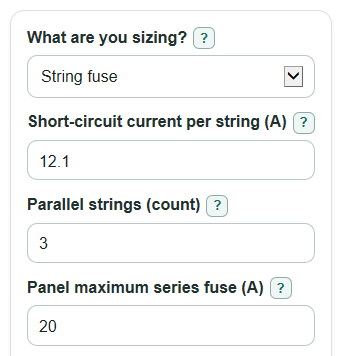
- Pick What are you sizing?: String fuse for each parallel string, or Combiner output fuse for the combined circuit after strings join.
- Enter Short-circuit current per string from the panel label or datasheet, then enter Parallel strings as the count of strings connected in parallel.
- Enter Panel maximum series fuse for string fuse sizing, and enter Wire ampacity after derating for the wire protected by the fuse.
- Use Advanced options only when you need a different Sizing factor, Fuse size list, or DC voltage rating check.
- After calculating, sanity-check the result: Recommended fuse size must fit the Safe-window result, stay at or below Largest allowed fuse from your limits, and use a fuse with a DC voltage rating at least as high as your Max PV circuit voltage.
Definitions
Isc: Short-circuit current. Use the current from one panel label or datasheet. Panels in series keep the same current, while parallel strings add current.
String fuse: A fuse placed on one parallel PV string before the strings combine.
Combiner output fuse: A fuse on the combined output after parallel strings join.
Sizing factor: The multiplier applied to PV short-circuit current before choosing a real fuse size. The default 1.5625 equals 1.25 times 1.25.
Panel maximum series fuse: The largest series fuse rating allowed by the panel datasheet for that module.
Wire ampacity after derating: The current the wire can safely carry after adjustments for heat, conduit fill, bundling, terminal ratings, and similar conditions [2].
Safe-window result: The check that compares the rounded fuse size with the largest fuse allowed by the entered panel and wire limits.
DC voltage rating margin: Fuse DC voltage rating minus Max PV circuit voltage. A negative value means the fuse voltage rating is too low.
Common mistakes and quick fixes
Mistake: Using operating current instead of Short-circuit current per string.
Fix: Use the Isc value from the panel label or datasheet for Short-circuit current per string.
Mistake: Counting series panels in Parallel strings.
Fix: Enter only the number of strings connected in parallel; panels in series do not add current for this input.
Mistake: Leaving Wire ampacity after derating at the cable package rating before heat, conduit, or bundling adjustments.
Fix: Enter the final derated ampacity for the actual wire run.
Mistake: Ignoring Panel maximum series fuse when the Safe-window result says no safe listed size fits.
Fix: Do not choose a larger Recommended fuse size; change the design or get a qualified review.
Mistake: Filling only Max PV circuit voltage or only Fuse DC voltage rating.
Fix: Fill both voltage fields to see DC voltage rating margin, or clear both fields.
Limitations & Key Assumptions / Boundary Conditions
- This is a planning aid. It is not permit approval, an inspection decision, or a replacement for a licensed electrician.
- The calculator uses the entered Isc, parallel string count, panel maximum series fuse, derated wire ampacity, sizing factor, and selected fuse list. Wrong inputs produce wrong fuse guidance.
- The result does not decide whether a fuse is required in every possible PV layout. It sizes and checks the fuse position you choose.
- The PV common sizes and NEC standard OCPD sizes are rounding lists for planning. Confirm the exact fuse, fuse holder, interrupt rating, temperature rating, and DC listing before buying parts.
- For string fuse mode, the upper limit is the smaller of Panel maximum series fuse and Wire ampacity after derating. For combiner output mode, the panel series fuse limit is not used because that row is hidden for that mode.
- The voltage check only compares Max PV circuit voltage with Fuse DC voltage rating. It does not calculate worst-case PV voltage from temperature or module Voc.
- If the needed fuse is above the selected fuse list, the calculator shows that the list is unsupported for that input instead of guessing a larger device.
Methodology
How the calculator chooses the current
The calculator first chooses the current that the selected fuse position needs to protect. For a string fuse, it uses one string Isc. For a combiner output fuse, it multiplies one string Isc by the number of parallel strings.
circuit_current_amps = isc_per_string_amps when What are you sizing? is String fuse.
circuit_current_amps = isc_per_string_amps * parallel_strings when What are you sizing? is Combiner output fuse.
How the minimum fuse is found
The selected Sizing factor is applied to the circuit current. The default NEC PV 1.25 x 1.25 setting is the common PV shortcut of 1.25 times 1.25 used in many PV fuse sizing guides [1]. The Basic 1.25x and Custom factor options are included for cases where a qualified design source tells you to use a different multiplier.
factor = 1.56 for NEC PV 1.25 x 1.25.
factor = 1.25 for Basic 1.25x.
factor = custom_sizing_factor for Custom factor.
minimum_fuse_amps = circuit_current_amps * factor
How rounding and the safe-window check work
The calculator rounds up to the first amp rating in the selected Fuse size list that is at least the Minimum fuse size before rounding. It then checks whether that rounded fuse is small enough for the entered upper limits.
recommended_fuse_amps = first selected fuse size that is greater than or equal to minimum_fuse_amps
maximum_allowed_fuse_amps = min(module_max_series_fuse_amps, conductor_ampacity_amps) for String fuse.
maximum_allowed_fuse_amps = conductor_ampacity_amps for Combiner output fuse.
fit_status = fits when Recommended fuse size is less than or equal to Largest allowed fuse from your limits.
fit_status = no_safe_standard_size when Recommended fuse size is greater than Largest allowed fuse from your limits.
Other outputs
Fuse positions to check equals the number of Parallel strings for a string fuse, and equals 1 for a combiner output fuse.
fuses_to_install_count = parallel_strings for String fuse.
fuses_to_install_count = 1 for Combiner output fuse.
If both voltage fields are entered, the calculator subtracts Max PV circuit voltage from Fuse DC voltage rating. A positive margin means the entered fuse voltage rating is above the entered circuit voltage. A negative margin means the entered fuse voltage rating is too low.
voltage_margin_volts = fuse_dc_voltage_rating_volts - max_circuit_voltage_volts
Mini example
Suppose a string fuse uses Short-circuit current per string of 12.1 A, Parallel strings of 3, Panel maximum series fuse of 20 A, Wire ampacity after derating of 30 A, and the NEC PV 1.25 x 1.25 factor. The string fuse current is 12.1 A. The minimum fuse is 12.1 * 1.5625 = 18.90625 A. The next PV common size is 20 A. The largest allowed fuse is min(20 A, 30 A) = 20 A, so the 20 A fuse fits the safe window.
Sources
The NEC PV preset retains 1.25 × 1.25 = 1.5625 internally before choosing the next fuse size. Published guides often shorten this to 1.56; rounding the factor first can change the selected fuse at a size boundary. Equipment limits and applicable code still govern. See the Littelfuse PV sizing guide.