
Find a practical solar cable size for a DC run using current, distance, voltage, and your voltage drop limit.
Advanced options
Table of contents
How to use our Solar Cable Size Calculator
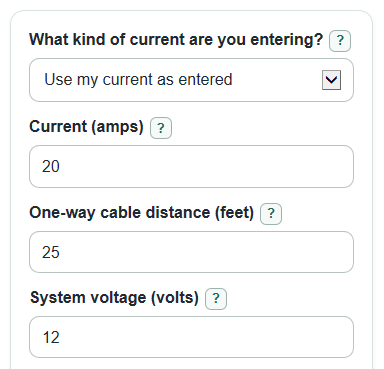
- Pick What kind of current are you entering? so the calculator knows whether to use your Current (amps) as typed or add a PV planning factor.
- Enter Current (amps), One-way cable distance (feet), System voltage (volts), and Allowed voltage drop (percent); use the one-way length only, not the round trip.
- Open Advanced options if you need to change Wire material or Estimated wire temperature (deg C), especially for aluminum wire or hot roof, attic, or conduit runs.
- Select Calculate, then read Recommended wire size first, followed by Voltage drop with this size and Power lost as heat.
- Sanity-check the result: if Recommended wire size is much thicker than expected, recheck One-way cable distance (feet), System voltage (volts), and the current option before buying wire.
Definitions
AWG: American Wire Gauge, a common US wire size scale. A smaller AWG number means a thicker conductor.
mm2: Square millimeters of conductor cross-section area. A larger mm2 value has lower resistance.
Voltage drop: The voltage lost in the cable because the wire has resistance. In this calculator it is shown as Voltage lost in the cable and Voltage drop with this size.
One-way cable distance: The measured path from the power source to the load or controller. The math doubles it because DC current travels out and back.
Current used for sizing: The Current (amps) after the selected current factor is applied.
Raw area needed before rounding: The exact conductor area from the voltage-drop formula before rounding up to a listed AWG size.
Isc: Short-circuit current from a solar panel label or datasheet. It is often higher than normal operating current.
Common mistakes and quick fixes
Mistake: Entering watts in Current (amps).
Fix: Convert watts to amps first, or get the amp value from the device, controller, fuse, or panel label.
Mistake: Using the full out-and-back length in One-way cable distance (feet).
Fix: Enter only the distance from the source to the load; the calculator doubles it in the formula.
Mistake: Leaving What kind of current are you entering? set to Use my current as entered when the number is panel short-circuit current.
Fix: Choose Panel short-circuit current, add 25% if your value is Isc from a panel label or datasheet.
Mistake: Typing 0, a blank, or a range like 2-3 in Allowed voltage drop (percent).
Fix: Enter one positive percent, such as 3, so Voltage drop with this size can be checked against a real limit.
Mistake: Ignoring Wire material when using aluminum conductors.
Fix: Set Wire material to Aluminum, because aluminum has more resistance than copper for the same conductor area.
Mistake: Treating Recommended wire size as a full code approval.
Fix: Use Recommended wire size for voltage-drop planning, then check ampacity, insulation, terminals, overcurrent protection, and local code separately.
Limitations & Key Assumptions / Boundary Conditions
- This is a voltage-drop planning tool for DC solar, RV, shed, and similar low-voltage runs. It is not a full ampacity, fuse, conduit-fill, terminal, insulation, or permit approval tool.
- The calculation assumes a two-conductor DC circuit and uses round-trip length equal to 2 times One-way cable distance (feet).
- Recommended wire size is limited to the loaded table from 18 AWG through 4/0 AWG. If the raw area is larger than 107.2 mm2, the calculator reports that the run is outside the table.
- The current factors only change the voltage-drop sizing current. They do not replace the rest of NEC or local electrical-code checks.
- Estimated wire temperature (deg C) adjusts resistance only. It does not apply insulation temperature ratings or ampacity correction tables.
- Real installations can differ because of connectors, splices, terminal heating, bundled cable, conduit, sunlight, battery voltage changes, and manufacturer wire tolerances.
Methodology
Calculation steps
The calculator first turns the entered Current (amps) into Current used for sizing. The selector uses a factor of 1 for Use my current as entered, 1.25 for Panel short-circuit current, add 25%, and 1.5625 for NEC planning current, add 56.25%.
design_current_amps = current_a * current_factor
Next it adjusts conductor resistivity for Wire material and Estimated wire temperature (deg C). The base resistivity values at 20 deg C are 0.017241 ohm*mm2/m for copper and 0.028264 ohm*mm2/m for aluminum. The temperature coefficients are 0.00393 per deg C for copper and 0.00403 per deg C for aluminum.
rho_T = rho_20 * (1 + alpha * (wire_temperature_c - 20))
The allowed voltage loss is the system voltage times the allowed percent.
allowed_drop_volts = system_voltage_v * max_drop_percent / 100
The raw conductor area uses the round-trip cable length. The factor 2 changes one-way distance into out-and-back length, and 0.3048 converts feet to meters.
required_area_mm2 = (2 * one_way_distance_ft * 0.3048 * design_current_amps * rho_T) / allowed_drop_volts
The calculator then scans the loaded AWG area table from 18 AWG through 4/0 AWG and picks the first size whose area is at least Raw area needed before rounding. Solar wire sizing is often checked for voltage drop as well as ampacity [1].
recommended_size = first AWG size where awg_area_mm2 >= required_area_mm2
After rounding up to that standard size, it recomputes the actual voltage loss and heat loss.
actual_drop_volts = (2 * one_way_distance_ft * 0.3048 * design_current_amps * rho_T) / recommended_area_mm2
actual_drop_percent = 100 * actual_drop_volts / system_voltage_v
power_lost_watts = design_current_amps * actual_drop_volts
Mini-example
With Current (amps) = 20, One-way cable distance (feet) = 25, System voltage (volts) = 12, Allowed voltage drop (percent) = 3, copper wire, and 20 deg C, the allowed drop is 0.36 volts. The raw area is about 14.60 mm2, so the calculator rounds up to 4 AWG with 21.2 mm2. The estimated drop with that size is about 0.25 volts, or 2.07%, and the cable loses about 5.0 watts as heat.