
Estimate the usable battery storage and number of home battery units you may need for an outage.
Advanced options
Table of contents
How to use our Home Battery Backup Size Calculator
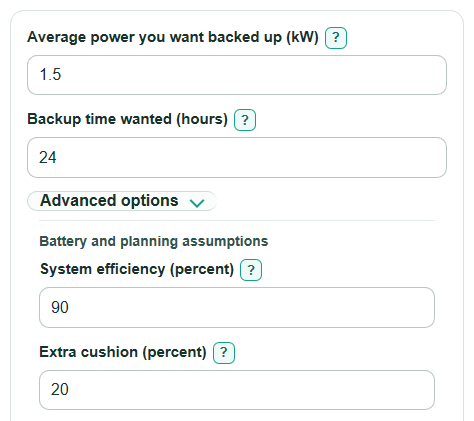
- Enter Average power you want backed up (kW) for only the circuits you want during an outage, such as a fridge, lights, WiFi, and medical gear.
- Enter Backup time wanted (hours), then open Advanced options only if you want to change efficiency, cushion, battery unit size, or the peak-power check.
- Use Highest power you may need at once (kW, optional) if large loads may run together, such as a pump, microwave, or air conditioner.
- Click Calculate and compare Recommended usable battery size with battery specs that list usable kWh.
- Sanity-check Estimated runtime with those units: if it looks too long or too short, recheck Average power you want backed up (kW) before changing battery count.
Definitions
Average power you want backed up (kW): The average rate of electricity use for the selected outage loads. Power is measured in kilowatts.
Backup time wanted (hours): How long you want those loads to run before the battery is treated as used up.
Kilowatt-hour (kWh): An energy amount. A 1 kW load running for 1 hour uses 1 kWh.
Recommended usable battery size: The battery energy you should compare with product specs that list usable capacity.
System efficiency (percent): The share of stored battery energy that reaches the backed-up home loads after losses.
Extra cushion (percent): Added battery size for load estimate errors, aging, cold weather, or future needs.
Usable size per battery unit (kWh): The usable energy capacity of one battery unit.
Highest power you may need at once (kW, optional): The largest combined load that may be on at the same time.
Common mistakes and quick fixes
Mistake: Using the whole electric panel size for Average power you want backed up (kW).
Fix: Enter the average power of only the backed-up loads, not the home's service rating.
Mistake: Typing a raw battery rating into Usable size per battery unit (kWh).
Fix: Use the usable kWh rating when you have it, or check Raw capacity if using a non-usable rating with Usable part of raw battery capacity (percent).
Mistake: Setting System efficiency (percent) to 100 because the battery label looks exact.
Fix: Use a realistic efficiency value so inverter and battery losses are included.
Mistake: Leaving Extra cushion (percent) at 0 when your loads may change or weather may reduce performance.
Fix: Add a cushion if you want more room for aging, cold weather, or estimate errors.
Mistake: Treating Highest power you may need at once (kW, optional) as another energy input.
Fix: Enter it only as a peak-power check; Recommended usable battery size is still based on kWh energy.
Mistake: Comparing Estimated battery units to install with surge ratings instead of Continuous power per battery unit (kW).
Fix: Use continuous power for the power check unless your equipment maker says a different rating is allowed.
Limitations & Key Assumptions / Boundary Conditions
- The estimate depends on Average power you want backed up (kW). Real homes use changing power, so a short high-load event can change runtime.
- Estimated runtime with those units assumes the entered average load stays the same and uses the selected System efficiency (percent).
- Highest power you may need at once (kW, optional) checks continuous output only. It does not confirm motor start surge, phase requirements, or equipment compatibility.
- Raw capacity if using a non-usable rating is only for batteries rated by raw or nominal capacity. If a product lists usable kWh, compare that spec with Recommended usable battery size.
- The calculator does not design transfer switches, electrical panels, solar recharging, generator charging, permits, or code compliance.
- Cold weather, battery age, manufacturer limits, reserved backup settings, and installer settings can reduce usable energy or power output.
Methodology
What the calculator sizes
The calculator first estimates the house energy needed during the outage, then increases that amount for efficiency loss and extra cushion. Energy capacity is measured in kWh. Power output is measured in kW. This is why the optional peak-power check can change the battery unit count even when the kWh size looks large enough.
Formulas used
planned_house_energy_kwh = avg_backup_power_kw * backup_time_hours
required_usable_capacity_kwh = planned_house_energy_kwh * (1 + planning_cushion_percent / 100) / (system_efficiency_percent / 100)
raw_nominal_capacity_kwh = required_usable_capacity_kwh / (usable_battery_percent / 100)
energy_units_needed = ceil(required_usable_capacity_kwh / battery_unit_usable_kwh)
power_units_needed = ceil(peak_backup_power_kw / unit_continuous_power_kw) when peak_backup_power_kw is entered; otherwise power_units_needed = 0
recommended_battery_units = max(energy_units_needed, power_units_needed)
total_usable_capacity_kwh = recommended_battery_units * battery_unit_usable_kwh
estimated_runtime_hours = total_usable_capacity_kwh * (system_efficiency_percent / 100) / avg_backup_power_kw
Worked example
For 1.5 kW of average backed-up power for 24 hours, the planned house energy is 1.5 * 24 = 36 kWh. With 90 percent system efficiency and a 20 percent cushion, the recommended usable battery size is 36 * 1.20 / 0.90 = 48 kWh. With 13.5 usable kWh per battery unit, the energy-based count is ceil(48 / 13.5) = 4 units. Those 4 units provide 54 usable kWh, and the estimated runtime is 54 * 0.90 / 1.5 = 32.4 hours.
How to read the outputs
Recommended usable battery size is the main kWh answer. Estimated battery units to install rounds up to whole units and uses the larger of the energy count and the optional peak-power count. Usable storage with those units is often higher than the exact recommended size because batteries come in fixed sizes. Estimated runtime with those units is a check on the rounded setup, not a guarantee for every real outage.