
Estimate voltage drop, load voltage, wire heat, and monthly loss cost for a Level 1 or Level 2 EV charger run.
Table of contents
How to use our EV Charger Voltage Drop Calculator
- Choose Charger voltage (V), then enter the actual Charging current (amps), not just the breaker size.
- Enter One-way wire distance (feet), select Wire size (AWG or kcmil), and choose Wire material.
- Open Advanced options only if you want to change Branch drop target (percent), add Known upstream drop (percent), or estimate monthly wire-loss cost from Charging time (hours per month) and Electric rate ($ per kWh).
- Click Calculate and read Voltage drop on this charger run first, then check Branch drop check and Total drop check.
- Sanity-check the answer: a longer run, higher current, smaller wire area, or aluminum Wire material should raise Voltage lost on this run and Power turned into heat in the wire.
Definitions
EV charger / EVSE: The wall unit or portable unit that sends power to the car. EVSE means electric vehicle supply equipment.
Voltage drop on this charger run: The percent of starting voltage lost in the conductors between the panel or subpanel and the charger.
One-way wire distance (feet): The measured path from the panel or subpanel to the charger in one direction. The formula doubles this distance for the out-and-back current path.
Wire size (AWG or kcmil): The conductor size being checked. Smaller AWG numbers and larger kcmil numbers usually mean more metal area and less voltage drop.
Circular mils: A standard way to describe conductor area. The calculator uses circular mils to compare listed wire sizes.
K factor: A resistance constant used in the voltage-drop formula. This calculator uses 12.9 for copper and 21.2 for aluminum.
Branch drop target (percent): The design target for this charger run only. A common default is 3%, but it is a design guide, not a full safety approval.
Total drop with upstream drop added: The charger-run drop plus any Known upstream drop (percent) you enter.
Power turned into heat in the wire: Charging power that is lost in the conductors instead of reaching the car.
kWh: Kilowatt-hour, a unit of energy. One kWh equals 1,000 watt-hours.
Common mistakes and quick fixes
Mistake: Entering breaker size in Charging current (amps) when the charger is set lower.
Fix: Use the actual continuous charging current, such as 32, 40, or 48 amps.
Mistake: Doubling the cable length before entering One-way wire distance (feet).
Fix: Enter the one-way path only; the calculator doubles it for the out-and-back circuit path.
Mistake: Treating Smallest listed wire size for the target as proof that the wire is allowed on the breaker.
Fix: Use it for voltage-drop planning only, then check ampacity, terminal ratings, conduit fill, permits, and local code.
Mistake: Leaving Wire material set to Copper when the run uses aluminum conductors.
Fix: Select Aluminum so Voltage drop on this charger run uses the higher aluminum resistance constant.
Mistake: Comparing Total drop with upstream drop added to Branch drop target (percent).
Fix: Compare the branch result to Branch drop target (percent), and compare the combined result to Total drop target (percent).
Mistake: Using Electric rate ($ per kWh) without including delivery or supply charges you actually pay.
Fix: Use your all-in price if you know it, so Estimated wire-loss cost is closer to your bill impact.
Limitations & Key Assumptions / Boundary Conditions
- This checks voltage drop only. It does not size breakers, prove ampacity, check conduit fill, check terminal temperature ratings, replace permits, or replace an electrician's review.
- The math is for typical US single-phase Level 1 and Level 2 AC EV charger branch circuits, using a two-wire out-and-back path.
- Do not use this for DC fast charger feeders, three-phase load studies, utility service drop checks, voltage rise studies, or full building load calculations.
- The calculator uses K-factor constants and listed conductor areas. Real voltage can differ because of conductor temperature, actual cable construction, splices, terminals, and supply voltage changes.
- The 3% branch and 5% total defaults are common design targets, not universal legal limits. Local code, adopted NEC edition, project specs, and the authority having jurisdiction can differ.
- Smallest listed wire size for the target is for voltage-drop planning only. A wire that passes voltage drop may still be too small or otherwise not allowed for the charger and installation method.
- Monthly Energy lost in the wire each month and Estimated wire-loss cost depend on Charging time (hours per month) and Electric rate ($ per kWh). They are planning estimates, not a bill guarantee.
Methodology
Voltage drop math
The calculator uses the single-phase two-wire K-factor voltage-drop method. The factor 2 counts the outgoing and returning conductor path for a typical Level 1 or Level 2 AC EV charger run.
branch_drop_volts = (2 * K * charge_current_amps * one_way_distance_ft) / circular_mils
branch_drop_percent = (branch_drop_volts / system_voltage) * 100
voltage_at_charger = system_voltage - branch_drop_volts
K is 12.9 for copper and 21.2 for aluminum, in ohm-circular-mils per foot. The selected Wire size (AWG or kcmil) supplies the circular mil area from the calculator's listed size table.
Status checks
Branch drop check passes when Voltage drop on this charger run is less than or equal to Branch drop target (percent). Total drop check passes when Total drop with upstream drop added is less than or equal to Total drop target (percent).
total_drop_percent = branch_drop_percent + known_upstream_drop_percent
If Estimated voltage at the charger is 0 V or less, the calculator still shows the math and adds a warning because the entered setup is not usable as a real circuit.
Monthly wire loss
Wire heat is calculated from charging current times voltage lost on the run. Monthly energy loss multiplies that heat by charging hours and converts watt-hours to kWh. The cost estimate then uses the entered electric rate.
wire_heat_watts = charge_current_amps * branch_drop_volts
loss_kwh_per_month = (wire_heat_watts * charging_hours_per_month) / 1000
loss_cost_per_month = loss_kwh_per_month * electric_rate_per_kwh
Wire-size scan
For Smallest listed wire size for the target, the calculator scans the listed sizes from smallest area to largest area for the selected Wire material. It returns the first listed size whose calculated branch drop percent is at or below Branch drop target (percent). If none of the listed sizes passes, it reports that no listed size in the calculator meets the target.
candidate_drop_percent = (((2 * K * charge_current_amps * one_way_distance_ft) / candidate_circular_mils) / system_voltage) * 100
Worked example
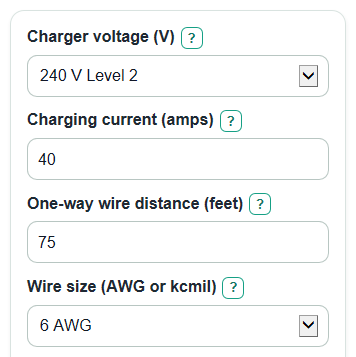
With 240 V, 40 amps, 75 feet one way, 6 AWG copper, a 3% branch target, 60 charging hours per month, and $0.17 per kWh, the voltage lost on this run is about 2.95 V. The voltage drop is about 1.23%, and the estimated voltage at the charger is about 237.05 V. Wire heat is about 118 W, which is about 7.08 kWh per month and about $1.20 per month. For the same voltage-drop target, the smallest listed copper size that meets the target is 8 AWG, but that result is not an ampacity approval.