
Use this calculator to size an EV charger breaker or find the safest charger amps for an existing breaker.
Advanced options
Table of contents
How to use our EV Charger Breaker Size Calculator
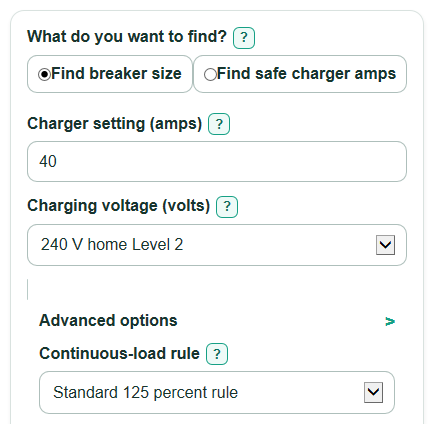
- Choose What do you want to find? based on what you already know: Charger setting (amps) or Breaker size (amps).
- Enter the visible required field for that mode, then choose Charging voltage (volts) as 240, 208, or 120 volts.
- Open Advanced options only if you need to change Continuous-load rule or enter Largest allowed breaker (amps) from a panel review, charger manual, or electrician.
- Click Calculate and read the first result first: Recommended breaker size or Max safe charger setting.
- Sanity-check the result: with the standard rule, a 40 A charger should usually show a 50 A breaker, and a 50 A breaker should usually show a 40 A safe charger setting.
Definitions
Charger setting (amps): The maximum current the EV charger is set to draw continuously.
Breaker size (amps): The amp rating printed on the circuit breaker handle.
Charging voltage (volts): The circuit voltage used by the charger, usually 240 volts for home Level 2, 208 volts at many commercial sites, or 120 volts for Level 1.
Continuous-load rule: The sizing rule that usually treats long-running EV charging as needing extra circuit capacity, commonly 125 percent of the charger current [2].
Recommended breaker size: The next supported standard breaker size that is at least the calculated minimum circuit size.
Max safe charger setting: The largest continuous charger amp setting allowed by the entered breaker under the selected rule.
Charging power: The estimated electrical power in kilowatts, found from volts times amps divided by 1000.
Largest allowed breaker (amps): An optional cap from a panel load calculation, charger instructions, site limit, or electrician.
Common mistakes and quick fixes
Mistake: Entering the breaker handle number into Charger setting (amps).
Fix: Use the charger's actual amp setting in Charger setting (amps), or switch What do you want to find? to find Max safe charger setting from Breaker size (amps).
Mistake: Assuming Breaker size (amps) can equal the charger amps under the normal rule.
Fix: Use the Standard 125 percent rule under Continuous-load rule unless the whole circuit is listed for 100 percent continuous use.
Mistake: Choosing the wrong Charging voltage (volts), such as 120 volts for a 240-volt Level 2 charger.
Fix: Pick 240 V home Level 2 for most US home installations, 208 V commercial Level 2 for many commercial sites, or 120 V Level 1 for a standard outlet charger.
Mistake: Treating Charging power as guaranteed battery charging speed.
Fix: Read Charging power as electrical input power before vehicle limits, charger losses, temperature effects, and battery tapering.
Mistake: Ignoring Largest allowed breaker (amps) when a panel load calculation or charger manual gives a smaller limit.
Fix: Enter that cap in Largest allowed breaker (amps) and use Best charger setting for your breaker limit if the recommended breaker is too large.
Mistake: Using Recommended breaker size without checking wire, receptacle, panel capacity, and local code.
Fix: Treat Recommended breaker size as planning math and have the full installation checked before work starts.
Limitations & Key Assumptions / Boundary Conditions
- This tool sizes the breaker from charger amps, or charger amps from breaker size. It does not size wire, conduit, receptacles, disconnects, grounding, GFCI protection, or panel capacity.
- The standard default uses the 125 percent continuous-load method. Use the 100 percent rated equipment option only when every required part of the circuit is listed for that use.
- Recommended breaker size is rounded to this calculator's supported standard list: 15, 20, 25, 30, 35, 40, 45, 50, 60, 70, 80, 90, 100, 110, and 125 A.
- If the exact installation has voltage drop, long wire runs, shared equipment, utility limits, local amendments, or manufacturer limits, the real design may need a different answer.
- Charging power is an electrical estimate. Actual miles of range per hour depends on the vehicle, onboard charger limit, battery temperature, state of charge, and charging losses.
- A nonstandard Breaker size (amps) can still be used for math in reverse mode, but the actual breaker rating must be verified from listed equipment.
- Results above the supported breaker range are outside this calculator's boundary and should be reviewed by a qualified electrician.
Methodology
Calculation steps
The calculator first picks a continuous-load factor from Continuous-load rule. Standard mode uses 1.25. The 100 percent rated option uses 1.0 only for equipment listed for that kind of continuous use.
F = 1.25 for the standard rule
F = 1.0 for 100 percent rated equipment only
In find-breaker mode, the calculator multiplies Charger setting (amps) by the factor to get Minimum circuit size before rounding.
minimum_circuit_amps = charger_amps * F
Then it chooses the first supported standard breaker size that is greater than or equal to that minimum.
recommended_breaker_amps = first standard_breaker where standard_breaker >= minimum_circuit_amps
In find-charger mode, the calculator divides Breaker size (amps) by the factor. With the standard rule, this is the same as using 80 percent of the breaker rating.
max_safe_charger_amps = breaker_amps / F
Charging power uses the selected Charging voltage (volts) and the amps used for the current mode.
charging_power_kw = voltage * amps_used / 1000
If Largest allowed breaker (amps) is entered and is lower than Recommended breaker size, the calculator keeps the true recommended breaker visible and also shows the largest charger setting that fits the lower limit.
max_allowed_charger_amps = max_allowed_breaker_amps / F
max_allowed_power_kw = voltage * max_allowed_charger_amps / 1000
Mini-example
For a 40 A charger on a 240 V home circuit with the standard rule, the minimum circuit size is 40 * 1.25 = 50 A. The next supported standard breaker is 50 A, so Recommended breaker size is 50 A. Charging power is 240 * 40 / 1000 = 9.6 kW. The reverse result is consistent: a 50 A breaker divided by 1.25 gives a Max safe charger setting of 40 A. A published continuous-load example also describes a 40 A Level 2 charger being sized as a continuous load [3].
Sources
- EV Charger Circuit Sizing Under NEC 625: Wire, Breaker, and Panel Capacity Calculations - Orbitaljump
- NEC 625 - EV Charger Sizing and the 125% Continuous-Load Rule | Malfettone Electric | Malfettone Electric - Malfettoneelectric
- Continuous Load Calculation: Sizing Conductors and Breakers - Legalclarity