
Estimate a refrigerator's daily, monthly, and yearly electricity cost from the number you actually have.
Advanced options
Table of contents
How to use our Refrigerator Electricity Cost Calculator
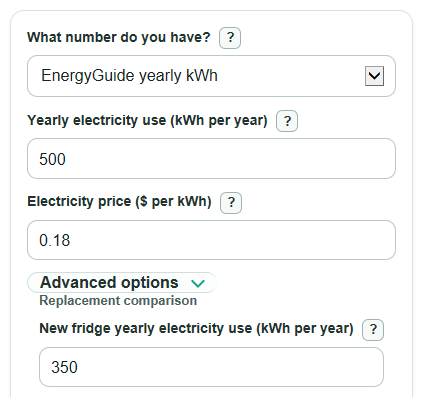
- Choose What number do you have?: EnergyGuide yearly kWh, Meter reading for a few days, or Average watts and hours.
- Enter the visible fields for that choice, then enter Electricity price ($ per kWh) from your bill if possible.
- Open Advanced options only if you want to compare a new fridge using New fridge yearly electricity use (kWh per year), Years to compare (years), and Extra upfront cost ($).
- Click Calculate and check Estimated electricity use per year against your source number; if it looks far too high, make sure you did not use nameplate watts as all-day power.
- Use Estimated cost per year as the main result, and use Simple payback time only when it appears with positive yearly savings.
Definitions
kWh: Kilowatt-hour, a unit for the amount of electricity used. One kWh is the energy used by 1,000 watts running for 1 hour.
EnergyGuide yearly kWh: The estimated yearly electricity use shown on the yellow EnergyGuide label or product spec sheet.
Electricity price ($ per kWh): The price you pay for each kWh. For a bill rate in cents, divide by 100.
Meter reading (kWh): The electricity use recorded by a plug-in power meter during your test period.
Average power while on (watts): The estimated power draw while the refrigerator is actively running, not the average over the whole year.
Year-round average power: The average watts over all hours in a year, including times when the compressor is off.
Simple payback time: The extra upfront cost divided by yearly electricity savings. It is shown only when electricity savings are positive.
Common mistakes and quick fixes
Mistake: Entering cents in Electricity price ($ per kWh), such as 18 instead of 0.18.
Fix: Enter dollars per kWh, so 18 cents becomes 0.18.
Mistake: Using the compressor nameplate as Average power while on (watts) and setting Hours on per day (hours) to 24.
Fix: Use a real average running watt value and the estimated compressor run time, or switch What number do you have? to EnergyGuide yearly kWh.
Mistake: Choosing Meter reading for a few days but leaving Days measured (days) at 0 or guessing the time period.
Fix: Enter the actual full test length in Days measured (days), and use a test that covers at least a few normal days if you can.
Mistake: Putting a monthly kWh estimate into Yearly electricity use (kWh per year).
Fix: Use the annual kWh from the yellow EnergyGuide label, or multiply a monthly estimate by 12 before entering it.
Mistake: Reading Estimated savings per year as a guaranteed bill drop.
Fix: Treat Estimated savings per year as an electricity-only estimate; room temperature, settings, and use habits can change real cost.
Mistake: Entering the full new-fridge price in Extra upfront cost ($) when comparing two choices.
Fix: Enter only the extra amount paid for the lower-kWh option compared with the other choice.
Limitations & Key Assumptions / Boundary Conditions
- The EnergyGuide path uses the label's tested yearly kWh estimate. Your home can differ because of room temperature, door openings, thermostat setting, loading, age, and seal condition.
- A short Meter reading (kWh) test can miss hot days, heavy use, defrost cycles, or vacation periods. Longer normal-use tests usually give a better yearly estimate.
- The Average power while on (watts) mode depends on two guesses: running watts and Hours on per day (hours). It can be much less reliable than an EnergyGuide label or meter reading.
- Electricity price ($ per kWh) should be your all-in rate when possible. Tiered rates, time-of-use plans, fixed charges, and taxes may make the bill impact different.
- Replacement comparison results include electricity only. They do not include delivery, disposal, repairs, rebates, sales tax, financing, food loss, or resale value.
- Simple payback time is a simple break-even estimate. It does not discount future savings, predict appliance life, or account for future rate changes.
Methodology
How the calculator picks yearly electricity use
The calculator first converts your selected input method into Estimated electricity use per year. The yellow EnergyGuide label is the preferred simple input when you have it because EnergyGuide labels are made to help shoppers compare appliance energy use and estimated yearly operating cost [2].
EnergyGuide mode: annual_kwh_est = annual_kwh
Meter mode: annual_kwh_est = measured_kwh / measured_days * 365
Watts mode: annual_kwh_est = average_watts * hours_on_per_day * 365 / 1000
How costs are calculated
After yearly kWh is known, cost is yearly kWh times Electricity price ($ per kWh). Monthly and daily costs are simple splits of the same yearly cost.
annual_cost = annual_kwh_est * electricity_rate
monthly_cost = annual_cost / 12
daily_cost = annual_cost / 365
The Year-round average power output spreads the yearly electricity use across every hour in a 365-day year.
year_round_average_watts = annual_kwh_est * 1000 / 8760
Replacement comparison
If New fridge yearly electricity use (kWh per year) is entered, the calculator compares current yearly cost with the new-fridge yearly cost. Positive savings mean the new fridge costs less to run. Negative savings mean it costs more to run.
compare_cost = compare_kwh * electricity_rate
annual_savings_vs_compare = annual_cost - compare_cost
comparison_year_savings = annual_savings_vs_compare * compare_years
simple_payback_years = extra_purchase_cost / annual_savings_vs_compare
Simple payback is shown only when Extra upfront cost ($) is above 0 and Estimated savings per year is above 0.
Mini example
If a refrigerator uses 500 kWh per year and electricity costs $0.18 per kWh, the yearly cost is 500 * 0.18 = $90. The monthly cost is $90 / 12 = $7.50, and the daily cost is $90 / 365, about $0.25 per day. Its year-round average power is 500 * 1000 / 8760, about 57.1 watts.
Calculation checks
Blank visible required inputs are errors. Negative kWh, watts, or days are not accepted. Days measured must be greater than 0, and Hours on per day (hours) must be from 0 to 24. Hidden inputs from other modes are not used, so an old value in another mode cannot change the result.