
Estimate your refrigerator's yearly, monthly, and daily electricity cost from EnergyGuide kWh, a meter reading, or watts and run time.
Advanced options
Table of contents
How to use our Refrigerator Running Cost Calculator
- Choose What number do you have? based on your best source: Annual energy use (kWh per year), Meter energy used (kWh), or Average running power (watts) with run time.
- Enter the matching fields for that method, then enter Electricity rate ($ per kWh) from your electric bill if possible.
- Use Advanced options if you want Projected cost over selected years or a replacement check with Comparison fridge energy use (kWh per year) and Comparison fridge cost ($).
- Click Calculate and read Cost per year first, then Cost per month, Cost per day, and Energy used per year.
- Sanity-check the result: if watts mode gives a much higher cost than expected, make sure Average run time (hours per day) is compressor run time, not 24 plugged-in hours.
Definitions
kWh: A kilowatt-hour is a unit of energy. A 1,000 watt device running for 1 hour uses 1 kWh.
Annual energy use (kWh per year): The refrigerator's estimated yearly electricity use, often found on the yellow EnergyGuide label or a product spec sheet [4].
Meter energy used (kWh): The electricity recorded by a plug-in meter during your test period.
Average running power (watts): The average power while the refrigerator compressor is running. This is not the short startup surge.
Average run time (hours per day): The estimated compressor-on time each day. A refrigerator is plugged in all day, but it cycles on and off.
Electricity rate ($ per kWh): The price you pay for each kWh. For this estimate, the best rate is the all-in kWh-based rate from your bill.
Projected cost over selected years: The total estimated electricity cost for the number of years entered, with the optional yearly price increase applied.
Simple break-even time: The comparison fridge cost divided by yearly energy savings. It counts energy savings only.
Common mistakes and quick fixes
Mistake: Entering the refrigerator's nameplate watts in Average running power (watts) and using 24 in Average run time (hours per day).
Fix: Use the average compressor-on power and the estimated hours the compressor runs per day, or switch What number do you have? to Annual kWh from EnergyGuide.
Mistake: Leaving Electricity rate ($ per kWh) blank or using only the supply charge.
Fix: Enter a nonblank all-in rate that includes kWh-based supply, delivery, taxes, and fees from your bill.
Mistake: Using Meter energy used (kWh) from a short test and forgetting the matching Days measured (days).
Fix: Enter the exact number of days measured, and use a longer test when door openings or room temperature changed a lot.
Mistake: Typing a monthly kWh number into Annual energy use (kWh per year).
Fix: Use the yearly kWh from the EnergyGuide label or product spec sheet, not one month of use.
Mistake: Reading Yearly savings vs comparison fridge as savings when the value is negative.
Fix: A negative value means the Comparison fridge energy use (kWh per year) costs more to run at the same Electricity rate ($ per kWh).
Mistake: Treating Simple break-even time as a full buying decision.
Fix: Use Comparison fridge cost ($) only for energy payback; also think about rebates, repairs, delivery, disposal, and food storage needs.
Limitations & Key Assumptions / Boundary Conditions
- EnergyGuide mode uses the listed Annual energy use (kWh per year). Your home can differ because of room temperature, door openings, food load, settings, and maintenance.
- Plug-in meter mode scales the measured days to a 365-day year. A short test may miss defrost cycles, hot weather, vacation use, or heavy door-opening days.
- Watts mode depends on Average run time (hours per day). Using 24 hours usually overstates cost because the compressor does not run all day.
- Electricity rate ($ per kWh) is treated as one constant rate unless you enter an annual Electricity price increase (percent per year). It does not model time-of-use rates or tiered bills.
- Projected cost over selected years keeps the same refrigerator kWh use each year. It does not model equipment aging, repairs, or changing household habits.
- Yearly savings vs comparison fridge and Simple break-even time compare energy cost only. They do not include rebates, taxes, financing, delivery, installation, disposal, repairs, resale value, or food spoilage risk.
- The calculator uses 365 days per year and 12 average months. Leap years and exact billing-cycle dates are ignored.
Methodology
How the energy number is chosen
The calculator uses only the input method selected under What number do you have? EnergyGuide annual kWh is the simplest path when you have the label or product listing, because it is already a yearly energy estimate for the refrigerator [4].
EnergyGuide mode: annual_energy_kwh = annual_kwh
Meter mode: annual_energy_kwh = meter_kwh / meter_days * 365
Watts mode: annual_energy_kwh = watts * run_hours_per_day / 1000 * 365
How cost is calculated
After the yearly kWh is found, the calculator multiplies it by Electricity rate ($ per kWh). Monthly and daily results are averages, not exact bill predictions.
annual_cost = annual_energy_kwh * electricity_rate
monthly_cost = annual_cost / 12
daily_cost = annual_cost / 365
Projection and comparison math
For a flat electricity price, the projected total is the yearly cost times the number of years. If Electricity price increase (percent per year) is entered, the calculator applies that increase once per year as a growing cost series.
if rate_increase_decimal = 0: projected_total_cost = annual_cost * projection_years
if rate_increase_decimal is not 0: projected_total_cost = annual_cost * (((1 + rate_increase_decimal) ^ projection_years - 1) / rate_increase_decimal)
When Comparison fridge energy use (kWh per year) is entered, savings are calculated at the same electric rate. Negative savings are kept because they mean the comparison fridge costs more to run.
annual_savings_vs_comparison = (annual_energy_kwh - compare_annual_kwh) * electricity_rate
break_even_years = compare_purchase_price / annual_savings_vs_comparison
Break-even is shown only when Comparison fridge cost ($) is entered and yearly savings are positive. If savings are zero or negative, energy savings alone do not repay the entered comparison cost.
Mini example
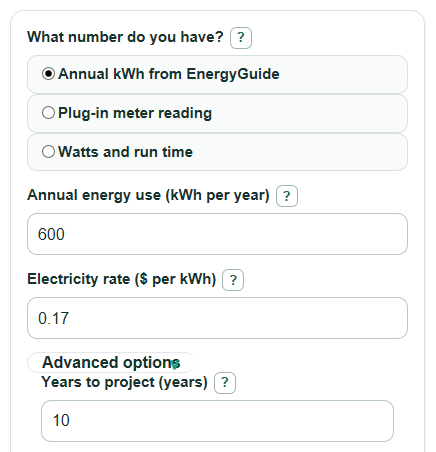
If a refrigerator uses 600 kWh per year and electricity costs $0.17 per kWh, Cost per year is 600 * 0.17 = $102. Cost per month is $102 / 12 = $8.50, and Cost per day is $102 / 365 = about $0.28. Over 10 years with no price increase, Projected cost over selected years is $1,020.
Sources
- How To Use the EnergyGuide Label To Shop for Home Appliances | Consumer Advice - FTC
- Electricity Data - U.S. Energy Information Administration (EIA) - EIA
- Purchasing and Maintaining Refrigerators and Freezers | Department of Energy - Energy
- Purchasing Energy-Efficient Residential Refrigerators | Department of Energy - Energy