
Estimate your home EV charger installation cost from real quote line items, then compare the total before and after selected incentives.
Personal-use 30C only: qualifying property at your main home, original use by you, primarily US use, and an eligible census tract. Service dates after June 30, 2026 do not qualify. This is not the business-credit calculation.
IRS eligibility and service-date rules. Eligible cost may differ from your complete project quote; the personal credit is nonrefundable.
Advanced options
Rebates and credit settings
Quote check
Table of contents
How to use our EV Charger Installation Cost Calculator
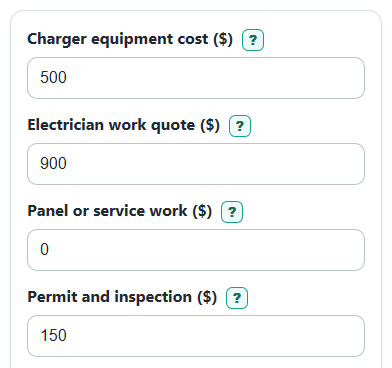
- Enter the Charger equipment cost, Electrician work quote, Panel or service work, and Permit and inspection amounts from your quote.
- Choose whether to include the Federal 30C credit estimate. If included, enter the service date, verify eligibility, and supply eligible cost and available tax liability. A service date after June 30, 2026 gives no credit.
- Open Advanced options if you want to add Other rebate or instant discount, change the Federal credit rate or Federal credit limit, or enter Distance from panel to charger.
- Click Calculate, then compare Estimated net cost after selected credits and rebates with Total project cost before credits and rebates.
- Sanity-check the result by making sure Electrical work and permit cost before incentives matches the labor, panel, and permit lines in your quote, not the charger hardware price.
Definitions
EVSE: Electric vehicle supply equipment. This is the charger equipment that safely sends power from your home wiring to the car.
Charger equipment cost: The price of the wall charger or plug-in EVSE before any separate installation labor.
Electrician work quote: The labor and basic electrical materials for the installation, such as wire, conduit, breaker, outlet, and mounting work.
Panel or service work: Extra electrical work for capacity or layout, such as a panel upgrade, service upgrade, subpanel, or load-management device.
Federal 30C credit estimate: A modeled tax credit amount based on the selected rate and limit. It reduces the net estimate, but actual eligibility must be checked separately.
Electrical work cost per panel-to-charger foot: The electrical work and permit cost divided by the entered wire-route distance. It is a rough quote comparison number, not a code check.
Common mistakes and quick fixes
Mistake: Putting the charger price inside Electrician work quote and also in Charger equipment cost.
Fix: Put the wall charger or EVSE price only in Charger equipment cost, and keep Electrician work quote for labor and basic electrical materials.
Mistake: Leaving Panel or service work blank when your quote includes a panel upgrade, subpanel, or load-management device.
Fix: Enter that amount in Panel or service work so Total project cost before credits and rebates includes it.
Mistake: Adding the same incentive in Other rebate or instant discount and also choosing Include for Federal 30C credit estimate.
Fix: Use Other rebate or instant discount only for non-federal rebates, instant discounts, or utility credits.
Mistake: Treating Federal 30C credit estimate as guaranteed cash back.
Fix: Use it as an estimate only, and check current rules, location eligibility, timing, and your tax situation before relying on it.
Mistake: Entering a straight-line garage distance for Distance from panel to charger.
Fix: Use the rough wire route distance so Electrical work cost per panel-to-charger foot is a better quote check.
Limitations & Key Assumptions / Boundary Conditions
- The calculator uses your entered quote lines. It does not estimate local labor prices, wire size, trenching, drywall repair, or utility work.
- The Federal 30C credit estimate is not tax advice. Actual eligibility can depend on current law, location rules, timing, tax liability, and IRS guidance.
- For qualifying personal-use property placed in service from January 1, 2023 through June 30, 2026, this worksheet caps the rate at 30% and credit at $1,000 for one charging port, also limited by the entered Form 8911 tax-liability amount. Outside that service-date window, this calculation includes no federal credit.
- Other rebate or instant discount is subtracted as entered. Some programs pay later instead of reducing the upfront bill, so your cash timing may differ.
- Distance from panel to charger is only used for the per-foot quote check. A short route can still cost more if it needs difficult routing, panel work, concrete, trenching, or code upgrades.
- A negative Estimated net cost after selected credits and rebates is allowed. It means the selected incentives are larger than the entered project cost, not that every program will pay you the difference.
Methodology
Cost stack
The calculator starts with the four quote lines most homeowners can identify: charger hardware, electrician work, panel or service work, and permit or inspection cost.
total_before_incentives = charger_cost + electrician_quote + panel_work_cost + permit_fee
It also separates installation-related costs from the charger hardware so you can compare one quote that includes the charger with another quote that does not.
install_work_before_incentives = electrician_quote + panel_work_cost + permit_fee
Credits and rebates
Do not include gives zero federal credit. Include if I qualify requires a service date, confirmed eligibility, eligible cost for one port and the available Form 8911 tax-liability limit. For the supported 2023 through June 30, 2026 window, the estimate is limited to 30% of eligible cost, $1,000 and available tax liability. Lower user-entered rate or cap assumptions are also respected.
federal_credit_estimate = min(eligible_cost * min(rate_percent, 30) / 100, cap, 1000, available_tax_liability); zero outside the supported service-date window
total_incentives = federal_credit_estimate + other_rebate
net_cost_after_incentives = total_before_incentives - total_incentives
The net cost is not floored at 0. If selected incentives are larger than the entered cost, the calculator keeps the negative value and shows a note explaining what it means.
Per-foot quote check
When Distance from panel to charger is greater than 0, the calculator divides the electrical work and permit cost by that distance.
install_work_per_foot = install_work_before_incentives / distance_from_panel_feet
If the distance is blank, 0, or negative, the main dollar results still calculate, but the per-foot card is omitted or replaced with a note asking for a distance greater than 0.
Mini-example
Suppose equipment is $600, electrician work $1,200, panel/service work $2,500 and permit/inspection $200, with a $500 other rebate. For illustration only, assume all $4,500 qualifies for one port placed in service June 30, 2026, the location and property requirements are met, and Form 8911 permits at least $1,000. The 30% credit is then capped at $1,000. Verify the eligible cost separately, including how any rebate affects its basis.
total_before_incentives = 600 + 1200 + 2500 + 200 = 4500
federal_credit_estimate = min(4500 * 30 / 100, 1000) = 1000
total_incentives = 1000 + 500 = 1500
net_cost_after_incentives = 4500 - 1500 = 3000
With a 40-foot Distance from panel to charger, the electrical work and permit cost is $3,900, so the quote check is $97.50 per foot.