
Use this calculator to choose a home EV charger amp setting that can refill your normal daily driving during your charging window.
Advanced options
Table of contents
How to use our EV Home Charger Size Calculator
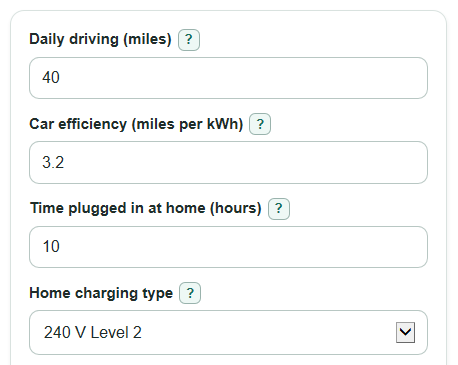
- Enter Daily driving (miles) for a normal busy day, not a rare road trip.
- Enter Car efficiency (miles per kWh) and Time plugged in at home (hours).
- Choose Home charging type and enter Car's max home charging current (amps) from your car manual, app, or charger screen if you know it.
- Open Advanced options if you want to change Charging loss (percent), Extra cushion (percent), or Largest breaker available for the charger (amps).
- Select Calculate, then sanity-check the result: Estimated miles added per hour times your home charging hours should be close to or above your Daily driving (miles).
Definitions
Daily driving (miles): The miles you want to replace during one home charging session.
Car efficiency (miles per kWh): How many miles your EV drives from 1 kilowatt-hour of battery energy.
Home charging type: The voltage used for charging. 120 V is a normal outlet, and 240 V is the faster home Level 2 setup often installed for EV charging.
Car's max home charging current (amps): The most AC current your car can accept at home. The charger cannot force the car to use more.
Charging loss (percent): The share of wall energy that does not end up stored in the battery, mostly from heat and charging electronics.
Extra cushion (percent): A planning buffer added before choosing the charger setting so the result is not sized exactly on the edge.
Charger setting (amps): The current limit set on the EV charger. Higher amps usually charge faster but need a larger circuit.
Breaker size to discuss with an electrician: The breaker rating suggested by the continuous-load planning rule for the chosen charger current.
Common mistakes and quick fixes
Mistake: Using a rare vacation trip for Daily driving (miles).
Fix: Use a normal busy day, then plan road trips with public charging separately.
Mistake: Leaving Car efficiency (miles per kWh) at a guess that does not match your car.
Fix: Use your dashboard average or EPA rating if you have it, because lower efficiency needs more charger current.
Mistake: Counting parked time instead of Time plugged in at home (hours).
Fix: Enter the hours the car can actually charge before you need to leave.
Mistake: Setting Car's max home charging current (amps) higher than the car can accept.
Fix: Check the car's AC charging limit; a larger charger will not help if the car limits current.
Mistake: Treating Breaker size to discuss with an electrician as a complete wiring design.
Fix: Use it as a planning number only; an electrician still checks wire size, panel capacity, permits, and local code.
Mistake: Ignoring Will it replace your daily driving in time? when a breaker or car limit blocks the target.
Fix: If it says not enough, look at Extra charging time needed if limited and adjust time, miles, car limit, or charging away from home.
Limitations & Key Assumptions / Boundary Conditions
- This is a planning calculator for home AC charging. It does not design the circuit or replace a licensed electrician.
- The breaker result does not choose wire gauge, conduit, GFCI details, service-panel capacity, load management, permits, or local code requirements.
- The standard charger settings are limited to 12 and 16 amps for 120 V, and 16, 24, 32, 40, 48, 64, and 80 amps for 240 V.
- Real charging speed can be lower in cold weather, very hot weather, near a full battery, or when the car reduces AC charging power.
- Charging loss is an estimate. Your real loss can change with temperature, charger model, voltage, current, and battery conditioning.
- Use Daily driving (miles) for normal home-charging needs. Long road trips usually need a separate public charging plan.
- If Largest breaker available for the charger (amps) is selected, the calculator treats 80 percent of that breaker as the usable continuous charger current.
Methodology
What the calculator solves
The calculator estimates the smallest standard charger current that can replace your entered Daily driving (miles) within your Time plugged in at home (hours). Home charging choices are commonly described with volts and amps [1].
Step 1: daily battery energy
First it estimates how much battery energy your driving uses.
daily_battery_kwh = daily_miles / miles_per_kwh
Step 2: wall energy for sizing
Then it adds Charging loss (percent) and Extra cushion (percent). Loss raises the wall energy needed because not all wall power reaches the battery. Cushion only affects the charger-size recommendation.
sizing_wall_kwh = daily_battery_kwh / (1 - charging_loss_percent / 100) * (1 + extra_cushion_percent / 100)
Step 3: exact current before rounding
The calculator converts the needed wall energy into amps using the selected Home charging type.
raw_required_amps = sizing_wall_kwh / charging_hours * 1000 / home_voltage
The 1000 converts kilowatts to watts because volts times amps equals watts.
Step 4: choose the charger setting
For 120 V, the standard settings checked are 12 and 16 amps. For 240 V, the settings checked are 16, 24, 32, 40, 48, 64, and 80 amps. The calculator chooses the first setting that is at least the exact current and is not above Car's max home charging current (amps). If Largest breaker available for the charger (amps) is selected, the setting also must be no more than 80 percent of that breaker.
recommended_charger_amps = first standard setting that meets raw_required_amps and all selected limits
If no standard setting meets the target, the calculator uses the largest feasible setting and marks Will it replace your daily driving in time? as not enough.
Step 5: power, breaker, and miles per hour
Charging power is wall-side power before charging loss is applied.
recommended_power_kw = home_voltage * recommended_charger_amps / 1000
The breaker planning number uses the continuous-load multiplier.
required_breaker_amps = first breaker size where breaker_size >= recommended_charger_amps * 1.25
The breaker sizes checked are 15, 20, 30, 40, 50, 60, 80, and 100 amps.
Estimated miles added per hour applies charging loss and your car efficiency.
miles_added_per_hour = recommended_power_kw * (1 - charging_loss_percent / 100) * miles_per_kwh
Time to replace your daily driving excludes the extra cushion so it answers the everyday refill time.
daily_recharge_hours = daily_battery_kwh / (recommended_power_kw * (1 - charging_loss_percent / 100))
If the best allowed setting is too slow, the calculator shows the shortage.
extra_hours_needed = max(0, daily_recharge_hours - charging_hours)
Mini-example
With 40 miles per day, 3.2 miles per kWh, 10 home charging hours, 240 V, 10 percent charging loss, and 15 percent cushion, daily battery use is 12.5 kWh. Wall energy for sizing is 12.5 / 0.90 * 1.15 = 15.97 kWh. Exact current is 15.97 / 10 * 1000 / 240 = 6.66 amps, so the smallest 240 V setting in the list is 16 amps. That gives 3.84 kW, about 11.1 miles added per hour, about 3.62 hours to replace the daily driving, and a 20 amp breaker size to discuss with an electrician.