
Find the smallest copper AWG wire size that keeps your LED strip feed-wire voltage drop under your chosen limit.
Table of contents
How to use our LED Strip Wire Size Calculator
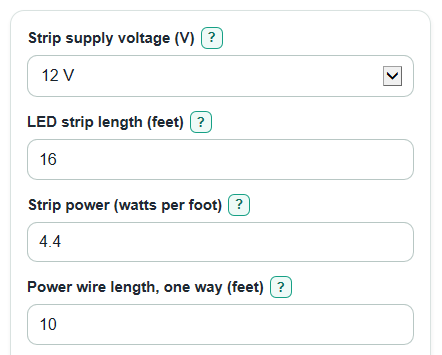
- Choose the Strip supply voltage (V) that matches the LED strip or power supply label.
- Enter LED strip length (feet), Strip power (watts per foot), and Power wire length, one way (feet); the wire length is only the power feed distance, not the LED tape length.
- Set Allowed voltage drop (percent), usually a small design limit such as 3 to 10 percent for low-voltage LED work.
- Open Advanced options only if you need Matching power feeds sharing this load (feeds), Wire temperature to use (C), or Check a wire you already have (AWG).
- Click Calculate, then sanity-check Current in each feed wire and Power lost as heat in the feed wires; very high current or heat loss means you may need more feeds, a shorter run, or a higher strip voltage.
Definitions
AWG: American Wire Gauge, a wire size scale where smaller numbers mean thicker copper wire.
Voltage drop: The voltage lost in the feed wires before power reaches the LED strip input.
One-way wire length: The distance from the power supply to the strip feed point; the math counts both the positive and return wires.
Watts per foot: The full-brightness power rating for one foot of LED strip.
Feed: A pair of power wires bringing power to the strip or to an injection point.
Current: The flow of electricity in amps through each feed wire.
Wire resistance: How much the copper wire resists current; higher resistance causes more voltage drop and more heat.
Common mistakes and quick fixes
Mistake: Putting the LED tape length into Power wire length, one way (feet).
Fix: Use the distance from the power supply to the strip feed point, because the calculator already asks for LED strip length (feet) separately.
Mistake: Entering watts per meter in Strip power (watts per foot).
Fix: Convert first by dividing watts per meter by 3.28084, then enter the watts-per-foot value.
Mistake: Assuming a bigger AWG number means a bigger wire when reading Recommended wire size.
Fix: Remember that AWG works backward: 16 AWG is thicker than 18 AWG, and 12 AWG is thicker than 16 AWG.
Mistake: Setting Matching power feeds sharing this load (feeds) to 2 when the feeds do not share the load evenly.
Fix: Use 1 unless the feed wires are similar and the layout really splits the strip load between them.
Mistake: Treating Checked wire result as full safety approval.
Fix: Use Checked wire result only for voltage drop, then check connector ratings, fuse size, wire current rating, insulation, and local rules.
Mistake: Ignoring Voltage drop with recommended wire because the strip still turns on.
Fix: Compare Voltage drop with recommended wire to your limit; too much drop can make LEDs dimmer or change color near the far end.
Limitations & Key Assumptions / Boundary Conditions
- This is a voltage-drop sizing aid for copper LED strip feed wires, not an ampacity, fuse, connector, insulation, or electrical-code approval tool.
- The result covers the power feed wires only. It does not include voltage drop along the copper traces inside the LED tape, which can matter on long or high-power strips.
- Multiple feeds are treated as matching feeds that share the load evenly. If one feed is much shorter, thicker, or connected differently, real current sharing can differ.
- The calculator uses a constant-power load estimate from LED strip length (feet) and Strip power (watts per foot). Real LED strips and controllers may draw less at lower brightness or different color settings.
- The recommendation is limited to the listed AWG sizes: 24, 22, 20, 18, 16, 14, 12, 10, 8, 6, and 4 AWG.
- Allowed voltage drop (percent) is blocked if it is over 20 percent because the simple feed-wire estimate becomes less useful for practical low-voltage LED design.
- Wire temperature changes resistance. The 65 C option is more cautious than 25 C, but it is still an estimate for the feed-wire temperature you choose.
Methodology
How the wire size is chosen
The calculator first estimates the total LED load, then divides that load across the number of matching feeds. It tests copper AWG sizes from 24 AWG through 4 AWG and picks the first listed size that stays at or below Allowed voltage drop (percent). The AWG resistance values are standard copper wire resistance values in ohms per 1000 feet [1].
total_power_watts = strip_length_ft * strip_power_w_per_ft
current_per_feed_amps = (total_power_watts / supply_voltage) / feed_count
If warm wire is selected, the copper resistance is increased with the copper temperature coefficient.
resistance_ohms_per_1000ft_at_temp = resistance_ohms_per_1000ft_at_25c * (1 + 0.00393 * (wire_temp_c - 25))
The feed-wire resistance uses round-trip length because current travels out on one conductor and back on the return conductor.
wire_resistance_ohms = (resistance_ohms_per_1000ft_at_temp / 1000) * (2 * wire_length_one_way_ft)
Voltage drop is then found from current times resistance, the same basic relationship used in Ohm's law.
voltage_drop_v = current_per_feed_amps * wire_resistance_ohms
voltage_drop_percent = 100 * voltage_drop_v / supply_voltage
voltage_at_strip = supply_voltage - voltage_drop_v
total_wire_loss_watts = feed_count * current_per_feed_amps^2 * wire_resistance_ohms
Worked mini-example
With the default values, a 12 V strip, 16 feet, 4.4 W/ft, 10 feet of one-way feed wire, 5 percent allowed drop, 1 feed, and 25 C wire gives 70.4 W total strip power. Current is 70.4 / 12 = 5.8667 A. For 16 AWG copper, resistance is 4.094 ohms per 1000 ft, so the 20 ft round trip is 0.08188 ohms. Voltage drop is 5.8667 * 0.08188 = 0.4804 V, which is 4.003 percent of 12 V. Since 18 AWG would be above 5 percent and 16 AWG is below 5 percent, the Recommended wire size is 16 AWG.
Checked wire option
If Check a wire you already have (AWG) is not set to Do not check, the same voltage-drop math is run for that selected AWG. Checked wire result is Pass only when Drop for the wire you checked is at or below Allowed voltage drop (percent).
Important calculation notes
If no listed AWG meets the drop limit, the calculator does not invent a passing size. It reports that the listed range is unsupported for the entered layout. If voltage reaching the strip feed point would be zero or negative, the result is also unsupported because the simple LED load estimate is no longer useful. The method sizes feed wires for voltage drop; LED tape voltage drop can still reduce brightness farther down the strip [2].