
Use this DC fuse size calculator to size a fuse from amps or watts, then check wire and fuse voltage safety.
Advanced options
Table of contents
How to use our DC Fuse Size Calculator
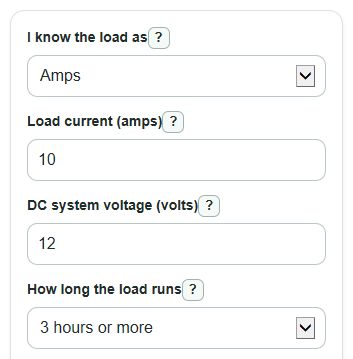
- Choose I know the load as, then enter either Load current or Load power from the device label or manual.
- Enter DC system voltage and How long the load runs so the calculator can find Normal load current and Current used for fuse sizing.
- Enter Smallest wire amp limit for the smallest wire in the circuit, because the fuse should protect the wire.
- Open Advanced options only if you want to change Fuse size list or enter Fuse DC voltage rating for a DC voltage check.
- After you click Calculate, sanity-check that Smallest common fuse that covers the load is not above the wire limit and that any DC voltage rating check passes.
Definitions
Load current: The device's normal maximum current in amps before any run-time sizing factor is added.
Load power: The device's power in watts. In watts mode, the calculator divides Load power by DC system voltage to estimate current.
DC system voltage: The circuit voltage in volts for a direct-current system, such as a battery or DC power supply.
Smallest wire amp limit: The safe amp limit for the smallest wire in the protected circuit section. The fuse mainly protects this wire from overheating.
Fuse size list: The set of common fuse amp ratings the calculator can round up to.
Fuse DC voltage rating: The highest DC voltage the fuse is rated to interrupt safely. It should be at least as high as DC system voltage.
Wire headroom after fuse choice: Smallest wire amp limit minus the selected fuse size. A negative value means the fuse is larger than the entered wire limit.
Common mistakes and quick fixes
Mistake: Entering an old fuse value as Load current.
Fix: Use the device's maximum normal Load current, or switch I know the load as to watts and enter Load power.
Mistake: Using AC voltage or a guessed battery label for DC system voltage.
Fix: Enter the nominal DC system voltage for the circuit, such as 12, 24, or 48 volts.
Mistake: Choosing Less than 3 hours for How long the load runs when the load can stay on for hours.
Fix: Choose 3 hours or more so Current used for fuse sizing includes the 1.25 factor.
Mistake: Entering the largest wire size in Smallest wire amp limit.
Fix: Use the amp limit for the smallest wire in the protected part of the circuit.
Mistake: Ignoring Wire safety check after getting a fuse size.
Fix: If Wire safety check fails, increase the wire amp limit, reduce the load, or redesign the circuit.
Mistake: Leaving Fuse DC voltage rating unchecked on higher-voltage DC systems.
Fix: Enter Fuse DC voltage rating when you know it and make sure DC voltage rating check passes.
Limitations & Key Assumptions / Boundary Conditions
- This is planning math only. Final fuse choice must follow the equipment manual, fuse data sheet, fuse holder rating, and local electrical rules.
- The fuse size is rounded up from the selected Fuse size list. A different fuse family can have different available sizes.
- The calculator checks amp rating and optional DC voltage rating only. It does not check interrupt rating, fuse speed, temperature derating, wire length, voltage drop, terminal quality, or enclosure heat.
- The Smallest wire amp limit must already include the correct wire gauge, insulation rating, bundle conditions, and installation environment.
- A passing Wire safety check does not prove the device is protected from damage. Fuses mainly protect wiring from overcurrent.
- If the needed current is above the largest value in the selected Fuse size list, the result should be treated as unsupported rather than rounded to an unsafe size.
Methodology
How the fuse size is found
The calculator first turns the entered load into Normal load current. In amps mode, it uses Load current directly.
load_current_amps = load_amps
In watts mode, it divides Load power by DC system voltage. DC system voltage must be greater than zero.
load_current_amps = load_watts / system_voltage
Next it applies the run-time factor. Loads that run for 3 hours or more use 1.25. Shorter loads use 1.00.
run_time_factor = 1.25 if run_time_type = continuous, else 1.00
The result is the Current used for fuse sizing.
calculated_current_amps = load_current_amps * run_time_factor
The recommended fuse is the first value in the selected Fuse size list that is greater than or equal to Current used for fuse sizing.
recommended_fuse_amps = first selected fuse size where size >= calculated_current_amps
Safety checks
The wire check compares the rounded fuse size with Smallest wire amp limit. The signed headroom is kept so a failing result shows how far over the wire limit the fuse is.
wire_headroom_amps = wire_amp_limit - recommended_fuse_amps
wire_check passes if recommended_fuse_amps <= wire_amp_limit
If Fuse DC voltage rating is entered, the calculator subtracts DC system voltage from that rating. A negative margin means the fuse rating is too low for the circuit voltage.
voltage_rating_margin_volts = fuse_dc_voltage_rating - system_voltage
Mini example
For a 10 amp load on a 12 volt DC system that can run for 3 hours or more, Normal load current is 10 amps. The continuous-load factor makes Current used for fuse sizing 12.5 amps. The next common Marine/RV DC size is 15 amps. If Smallest wire amp limit is 20 amps, Wire headroom after fuse choice is 5 amps and the wire check passes.