
Enter an SMD resistor code to find its resistance, or enter a resistance to create an exact supported marking.
Table of contents
How to use our SMD Resistor Code Calculator
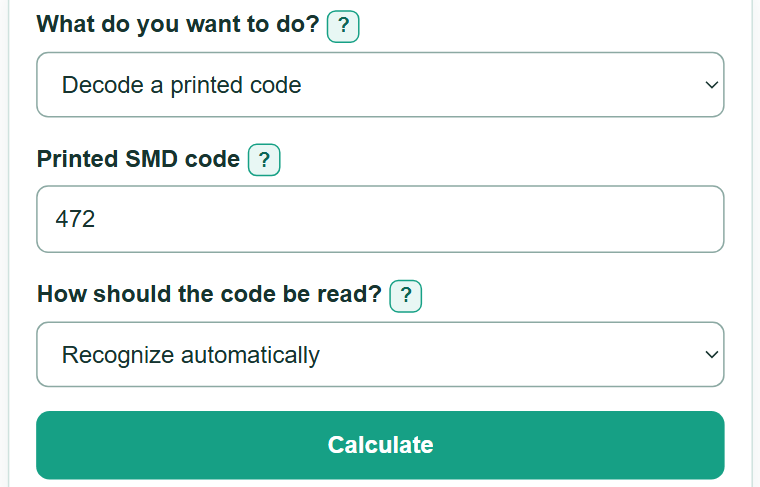
- Select "Decode a printed code" when you have characters from a resistor, board photo, or parts record.
- Enter the code exactly as printed. Leave "How should the code be read?" on "Recognize automatically" unless part documentation identifies a code style.
- Click "Calculate" and read the resistance first. Then check "Code style used" and "How the code was read" to catch a multiplier mistake.
- For reverse lookup, select "Find a marking", enter the resistance, choose its unit and the required marking style, then click "Calculate".
- Compare the answer with the schematic or part specification before ordering a replacement, especially when text is worn or a code is not supported.
Definitions
SMD resistor: A resistor made to mount directly on a circuit board.
Ohm (ohm): The unit of electrical resistance. One kohm is 1,000 ohm, and one Mohm is 1,000,000 ohm.
3-digit code: A code where the first two digits are the starting number and the last digit is the power-of-ten multiplier.
4-digit code: A code where the first three digits are the starting number and the last digit is the power-of-ten multiplier.
R notation: A code that uses R as a decimal point, such as 4R7 for 4.7 ohm.
EIA-96 code: A two-digit index for a base resistance value followed by a letter multiplier.
Zero-ohm link: A part marked with all zeros, such as 000, used as a near-zero-resistance board connection.
Common mistakes and quick fixes
Mistake: Reading every digit in 472 as the resistance number.
Fix: In a 3-digit code, 47 is the starting number and 2 means multiply by 100. Code 472 means 4,700 ohm.
Mistake: Treating R as an EIA-96 multiplier letter.
Fix: R is a decimal point in R notation. For example, 4R7 means 4.7 ohm.
Mistake: Entering spaces or guessing a worn character.
Fix: Enter one uninterrupted code. Check a magnified photo, reel label, or manufacturer document if a character could be a letter or number.
Mistake: Assuming any two digits and a letter form an EIA-96 code.
Fix: EIA-96 needs an index from 01 through 96 and a supported multiplier letter. Use the documented style when it is known.
Mistake: Using the generated code alone to select a replacement part.
Fix: Also match the required tolerance, package size, power rating, voltage rating, and temperature coefficient in the part specification.
Limitations & Key Assumptions / Boundary Conditions
- The result is the nominal resistance indicated by a supported marking, not a measurement of a part installed in a circuit.
- A printed code does not identify tolerance, package size, power rating, voltage rating, temperature coefficient, manufacturer, or part number.
- Some packages are unmarked or use manufacturer-specific markings, and worn text can be impossible to identify reliably.
- Automatic recognition covers 3-digit codes, 4-digit codes, R notation, EIA-96 codes, and all-zero links only.
- Reverse lookup returns a marking only when the selected style represents the entered resistance exactly. It does not substitute a nearby value.
Methodology
How codes are decoded
A 3-digit numeric code uses its first two digits as the starting number. Its last digit is a power-of-ten multiplier.
ABN = AB x 10^N ohm
A 4-digit numeric code works the same way but starts with three digits.
ABCN = ABC x 10^N ohm
R notation uses R as the decimal point.
4R7 = 4.7 ohm
An EIA-96 code uses a two-digit index to select a base value, then applies the final letter as a multiplier.
EIA-96 resistance = indexed base value x letter multiplier
For a quick check, 472 means 47 x 10^2 = 4,700 ohm, or 4.7 kohm. Code 01C uses EIA-96 base value 100 and multiplier C, which is 100, so it means 10,000 ohm.
Creating a marking
The calculator converts the entered value to ohms using the chosen unit. It then looks for an exact match in the selected marking style. If no exact match exists, it does not round the value or create a nearby code.
resistance in ohms = entered value x unit multiplier
Calculation choices
All-zero codes are handled first as zero-ohm links. The calculator rejects partial codes, spaces within a code, unsupported letters, negative resistance values, and malformed numbers. A decoded code gives nominal resistance only; check the component specification for all other ratings.