
Read a resistor's painted bands or find the colors for a resistance you need. Check tolerance, reading direction, and an optional six-band temperature-change estimate.
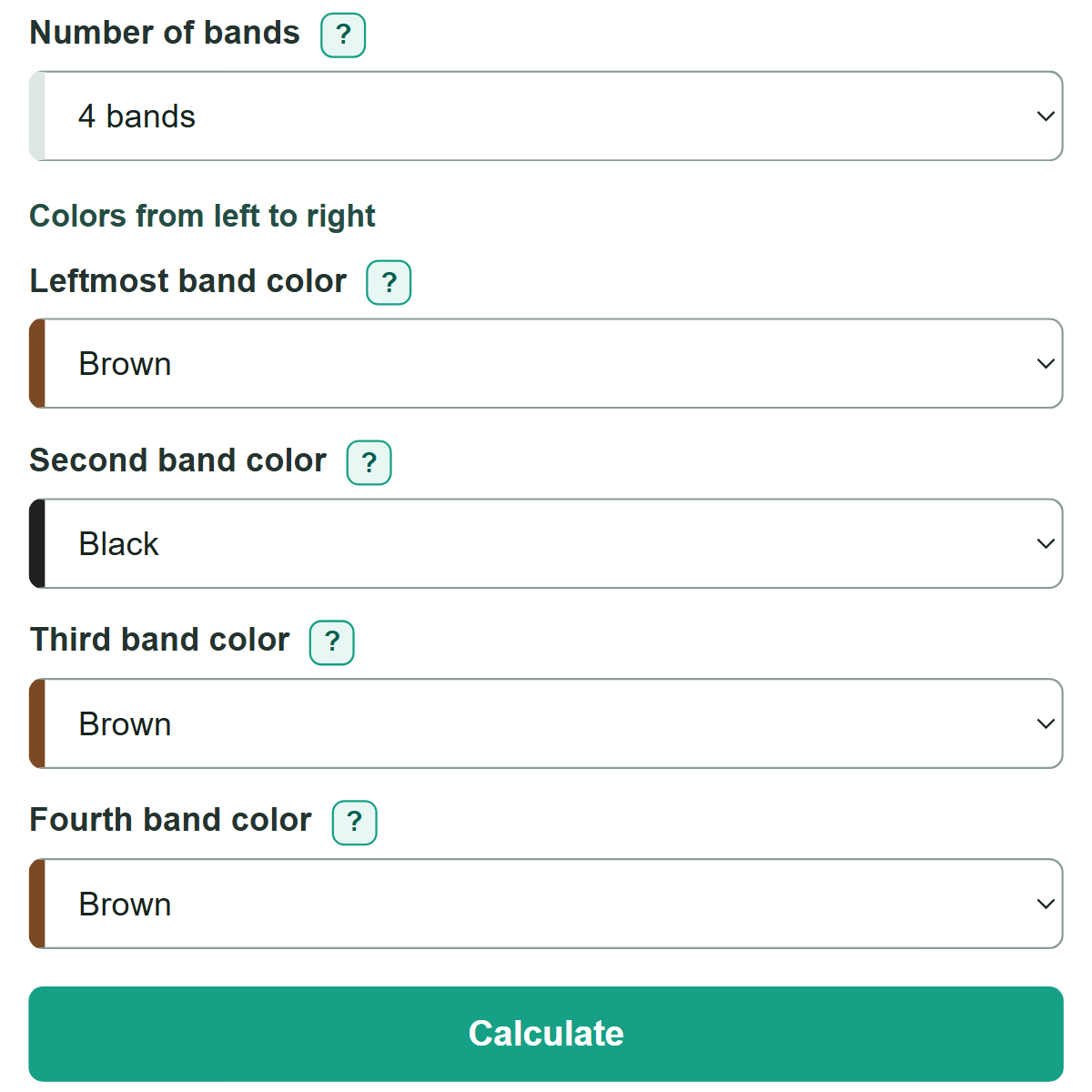
Colors from left to right
Advanced options
This is the nominal value from the entered left-to-right bands.
Reverse-reading tolerance: percent
This describes how strongly resistance may change as temperature changes.
% of the marked resistance. This is a linear magnitude estimate, not a prediction that resistance always increases. Tolerance, aging and self-heating are separate; use the manufacturer's TCR and rated temperature interval.
Table of contents
How to use our Resistor Color Code Calculator
- For reading an existing resistor, choose "Bands to value" in "What do you want to do?"
- Count every painted band on the resistor, then select the matching choice in "Number of bands."
- Hold the resistor in one direction and select its colors from left to right. A wider gap is often before the tolerance band.
- Select "Calculate" to see the decoded nominal resistance, tolerance, and allowed minimum-to-maximum range.
- Read the "Reading-direction check." If both directions are valid, use the wider physical gap to identify the tolerance end.
- Sanity-check a faded, burned, or uncertain resistor with its part documentation or a meter reading taken with power off.
For the opposite task, choose "Value to bands", then enter "Needed resistance", "Resistance unit", "Color-code layout", and the requested rating choices. Select "Calculate" to see the band names, represented value, tolerance range, and any rounding difference. A 3-band layout has no tolerance band and means ±20%.
For a six-band rating, open "Advanced options" and select "Estimate resistance change with temperature" to enter "Temperature change (°C)". A positive or negative change gives the same estimated magnitude; check the manufacturer's rated temperature interval.
Definitions
Significant digits: The first two digit colors in a 4-band resistor, or the first three digit colors in a 5- or 6-band resistor. They make the starting number.
Multiplier: The color that scales the significant digits. For example, red multiplies the starting number by 100.
Nominal resistance: The labeled target resistance decoded from the digit and multiplier bands before tolerance is applied.
Tolerance: The allowed percentage above or below nominal resistance. In the supported color table, gold is 5% and brown is 1%.
Temperature coefficient: On a 6-band resistor, the amount resistance may change as temperature changes, stated in ppm per degree C.
ppm per degree C: Parts per million per degree Celsius. A value of 50 ppm per degree C means about 50 millionths of the resistance per 1 degree C change.
Reading direction: The end from which the color sequence is read. A wider gap before the tolerance band is a useful physical clue. [1]
Common mistakes and quick fixes
Mistake: Reading the bands from the wrong end.
Fix: Look for the wider gap before the tolerance band. Use the reading-direction check as a second check.
Mistake: Selecting four bands when the resistor has five or six.
Fix: Count every painted band, then choose the matching "Number of bands" before selecting colors.
Mistake: Using gold or silver as a significant digit.
Fix: Choose Black through White for digit bands. Gold and silver can be multiplier colors, not digit colors.
Mistake: Putting the multiplier and tolerance in the wrong positions.
Fix: In a 4-band layout, band 3 is the multiplier and band 4 is tolerance. In a 5- or 6-band layout, band 4 is the multiplier and band 5 is tolerance.
Mistake: Trusting a decode from faded or heat-damaged bands.
Fix: Check the part documentation or measure resistance with power off. Circuit connections can affect an in-circuit measurement.
Limitations & Key Assumptions / Boundary Conditions
- "Bands to value" decodes leaded resistors with 4, 5, or 6 painted bands. "Value to bands" encodes 3-, 4-, 5-, or 6-band layouts. This calculator does not decode surface-mount codes or printed alphanumeric markings.
- A valid reverse reading means the colors can make a second mathematical answer. It cannot identify the correct physical direction when spacing or markings are unclear.
- The tolerance range is the marked range for the resistor. An in-circuit meter reading can differ because of parallel paths, temperature, meter accuracy, or component damage.
- The optional temperature result estimates the magnitude of change from a six-band TCR using a linear model. It does not determine the direction of change or include tolerance, aging, self-heating, or moisture. Color conventions and rated temperature intervals depend on the manufacturer; use the component documentation.
- Encoding finds a nearest representable color code, not a preferred E-series or stocked part. Requests outside the layout's supported resistance range are rejected. Zero-ohm links and nonstandard markings need their own documentation.
- Faded, burned, coated, or nonstandard bands may not be readable reliably. Confirm the value with documentation or a suitable measurement.
Methodology
Color-band decoding
The calculator uses the selected left-to-right order. A 4-band resistor has two significant digits; a 5- or 6-band resistor has three. Black through white map to digits 0 through 9. Gold and silver can be multipliers but cannot be significant digits. [1]
R = (10d1 + d2) x m for 4 bands
R = (100d1 + 10d2 + d3) x m for 5 or 6 bands
R is nominal resistance in ohms, d1 through d3 are the digit values, and m is the multiplier.
Tolerance range
The tolerance band is band 4 in a 4-band layout and band 5 in a 5- or 6-band layout. The calculator applies its percentage to the nominal resistance without rounding during the calculation.
minimum = R x (1 - tolerance / 100)
maximum = R x (1 + tolerance / 100)
For example, brown, black, red, gold gives 10 x 100 = 1,000 ohms. With 5% tolerance, the marked range is 950 to 1,050 ohms.
Reading direction
The calculator reverses the complete color sequence and tests the reversed positions against the same digit, multiplier, tolerance, and temperature-coefficient tables. When both directions are valid, color roles alone cannot choose between them. Check for the wider gap before the tolerance band.
Sixth band
For a valid 6-band resistor, band 6 gives the temperature coefficient in ppm per degree C. This value is separate from tolerance and is not shown for 4- or 5-band layouts.
Value to bands
Resistance is converted to ohms. Three- and four-band layouts use two significant digits (10–99); five- and six-band layouts use three (100–999). The calculator compares representable values across multipliers from 0.01 to 1,000,000,000 and chooses the closest value, with exact midpoint ties rounded upward. Three bands omit tolerance and mean ±20%. Six bands add the selected temperature coefficient. [2][3]
rounding difference (%) = (represented - requested) / requested x 100
Resistance-change magnitude
The estimate uses the absolute temperature difference and the marked or selected temperature coefficient. For example, 10,000 Ω at 100 ppm/°C over a 40°C change gives a 40 Ω magnitude (0.4%). A TCR rating does not by itself establish whether the actual resistance rises or falls. Apply it within the manufacturer's specified temperature interval. [4]
change magnitude (ohms) = R x TCR x abs(temperature change) / 1,000,000
Calculation choices
Results are shown in ohms. Decoded resistance and tolerance ranges are calculated in ohms; encoding inputs may be entered in ohms, kΩ, or MΩ. Color meanings must match the component documentation, especially temperature-coefficient markings.