
Enter your solar panel and battery bank details to estimate the MPPT controller output-current rating your system needs.
Choose an output-current rating at or above this estimate. Separately confirm battery-voltage support, PV input-voltage limits, wiring, and manufacturer requirements.
This is the combined nameplate power of the panels connected to this controller.
This is total rated array power divided by nominal battery bank voltage before the margin is added.
Table of contents
How to use our MPPT Charge Controller Calculator
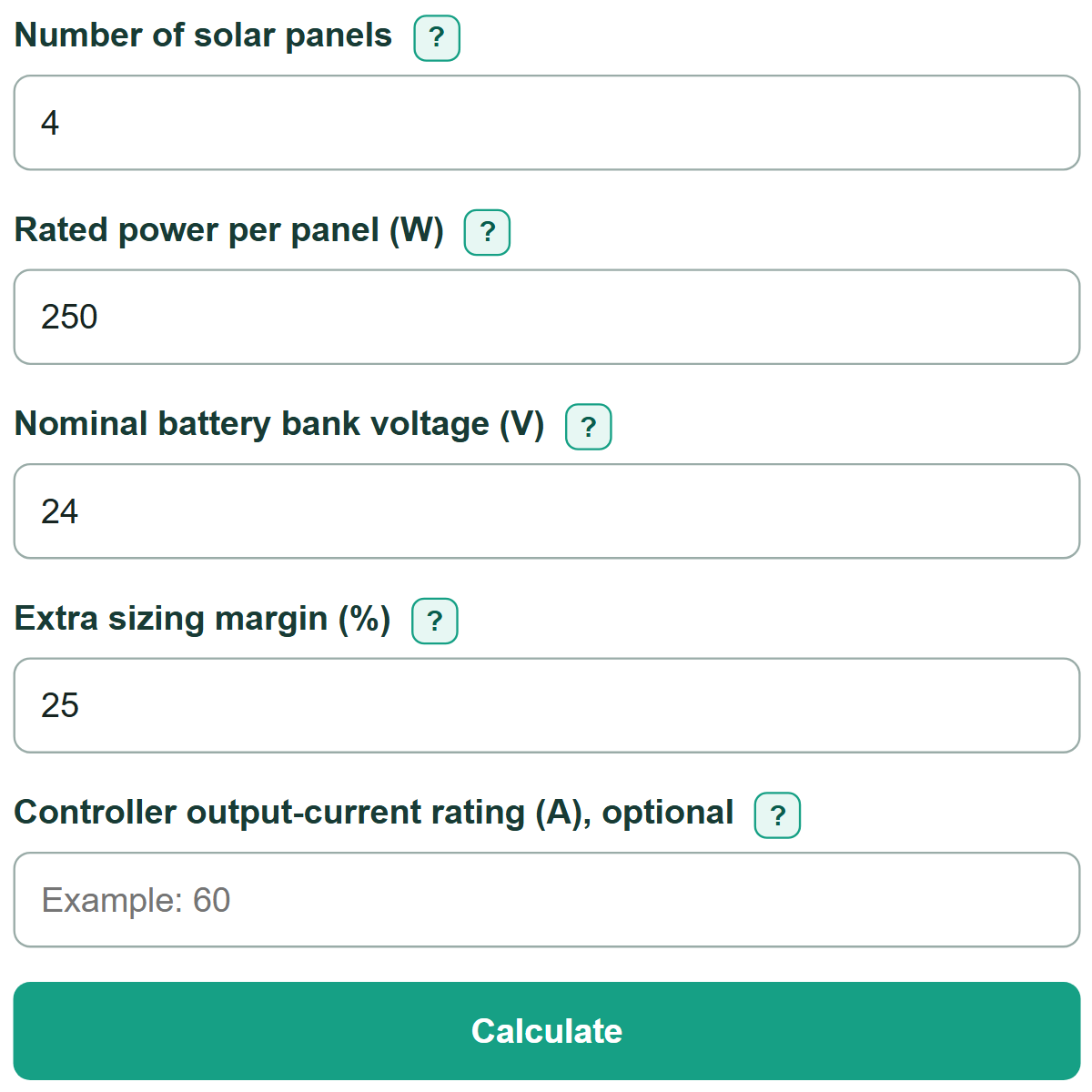
- Count the solar panels connected to the one controller you are sizing, then enter that number and the rated watts for one panel from its label or data sheet.
- Enter the nominal voltage of the full battery bank, such as 12 V, 24 V, or 48 V. If batteries are in series, use their combined bank voltage.
- Enter the extra sizing margin required by the controller instructions or applicable local electrical requirements.
- Optionally enter an existing controller's output-current rating, then select "Calculate" to see whether it meets this current estimate.
- Sanity-check the result: more panel watts or more panels should raise the estimated current, while a higher battery bank voltage should lower it. Separately verify PV input-voltage limits and battery-voltage support.
Definitions
MPPT: Maximum power point tracking. This controller method adjusts how it takes power from a solar array.
Rated power per panel: The labeled maximum power for one panel, often called Pmax, measured in watts (W).
Nominal battery bank voltage: The planned voltage of the complete battery bank, such as 12 V, 24 V, or 48 V.
Output current: Charging current delivered by the controller to the battery bank, measured in amps (A).
Extra sizing margin: A percentage added to the calculated current for the planning requirement you choose.
Common mistakes and quick fixes
Mistake: Entering the whole array's wattage as the power of one panel.
Fix: Enter the watt value for one panel. The calculator multiplies it by the number of panels.
Mistake: Using the voltage printed on one battery when batteries are wired in series.
Fix: Enter the nominal voltage of the complete battery bank, not one battery's voltage.
Mistake: Treating the extra sizing margin as a universal rule.
Fix: Use the percentage from the controller maker and applicable local requirements. Enter 0% only if that is your planned assumption.
Mistake: Assuming a controller that meets the current estimate is fully compatible.
Fix: Also check maximum PV input voltage, cold-weather open-circuit voltage, battery-voltage support, wiring, fuses, and installation requirements.
Mistake: Ignoring a negative capacity difference for an entered controller.
Fix: A negative "Controller current capacity above estimate" means the entered controller rating is below the estimate.
Limitations & Key Assumptions / Boundary Conditions
- This is a planning estimate based on rated panel power, nominal battery-bank voltage, and the margin you enter.
- It assumes every counted panel has the entered rated power and is connected to the controller being sized.
- It does not check array open-circuit voltage, cold-weather voltage rise, controller maximum PV input voltage, battery-voltage compatibility, wire size, fuses, disconnects, or local electrical requirements.
- Actual solar output can change with sunlight, temperature, shading, panel direction, dirt, and other system losses.
- A controller that meets the estimated output-current rating can still be unsuitable if its PV input-voltage or battery requirements do not match the system.
Methodology
Calculation method
The calculator first finds the combined rated power of panels connected to the controller.
total array power (W) = number of panels * rated power per panel (W)
It divides that power by the nominal voltage of the full battery bank to estimate output current before the selected margin.
base output current (A) = total array power (W) / nominal battery bank voltage (V)
It then applies the extra sizing margin once.
estimated minimum current (A) = base output current (A) * (1 + extra sizing margin (%) / 100)
Worked example
Four 250 W panels have 1,000 W of rated array power. On a 24 V battery bank, the current before margin is 1,000 / 24 = 41.6667 A. With a 25% margin, the estimated minimum controller output current is 41.6667 * 1.25 = 52.08 A.
If you enter a controller rating, the calculator subtracts the estimate from that rating. A positive difference is spare current capacity, zero meets the estimate exactly, and a negative difference is a shortfall.
controller capacity above estimate (A) = entered controller rating (A) - estimated minimum current (A)