
Estimate what your microwave costs to run using input watts, heating minutes, daily uses, and your electricity price.
Advanced options
Table of contents
How to use our Microwave Running Cost Calculator
- Enter Electrical input power (watts) from the microwave label, not the cooking wattage printed on the front.
- Enter Minutes used each time (minutes) and Uses per day as your average routine, such as 5 minutes and 2 uses per day.
- Enter Electricity price ($ per kWh) from your bill, using the total price if your bill separates supply and delivery charges.
- Open Advanced options only if you want to include Average power setting (percent), Standby clock power (watts), Plugged-in time (hours per day), or Days in billing month.
- Check whether Estimated cost for the month makes sense: microwave costs are often small because active cooking time is usually measured in minutes, not hours.
Definitions
Electrical input power (watts): The electric power the microwave draws from the outlet while running. This can be higher than the cooking power number advertised on the front.
Watt: A unit of power, which means how fast electricity is being used.
Kilowatt-hour (kWh): A unit of energy used on electric bills. One kWh is 1,000 watts used for 1 hour [1].
Electricity price ($ per kWh): The amount you pay for each kWh of electricity. Your own bill is the best place to find it because prices vary [2].
Average power setting (percent): The percent of full input power used during heating time. For this estimate, 50 percent means half the average active power.
Standby clock power (watts): The power used while the microwave is plugged in but not cooking, usually for the clock or display.
Plugged-in time (hours per day): The number of hours per day the microwave is connected to power, including both cooking time and idle time.
Common mistakes and quick fixes
Mistake: Using the front-panel cooking watts for Electrical input power (watts) .
Fix: Use the input watts on the appliance label near the cord, door frame, or back of the microwave.
Mistake: Entering seconds in Minutes used each time (minutes) , such as 30 for a 30-second warm-up.
Fix: Convert seconds to minutes, so 30 seconds is 0.5 and 2 minutes 30 seconds is 2.5.
Mistake: Treating Uses per day as uses per week.
Fix: Divide weekly uses by 7, so 10 uses per week is about 1.43 uses per day.
Mistake: Leaving Electricity price ($ per kWh) at the default when your local rate is much different.
Fix: Use the price from your electric bill, because electricity prices vary by location and plan.
Mistake: Setting Average power setting (percent) to 50 when you usually cook on full power.
Fix: Leave it at 100 unless you often choose a lower power level for the whole heating time.
Mistake: Comparing Standby clock cost for the month after entering a guessed Standby clock power (watts) .
Fix: Enter 0 if you do not know standby watts, or measure it with a plug-in power meter.
Limitations & Key Assumptions / Boundary Conditions
- The estimate depends on Electrical input power (watts). If you enter cooking watts instead of input watts, the cost will usually be too low.
- Average power setting (percent) is treated as average draw during heating time. Some microwaves lower power by cycling on and off, so short runs may not match the exact percent.
- Standby clock power (watts) is only as good as the number entered. Use 0 if you do not know it, or measure it with a plug-in power meter.
- The calculator does not model brief startup surges, fan-only time after cooking, door-open light time, or changes caused by food type and container.
- Estimated cost per year uses 365 days and assumes the same average use every day.
- Estimated cost for the month uses Days in billing month, so it may differ from a bill with taxes, fixed charges, time-of-use pricing, or tiered rates.
- If active cooking time is greater than Plugged-in time (hours per day), standby time is floored at 0 to avoid a negative standby cost.
Methodology
How the cost is calculated
The calculator first converts microwave use into active cooking hours per day. Minutes are divided by 60 because electricity cost uses hours.
active_hours_per_day = (minutes_per_use * uses_per_day) / 60
Then it converts watts to kilowatts by dividing by 1,000, applies the selected average power setting, and multiplies by active hours. Electric bills commonly use kilowatt-hours, or kWh [1].
active_kwh_per_day = (input_watts / 1000) * (power_setting_percent / 100) * active_hours_per_day
If standby power is entered, the calculator subtracts active cooking time from plugged-in time and floors standby hours at 0 so idle energy cannot be negative.
standby_hours_per_day = max(0, plugged_hours_per_day - active_hours_per_day)
standby_kwh_per_day = (standby_watts / 1000) * standby_hours_per_day
Total daily energy is active energy plus standby energy. Cost is energy multiplied by your electricity price, which can vary by customer and location [2]. Appliance running cost estimates are normally based on energy use and an electricity cost per unit [3].
daily_energy_kwh = active_kwh_per_day + standby_kwh_per_day
daily_cost = daily_energy_kwh * electricity_rate
monthly_cost = daily_cost * billing_days
yearly_cost = daily_cost * 365
Cost per cooking minute excludes standby cost because it is meant to price one extra minute of active heating.
cost_per_cooking_minute = (input_watts / 1000) * (power_setting_percent / 100) * electricity_rate / 60
Worked mini-example
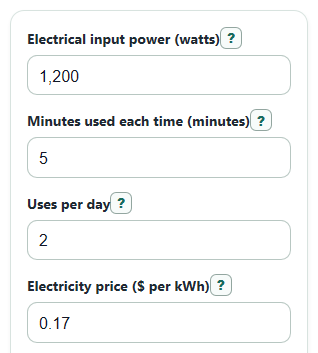
With 1,200 input watts, 5 minutes per use, 2 uses per day, full power, no standby power, and $0.17 per kWh: active time is 10 minutes per day, or 0.1667 hours. Active energy is 1.2 kW times 0.1667 hours, which is 0.2 kWh per day. Daily cost is 0.2 times $0.17, or $0.034. With 30.4375 billing days, the month estimate is about $1.03.