
Estimate how much your electric dryer costs per load, week, month, and year using the number you actually know.
Advanced options
Table of contents
How to use our Dryer Running Cost Calculator
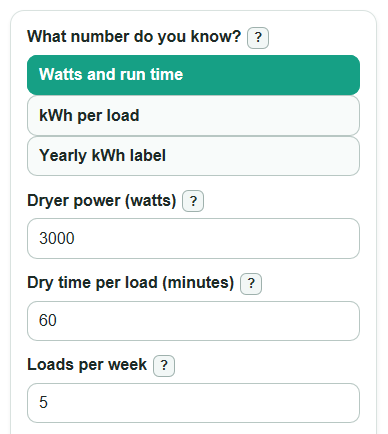
- Choose What number do you know?: Watts and run time, Energy per load (kWh), or Yearly energy from label (kWh per year).
- Fill in the visible energy fields, then enter Loads per week and Electricity price ($ per kWh).
- Open Advanced options only if you want to include Loads run at cheaper price (percent), Cheaper electricity price ($ per kWh), or compare Other dryer energy per load (kWh).
- Select Calculate and read Cost per load first, then Yearly cost, Monthly cost, Weekly cost, Energy per load, and Yearly energy.
- Sanity-check the result: if Electricity price ($ per kWh) is above 2, you may have typed cents instead of dollars, such as 18.2 instead of 0.182.
Definitions
kWh: Kilowatt-hour. It is energy used over time. Using 1000 watts for 1 hour uses 1 kWh.
Dryer power (watts): The electric power rating used in the watts-and-time method. Higher watts and longer time make Energy per load go up.
Energy per load (kWh): The electricity used by one dryer cycle. This can come from the calculator's watt-time math or from a meter, smart panel, or appliance app.
Yearly energy from label (kWh per year): The annual energy number from an EnergyGuide-style label. It is useful for comparing dryers because it uses a standard label estimate.
Electricity price ($ per kWh): The price you pay for each kWh of electricity. If your bill lists cents per kWh, divide by 100 before entering it.
Blended electricity price: The average price after mixing regular-price loads and cheaper off-peak loads.
Simple payback time: The extra upfront cost divided by yearly operating savings. It is shown only when the other dryer saves money each year.
Common mistakes and quick fixes
Mistake: Typing cents into Electricity price ($ per kWh), such as 18.2 for 18.2 cents.
Fix: Enter dollars per kWh instead, so 18.2 cents becomes 0.182.
Mistake: Using the dryer label wattage in Dryer power (watts) and assuming the heater stays on at full power the whole cycle.
Fix: If you have measured data, switch What number do you know? to Energy per load (kWh) for a better estimate.
Mistake: Counting every laundry load in Loads per week even when some loads are air dried.
Fix: Count only loads that actually use the dryer.
Mistake: Entering Yearly energy from label (kWh per year) and expecting it to match a household that does far more or far less laundry than the label test.
Fix: Treat Check this estimate as a reminder that label-based results are best for comparing dryers, not proving your exact bill.
Mistake: Filling Cheaper electricity price ($ per kWh) but leaving Loads run at cheaper price (percent) blank.
Fix: Enter the percent of dryer loads run at the cheaper price, or leave both off-peak fields blank.
Mistake: Reading Yearly savings with other dryer as guaranteed cash back.
Fix: Use it as an electricity-cost comparison only; a negative value means the other dryer costs more to run.
Limitations & Key Assumptions / Boundary Conditions
- This estimates electricity cost for an electric dryer. It does not estimate gas cost for a gas dryer.
- The watts-and-run-time method is a rough estimate because many dryers cycle the heater on and off during a load.
- EnergyGuide label results use the entered yearly kWh number as a standard annual estimate. Your household can differ if you dry many more or fewer loads.
- Electricity price should be your all-in price per kWh if possible. Fixed monthly charges, taxes, demand charges, and credits may not scale with dryer use.
- The off-peak option assumes the entered percent of loads all use the cheaper price. It does not model separate weekend, peak, or tiered rates.
- Upgrade savings compare electricity use only. They do not include repair costs, dryer life, vent cleaning, rebates, taxes, financing, or changes in drying habits.
- Monthly cost is a simple yearly average divided by 12, so real monthly bills can move with laundry volume and electricity rates.
Methodology
Energy used by one load
The calculator first picks the energy method from What number do you know?. For watts and time, it converts watts to kilowatts and minutes to hours.
energy_per_load_kwh = (power_watts / 1000) * (minutes_per_load / 60)
If you choose Energy per load (kWh), the entered kWh number is used directly.
energy_per_load_kwh = kwh_per_load_input
If you choose Yearly energy from label (kWh per year), the yearly kWh is used directly for yearly energy, then divided across your weekly load count to estimate one load.
annual_energy_kwh = annual_kwh_input
energy_per_load_kwh = annual_energy_kwh / (loads_per_week * 52)
Yearly energy and blended price
For the two per-load methods, yearly energy is based on your Loads per week.
annual_energy_kwh = energy_per_load_kwh * loads_per_week * 52
If no off-peak entries are used, the Blended electricity price equals Electricity price ($ per kWh). If Loads run at cheaper price (percent) is entered, the calculator mixes the regular price and Cheaper electricity price ($ per kWh).
effective_rate = (off_peak_percent / 100) * off_peak_rate + (1 - off_peak_percent / 100) * electricity_rate
Cost outputs
Cost per load is the main answer. Weekly, yearly, and monthly costs are built from the same energy and price values.
cost_per_load = energy_per_load_kwh * effective_rate
weekly_cost = cost_per_load * loads_per_week
annual_cost = annual_energy_kwh * effective_rate
monthly_cost = annual_cost / 12
Other dryer comparison
When Other dryer energy per load (kWh) is entered, savings are based on the difference in kWh per load. Positive savings mean the other dryer costs less to run. Negative savings mean it costs more to run.
upgrade_annual_savings = (energy_per_load_kwh - new_dryer_kwh_per_load) * loads_per_week * 52 * effective_rate
If Extra upfront cost ($) is entered and yearly savings are positive, simple payback is calculated.
upgrade_payback_years = extra_upfront_cost / upgrade_annual_savings
Mini example
A 3000 watt dryer running 60 minutes uses 3.0 kWh per load. At $0.182 per kWh, Cost per load is 3.0 * 0.182 = $0.55. With 5 loads per week, Yearly energy is 3.0 * 5 * 52 = 780 kWh, and Yearly cost is 780 * 0.182 = $141.96.
Validation choices
Visible required fields must be filled and greater than 0 where a zero value would break the calculation. Optional advanced fields are ignored when blank, but nonblank invalid entries show an error. If Electricity price ($ per kWh) is greater than 2, the calculator still runs but shows a note because that often means cents were entered instead of dollars.