
Enter your energy costs and air-sealing plan to estimate annual heating and cooling bill savings and simple payback.
Project price
Table of contents
How to use our Air Sealing Savings Calculator
- Choose "Annual heating and cooling cost" if you know that yearly amount. Choose "Whole-home annual energy bill" if your bill includes heating, cooling, appliances, lighting, and other home energy use.
- Enter the requested annual cost for your selected path. For the whole-home path, also enter the percent used for heating and cooling.
- Enter the expected heating and cooling cost reduction from an energy assessment, contractor proposal, or your own planning scenario.
- Enter the air-sealing project cost before rebates or credits.
- Enter only confirmed rebates or credits. Enter 0 if there are none.
- Select "Calculate." Start with estimated annual heating and cooling bill savings, then review the cost basis, monthly average, net project cost, and simple payback.
- For a quick check, make sure the whole-home path does not apply savings to appliance and lighting costs, and treat the result as an estimate rather than a guaranteed bill reduction.
Definitions
Air sealing: Closing unintended gaps and cracks in a home's exterior shell that let air move in or out.
Heating and cooling cost basis: The yearly heating and cooling cost used for the savings calculation. It is entered directly or found by multiplying a whole-home bill by the heating and cooling share.
Expected heating and cooling cost reduction: The percent decrease used in the scenario. For example, 15% applies a 15% reduction to the heating and cooling cost basis.
Net project cost: Project cost minus confirmed rebates or credits.
Simple payback: Net project cost divided by estimated annual savings. It estimates how many years of savings equal the net cost without including financing or the time value of money.
Common mistakes and quick fixes
Mistake: Applying the expected reduction to the entire home energy bill even though it includes appliances, lighting, and other uses.
Fix: Choose "Whole-home annual energy bill" and enter the heating and cooling share, or enter your annual heating and cooling cost directly.
Mistake: Including fixed utility customer charges that may stay the same after air sealing.
Fix: Exclude fixed charges when practical and use the part of the bill that can change with energy use.
Mistake: Counting a possible rebate or tax credit as confirmed.
Fix: Enter only an incentive you have confirmed for this project. Enter 0 until you know the amount and eligibility.
Mistake: Treating an expected reduction as a guaranteed result.
Fix: Use a home-specific assessment or proposal when available, and use the calculator result for planning.
Limitations & Key Assumptions / Boundary Conditions
- This is a bill-based planning estimate, not a home energy model or a guarantee of utility savings.
- Actual savings can change with weather, energy prices, thermostat settings, equipment performance, installation quality, and household energy use.
- Fixed utility customer charges may not decrease after air sealing, so exclude them from the annual cost when practical.
- The whole-home bill path depends on the heating and cooling share entered. An inaccurate share can overstate or understate savings.
- Simple payback does not include financing, maintenance, energy-price changes, tax effects, comfort value, or the time value of money.
- Air sealing can affect ventilation, moisture, radon, and combustion safety. Major work should be considered as part of a whole-house approach. [1][1]
Methodology
Calculation method
The calculator finds the annual heating and cooling cost that air sealing could affect. With the whole-home bill path, it first removes the entered share for appliances, lighting, and other non-heating and cooling uses.
heating and cooling cost basis = annual heating and cooling cost
heating and cooling cost basis = whole-home annual energy bill x heating and cooling share / 100
annual savings = heating and cooling cost basis x expected reduction / 100
average monthly savings = annual savings / 12
net project cost = project cost - confirmed rebates or credits
simple payback = net project cost / annual savings
Worked example
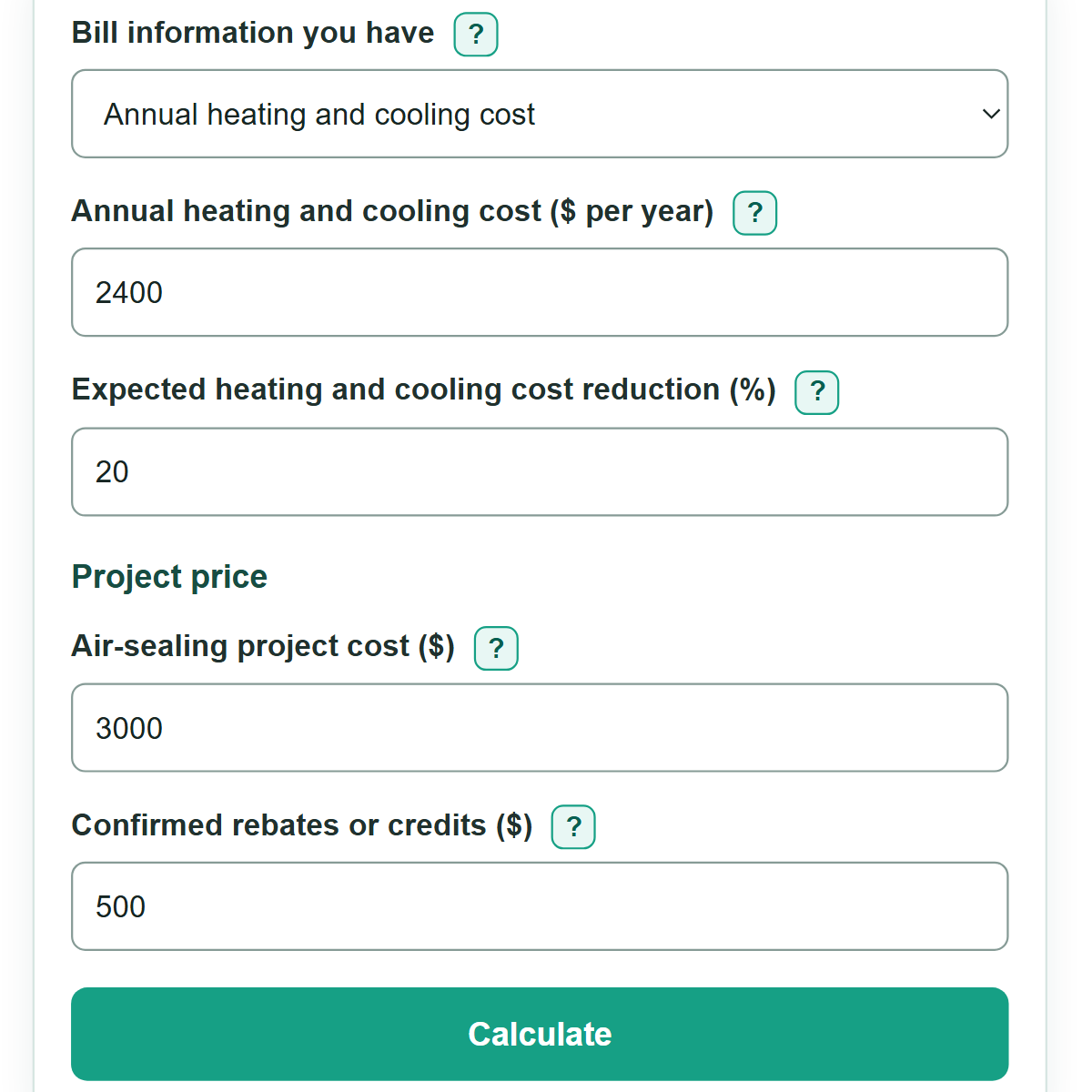
With a $2,400 annual heating and cooling cost and a 20% expected reduction, estimated annual savings are $480.00. A $3,000 project cost minus $500 in confirmed incentives gives a $2,500.00 net project cost. Average monthly savings are $40.00, and simple payback is 5.2 years.
Payback edge cases
If confirmed incentives equal the project cost, net project cost is $0.00 and payback is 0.0 years. If annual savings are $0.00 while net project cost is positive, there is no finite simple payback.