
Estimate the daily, monthly, and yearly electric bill cost for one or more ceiling fans using watts or an EnergyGuide label.
Advanced options
Table of contents
How to use our Ceiling Fan Running Cost Calculator
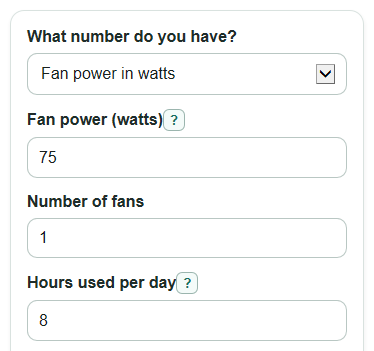
- Choose What number do you have?: Fan power in watts if you know the fan watts, or EnergyGuide yearly cost if you have the label dollar amount.
- Enter Number of fans, Hours used per day, and Electricity price ($ per kWh) from your electric bill or a good local estimate.
- Open Advanced options only if you want to adjust Power used (percent of listed watts), add Light kit power (watts per fan), or change Days in one running month and Months used per year.
- Click Calculate, then read Estimated cost for one running month first because it is the closest match to a normal electric bill.
- Sanity-check the result by looking at Power counted for each fan and Electricity used in one running month; a big jump usually means lights, fan count, hours, or the rate were entered too high.
Definitions
Fan power (watts): The electric power the fan motor uses while running. A higher watt number means more electricity use each hour.
EnergyGuide yearly cost ($): The yearly cost printed on the yellow label. The calculator uses it to estimate fan watts, then recalculates cost using your hours, rate, fan count, and season.
Electricity price ($ per kWh): The amount you pay for one kilowatt-hour of electricity. Electric bills usually charge energy use in kilowatt-hours.
Kilowatt-hour (kWh): A unit of energy. A 1000 watt device running for 1 hour uses 1 kWh.
Power used (percent of listed watts): An adjustment for measured lower or higher fan power. It is not a comfort level unless you know the watts for that speed.
Power counted for each fan: The watts the calculator uses for one fan after the percent setting and any Light kit power (watts per fan) are added.
Common mistakes and quick fixes
Mistake: Leaving Electricity price ($ per kWh) at the default when your bill rate is very different.
Fix: Replace Electricity price ($ per kWh) with your all-in bill price if you know it, or use a local average only as a rough estimate.
Mistake: Choosing EnergyGuide yearly cost when you actually have Fan power (watts).
Fix: Set What number do you have? to Fan power in watts and enter the watt value in Fan power (watts).
Mistake: Adding Light kit power (watts per fan) when the lights are not on during the fan hours.
Fix: Keep Light kit power (watts per fan) at 0 unless the light runs for the same Hours used per day.
Mistake: Using Hours used per day for a whole month instead of one typical day.
Fix: Enter the average daily fan time in Hours used per day, then use Days in one running month for the billing-cycle length.
Mistake: Setting Power used (percent of listed watts) to a speed level without measured watts.
Fix: Keep Power used (percent of listed watts) at 100 unless you have a real watt reading or a manual that lists power by speed.
Limitations & Key Assumptions / Boundary Conditions
- The estimate is for electricity only. It does not include fan purchase price, installation, repairs, taxes that are not part of your $ per kWh rate, or demand charges.
- EnergyGuide yearly cost mode reverse-calculates an estimated watt value from a rounded label cost, so it may not match a measured watt meter exactly.
- The calculator assumes each entered fan uses the same Power counted for each fan and runs for the same Hours used per day.
- Light kit power is counted only when you enter it, and it is assumed to run for the same hours as the fan.
- Days in one running month is not calendar-aware. Use your actual bill-cycle days if you want a closer monthly bill estimate.
- Fan speed, motor type, remote controls, and real voltage can change actual watts. Use a plug-in watt meter or manufacturer power table when you need a tighter estimate.
- A ceiling fan can help people feel cooler, but it does not lower room air temperature by itself. Turn it off in empty rooms if comfort is the only reason it is running.
Methodology
How the calculator finds cost
The calculator first finds the watts counted for one fan. In watts mode, it uses Fan power (watts), Power used (percent of listed watts), and Light kit power (watts per fan).
power_used_per_fan_w = fan_watts * (power_percent / 100) + light_watts_per_fan
It then multiplies by Number of fans and Hours used per day, and divides by 1000 to convert watts to kilowatts.
daily_kwh = power_used_per_fan_w * fan_count * hours_per_day / 1000
daily_cost = daily_kwh * electricity_rate
monthly_energy = daily_kwh * days_per_month
monthly_cost = monthly_energy * electricity_rate
yearly_cost = daily_kwh * days_per_month * months_per_year * electricity_rate
cost_per_hour_all_fans = power_used_per_fan_w * fan_count / 1000 * electricity_rate
EnergyGuide mode
If "What number do you have?" is "EnergyGuide yearly cost", this reverses the FTC ceiling-fan label method: 6.4 hours per day, 365 days, and $0.12 per kWh [3]. These are label assumptions, not your current tariff. Because label dollars are rounded, inferred watts are approximate; use "Fan power in watts" when measured or listed watts are available, or when the label uses different assumptions.
label_watts = (energyguide_yearly_cost / 0.12) * 1000 / (6.4 * 365)
power_used_per_fan_w = label_watts * (power_percent / 100) + light_watts_per_fan
Mini example
For 1 fan at 75 watts, 8 hours per day, and $0.17 per kWh, the daily energy is 75 * 1 * 8 / 1000 = 0.6 kWh. The daily cost is 0.6 * $0.17 = $0.102, and the default running-month cost is 0.6 * 30.4375 * $0.17 = $3.10. The yearly cost with 12 running months is $37.26.
Calculation notes
The default Days in one running month is 30.4375, which equals 365.25 / 12. The default Electricity price ($ per kWh) is only a starter value; residential electricity prices vary by place and time, so your bill rate is the better input [2]. Hidden mode fields are not used in the math: Fan power (watts) is ignored in EnergyGuide mode, and EnergyGuide yearly cost ($) is ignored in watts mode.
Sources
- Fans for Cooling | Department of Energy - Energy
- Electric Power Monthly - U.S. Energy Information Administration (EIA) - EIA
- U.S. DOE (EERE) - FTC EnergyGuide label cost calculation method (includes ceiling fan example; $/kWh assumption) - Energy
- U.S. DOE - Ceiling fan test procedure notice (explains EnergyGuide metrics incl. Estimated Yearly Energy Cost) - Energy