
Estimate furnace running cost from BTU rating, efficiency, run time, fuel price, and optional blower electricity.
Advanced options
Table of contents
How to use our Furnace Running Cost Calculator
- Choose the Fuel type: natural gas, propane, or electric resistance.
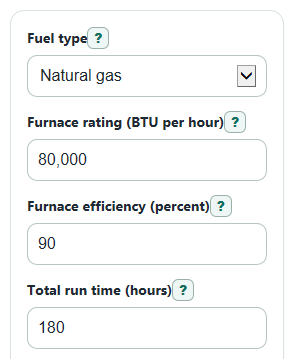
- Enter the Furnace rating (BTU per hour), Furnace efficiency (percent), Total run time (hours), and Fuel price ($ per selected fuel unit).
- Open Advanced options if needed, then set What the BTU number means, Blower fan power (watts), Electricity price ($ per kWh), or Fixed bill charge ($).
- Click Calculate and read Total running cost first, then compare Fuel used, Average cost per running hour, and Cost for each million BTU of heat.
- Sanity-check the result by making sure the fuel unit matches your bill: therms for natural gas, gallons for propane, or kWh for electric resistance.
Definitions
BTU per hour: A heat energy rate. A higher number means the furnace uses or delivers more heat each hour it runs.
Furnace efficiency (percent): The percent of fuel energy that becomes useful heat sent into the home. For furnaces, this is often shown as AFUE.
Fuel input rating: A furnace rating that describes how much fuel energy the furnace burns each hour.
Heat output rating: A furnace rating that describes how much useful heat the furnace sends into the home each hour.
Therm: A natural gas billing unit equal to 100,000 BTU of energy.
kWh: Kilowatt-hour, a unit used on electric bills. Electric resistance heating and blower fan electricity are measured in kWh.
Million BTU: One million BTU of heat energy. The calculator uses this to compare fuel cost for the same useful heat.
Common mistakes and quick fixes
Mistake: Using an output BTU value in Furnace rating (BTU per hour) while What the BTU number means is set to fuel used.
Fix: If the furnace label says output, heating capacity, or heat sent into the home, change What the BTU number means to heat sent into the home.
Mistake: Entering a monthly bill total in Fuel price ($ per selected fuel unit) instead of a unit price.
Fix: Use dollars per therm for natural gas, dollars per gallon for propane, or dollars per kWh for electric resistance.
Mistake: Putting calendar time in Total run time (hours) , such as 720 hours for a month, when the furnace did not run nonstop.
Fix: Enter only the hours the furnace actually ran during the period.
Mistake: Leaving Furnace efficiency (percent) at 100 for a gas or propane furnace that has an AFUE rating below 100.
Fix: Use the AFUE percent from the furnace label, manual, or service paperwork.
Mistake: Adding fan power in Blower fan power (watts) but leaving an old or blank value in Electricity price ($ per kWh) .
Fix: Enter your electric rate, or set Blower fan power (watts) to 0 if you do not want fan electricity included.
Mistake: Adding a whole gas bill service fee to Fixed bill charge ($) when the furnace is only part of the bill.
Fix: Use 0, or enter only the fixed charge amount you want assigned to this furnace estimate.
Limitations & Key Assumptions / Boundary Conditions
- The result is an estimate for the run time you enter. It does not predict how many hours your furnace will run in a real month.
- Fuel prices can include taxes, delivery fees, tiered rates, or discounts. The calculator uses the unit price you enter.
- The efficiency value is treated as one steady percent. Real furnace efficiency can change with cycling, duct losses, maintenance, and outdoor temperature.
- If What the BTU number means is wrong, fuel use and cost can be too high or too low.
- Fixed bill charge ($) is added once to the period. Do not use it for charges that are already included in the unit fuel price.
- Blower fan cost assumes the fan runs for the same hours as the furnace and uses the steady Blower fan power (watts) entered.
- For electric resistance heat, the calculator treats electricity as the heating fuel and still lets you add separate blower electricity if you choose.
Methodology
Calculation steps
The calculator first turns Furnace efficiency (percent) into a decimal.
eff_decimal = efficiency_percent / 100
If What the BTU number means is fuel used by furnace, the BTU rating is treated as fuel input.
fuel_energy_btu = furnace_btu_per_hour * total_run_hours
delivered_heat_btu = fuel_energy_btu * eff_decimal
If What the BTU number means is heat sent into the home, the BTU rating is treated as useful heat output.
delivered_heat_btu = furnace_btu_per_hour * total_run_hours
fuel_energy_btu = delivered_heat_btu / eff_decimal
The fuel energy is then converted to the selected billing unit. The calculator uses 100,000 BTU per therm of natural gas, 91,452 BTU per gallon of propane, and 3,412 BTU per kWh of electricity.
fuel_units_used = fuel_energy_btu / fuel_heat_content_btu_per_unit
fuel_cost = fuel_units_used * fuel_price
Optional blower electricity is added only from the blower fields.
blower_electric_cost = (blower_watts / 1000) * total_run_hours * electricity_price
The main cost outputs are then calculated from the fuel cost, optional blower cost, and optional fixed charge.
total_cost = fuel_cost + blower_electric_cost + fixed_charge
cost_per_hour = total_cost / total_run_hours
delivered_heat_mmbtu = delivered_heat_btu / 1000000
cost_per_delivered_mmbtu = total_cost / delivered_heat_mmbtu
Worked example
For a natural gas furnace rated at 80,000 BTU per hour, 90 percent efficiency, 180 run hours, and $1.25 per therm, with the BTU number set to fuel used by furnace, fuel energy is 14,400,000 BTU. That is 144 therms. Fuel cost is 144 * $1.25 = $180. Useful heat is 14,400,000 * 0.90 = 12,960,000 BTU, or 12.96 million BTU. With no blower cost or fixed charge, Total running cost is $180, Average cost per running hour is $1.00, and Cost for each million BTU of heat is about $13.89.
How to read the outputs
Total running cost is the all-in estimate for the period you entered. Fuel cost only leaves out optional blower electricity and fixed bill charge. Fuel used helps compare the estimate with a gas bill, propane refill, or electric bill. Cost for each million BTU of heat is useful when comparing fuels or efficiency settings because it looks at useful heat delivered to the home.