
Estimate LED lumens, candela, lux, and beam spot width from datasheet values or a lux meter reading.
An LED count, such as 72 LEDs, does not tell you a lamp’s brightness. Use its rated lumens with “Lumens”, or its intensity and beam angle with “Datasheet intensity”. Do not enter the LED count as “LED intensity”.
Table of contents
How to use our LED Brightness Calculator
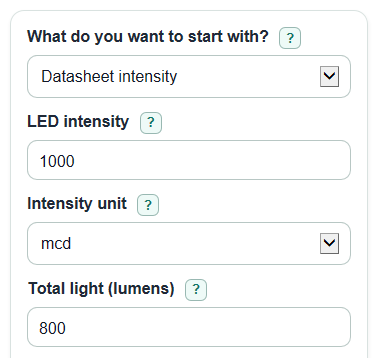
- Choose What do you want to start with? based on the value you already have: LED intensity, Total light, or Lux meter reading.
- Enter Full beam angle and the distance value that matches your setup. Use the full datasheet angle, not half the angle.
- If you start with LED intensity, pick the correct Intensity unit because 1000 mcd equals 1 cd.
- Open Advanced options only when you need Number of matching LEDs, Light lost in lens or cover, or a different Number format.
- Click Calculate, then sanity-check the results: a smaller Full beam angle should raise Beam-center intensity and Estimated light on target, while a longer Target distance should lower lux.
Definitions
LED intensity: The brightness number from a datasheet, usually in mcd or cd. Many visible LED datasheets give luminous intensity in millicandela [3].
mcd: Millicandela. It is one thousandth of a candela, so 1000 mcd equals 1 cd [4].
cd: Candela. It measures light strength in one direction, so a narrow LED can have a high cd value even if its total light is small.
lm: Lumen. It measures total visible light output from the beam or source.
lx: Lux. It measures light landing on a surface, so it changes with distance and beam spread.
Full beam angle: The whole cone angle of the LED beam, measured across the beam, not from the center line to one side.
sr: Steradian. It measures 3D beam spread. A smaller sr value means the same light is packed into a tighter cone.
Scientific notation: A short way to show very small or very large numbers, such as 2.5e-4 for 0.00025.
Common mistakes and quick fixes
Mistake: Entering a millicandela value in LED intensity but leaving Intensity unit set to cd.
Fix: Set Intensity unit to mcd when the datasheet says mcd, or divide the LED intensity by 1000 before using cd.
Mistake: Using half the viewing angle for Full beam angle.
Fix: Enter the full angle printed in the datasheet, such as 30 for a 30 degree LED.
Mistake: Mixing up Target distance and Lux reading distance in Lux meter reading mode.
Fix: Put the meter test distance in Lux reading distance and the surface you care about in Target distance.
Mistake: Treating Estimated total light as how bright the center spot looks.
Fix: Use Beam-center intensity and Estimated light on target to judge the hot spot at a distance.
Mistake: Using Number of matching LEDs when the LEDs point in different directions.
Fix: Use Number of matching LEDs only for LEDs aimed the same way with the same beam angle.
Mistake: Leaving Light lost in lens or cover at 0 when a diffuser blocks some light.
Fix: Enter a reasonable loss percent, such as 10, if the lens or cover reduces the light before it leaves the fixture.
Limitations & Key Assumptions / Boundary Conditions
- The math assumes a round, even cone beam. Real LEDs often have a center hot spot, rings, color shift, or a soft edge.
- Datasheet LED intensity is usually measured at a stated current and temperature. Changing current, heat, or LED bin can change the real result.
- Beam spot width is a geometry estimate. Beam angles near or above 180 degrees can make the flat-surface spot estimate less useful.
- Lux meter mode assumes the meter was on the beam center and pointed correctly at the LED.
- Number of matching LEDs assumes the LEDs point the same way and overlap at the target. Wide spacing can make the real pattern uneven.
- Light lost in lens or cover is a simple percent reduction. It does not model how a lens can also change the beam angle.
- The inverse-square lux estimate works best when the LED or LED group is small compared with the distance to the target.
Methodology
Core unit conversions
The calculator keeps the light math in candela, lumens, lux, meters, and steradians. Candela, lux, and lumens are separate ways to describe light [2]. If the LED intensity input is in mcd, it is converted to cd first.
cd = mcd / 1000
The full beam angle is changed from degrees to radians before using trigonometry.
θ = Full beam angle * pi / 180
For a round cone beam, the beam spread is the solid angle ω (beam spread in steradians).
ω = 2 * pi * (1 - cos(θ / 2))
How each start mode is solved
In Datasheet intensity mode, one LED candela value is multiplied by Number of matching LEDs and reduced by Light lost in lens or cover. That gives the total beam-center intensity used for lux.
cd_total = cd_each * Number of matching LEDs * (1 - Light lost in lens or cover / 100)
Estimated total light = cd_each * ω * Number of matching LEDs * (1 - Light lost in lens or cover / 100)
In Lumens mode, Total light is treated as the total light already available after any real-world losses you included in that number.
Beam-center intensity = Total light / ω
In Lux meter reading mode, the center candela is found from the measured lux and the Lux reading distance. The same inverse-square idea is used when estimating lux at a different Target distance [1].
Beam-center intensity = Lux meter reading * Lux reading distance ^ 2
Estimated total light = Beam-center intensity * ω
Target results
Estimated light on target is calculated from center candela and Target distance.
Estimated light on target = Beam-center intensity / Target distance ^ 2
Approximate beam spot width uses the same full beam angle and the target distance.
Approximate beam spot width = 2 * Target distance * tan(θ / 2)
If Number of matching LEDs is more than 1, Estimated light per LED is the total lumens divided by the LED count.
Estimated light per LED = Estimated total light / Number of matching LEDs
Worked mini-example
For the default example, LED intensity is 1000 mcd, which becomes 1 cd. With a 30 degree Full beam angle, ω is about 0.214 sr. Estimated total light is 1 * 0.214 = 0.214 lm. At a Target distance of 2 m, Estimated light on target is 1 / 2^2 = 0.25 lx. The Approximate beam spot width is about 1.07 m.