
Use this battery energy calculator to convert Ah or mAh labels into Wh, kWh, needed capacity, and runtime.
Advanced options
Table of contents
How to use our Battery Energy Calculator
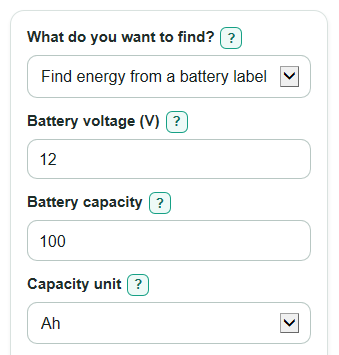
- Choose What do you want to find?: Find energy from a battery label, Find battery size from energy, or Estimate runtime.
- Enter Battery voltage (V) using the nominal battery voltage on the label, then fill in Battery capacity and Capacity unit or Energy amount and Energy unit as shown.
- For runtime, enter Load power (W) as the device's average power use, not its short startup surge.
- Open Advanced options only if you want to change Usable battery amount (percent), Runtime efficiency (percent), Number format, or Decimal places.
- Sanity-check the result: a 12 V 100 Ah battery should be about 1200 Wh, and a 3.7 V 26800 mAh power bank should be about 99 Wh.
Definitions
Battery voltage (V): The nominal electrical pressure of the battery. Use the voltage on the battery label, not the charger output.
Battery capacity: The charge amount on the label. It is usually shown in Ah for larger batteries or mAh for small packs.
Ah: Amp-hours. This measures charge, not energy by itself.
mAh: Milliamp-hours. 1000 mAh equals 1 Ah.
Wh: Watt-hours. This measures stored energy and is the best number for comparing batteries with different voltages.
kWh: Kilowatt-hours. 1 kWh equals 1000 Wh, so it is easier to read for large battery banks.
Load power (W): The average watts used by the device you want to run.
Usable battery amount (percent): The part of the rated battery energy you plan to use.
Runtime efficiency (percent): The percent of usable energy that reaches the load after conversion losses.
Common mistakes and quick fixes
Mistake: Using charger voltage in Battery voltage (V).
Fix: Use the nominal battery voltage printed on the battery, such as 3.7 V, 12 V, 24 V, or 48 V.
Mistake: Typing a mAh number in Battery capacity while leaving Capacity unit set to Ah.
Fix: If the label says mAh, set Capacity unit to mAh before calculating.
Mistake: Comparing Battery capacity numbers across different voltages.
Fix: Compare Rated battery energy in Wh, because voltage changes how much energy the same Ah number holds.
Mistake: Entering peak watts in Load power (W) for runtime.
Fix: Use the average watts the device uses over time, or the Estimated runtime can look too short.
Mistake: Leaving Usable battery amount (percent) at 100 when you only plan to use part of the battery.
Fix: Enter the planned usable percent, such as 80, so Usable energy after your setting matches your plan.
Mistake: Treating the Lithium-ion flight note as final airline approval.
Fix: Use the note as a quick Wh check, then confirm the rule with your airline before travel.
Limitations & Key Assumptions / Boundary Conditions
- The calculator uses nominal Battery voltage (V). Real battery voltage changes while charging and discharging, so measured energy can differ.
- Battery capacity labels are rated values. Age, temperature, discharge rate, and battery management settings can lower usable energy.
- Estimated runtime uses average Load power (W). Devices with changing power use can run longer or shorter than the result.
- Runtime efficiency (percent) is a planning estimate for conversion losses. It does not model a specific inverter, USB converter, or motor controller curve.
- The Lithium-ion flight note is a quick watt-hour check for common spare lithium-ion batteries and power banks. Airline, country, device type, and installed-vs-spare rules can change what is allowed.
- Results are rounded for display. Use more Decimal places if small differences matter.
Methodology
Core energy math
The calculator first puts the label into amp-hours and watt-hours. Amp-hours tell charge. Watt-hours tell energy, so voltage is needed before batteries with different voltages can be compared.
capacity_ah = capacity_mah / 1000
rated_energy_wh = voltage_v * capacity_ah
rated_energy_kwh = rated_energy_wh / 1000
If the user enters energy in kWh, the calculator changes it to Wh before finding the matching battery size.
energy_wh = energy_kwh * 1000
needed_capacity_ah = energy_wh / voltage_v
needed_capacity_mah = needed_capacity_ah * 1000
Usable energy and runtime
Usable energy applies the Usable battery amount (percent). Runtime also applies Runtime efficiency (percent), then divides by Load power (W).
usable_energy_wh = rated_energy_wh * usable_percent / 100
runtime_hours = usable_energy_wh * runtime_efficiency_percent / 100 / load_power_w
Worked mini-example
For a 12 V battery labeled 100 Ah, rated energy is 12 * 100 = 1200 Wh, which is 1.2 kWh. If Usable battery amount (percent) is 80 and Runtime efficiency (percent) is 90, usable energy is 960 Wh and a 150 W load runs for 960 * 0.90 / 150 = 5.76 hours.
Flight note method
The lithium-ion flight note compares Rated battery energy with common FAA passenger thresholds: under 100 Wh, 100 Wh through 160 Wh, and above 160 Wh. At exactly 100 Wh or 160 Wh, the note uses stricter wording so the user knows to check approval at the boundary [1].
Unit relationship
One watt-hour equals 3600 joules because one watt is one joule per second and one hour is 3600 seconds.
energy_j = energy_wh * 3600