
Enter your battery rating, charging rate, and charge levels to estimate how long it will take to reach your target.
Advanced options
Table of contents
How to use our Battery Charge Time Calculator
- Choose "Capacity and current" if your labels show mAh and mA or Ah and A. Choose "Energy and power" only for a matched Wh and W pair.
- Copy the battery rating and the charging current or power from the battery, device, charger, or manual. Use the rate the device actually accepts when you know it.
- Enter "Starting charge (%)" and "Target charge (%)" for this charging session. The target can equal the starting charge.
- Open "Advanced options" only if you have a documented or measured value for "Charging efficiency (%)". Leave it blank if you do not know it.
- Select "Calculate," then check that "Charge or energy to add" fits the percentage gap you entered before using the estimated time.
Definitions
mAh (milliamp-hour): A unit of battery charge capacity. 1,000 mAh equals 1 Ah.
Ah (amp-hour): A unit of battery charge capacity often printed on larger batteries.
Wh (watt-hour): A unit of stored electrical energy.
Charging current: The rate of charge flow, shown in mA or A.
Charging power: The rate of energy transfer, shown in watts (W).
Charging efficiency: An optional adjustment for known losses. An 80% entry makes the estimated time longer than the ideal constant-rate time.
Ideal constant-rate time: The mathematical estimate when the entered current or power stays unchanged and no loss adjustment is applied.
Common mistakes and quick fixes
Mistake: Entering 5 while "Battery capacity unit" is set to mAh when the label says 5 Ah.
Fix: Enter 5 with Ah selected, or enter 5,000 with mAh selected.
Mistake: Putting a charger watt rating into the capacity-and-current method.
Fix: Use "Energy and power" only with a Wh battery rating and a W charging-power rating.
Mistake: Assuming the charger's maximum label is the rate the battery receives for the whole session.
Fix: Use the device's accepted current or power when known. The device may accept less than the charger's maximum.
Mistake: Setting the target below the starting charge.
Fix: Set "Target charge (%)" to at least the starting percentage. This calculator estimates charging forward, not discharge time.
Mistake: Entering 0% efficiency because the efficiency is unknown.
Fix: Leave "Charging efficiency (%)" blank when unknown. A entered value must be greater than 0% and no more than 100%.
Limitations & Key Assumptions / Boundary Conditions
- This is a planning estimate, not a safe-charger selector. Use a charger, cable, voltage, and charging profile approved for the battery or device.
- The calculation assumes the entered current or power stays constant. Actual accepted rate can change with the device, battery-management system, charger, cable, temperature, and state of charge.
- Charging can slow near a high target, so the estimate can be shorter than actual time, especially for a target of 90% or higher.
- Label capacity and energy are rated values. Battery age, temperature, condition, and usable capacity can change actual charging time.
- An entered efficiency is only an arithmetic adjustment. Leave it blank unless it is documented or measured for the equipment and conditions being used.
- Ah and Wh are kept in separate methods because a label alone may not provide enough information to convert between them reliably.
Methodology
Calculation
The calculator finds the share of the battery that must be added. Starting and target charge must each be from 0% to 100%, and the target cannot be lower than the starting charge.
charge fraction = (target charge - starting charge) / 100
For "Capacity and current," it converts mAh to Ah and mA to A when needed. It then divides the needed charge by the charging current.
ideal time (hours) = battery capacity (Ah) x charge fraction / charging current (A)
For "Energy and power," it divides the needed watt-hours by charging power in watts.
ideal time (hours) = battery energy (Wh) x charge fraction / charging power (W)
If "Charging efficiency (%)" is blank, the calculation uses 100% for arithmetic. If a value is entered, the ideal time is divided by that value written as a decimal.
estimated time (hours) = ideal time / efficiency decimal
Worked example
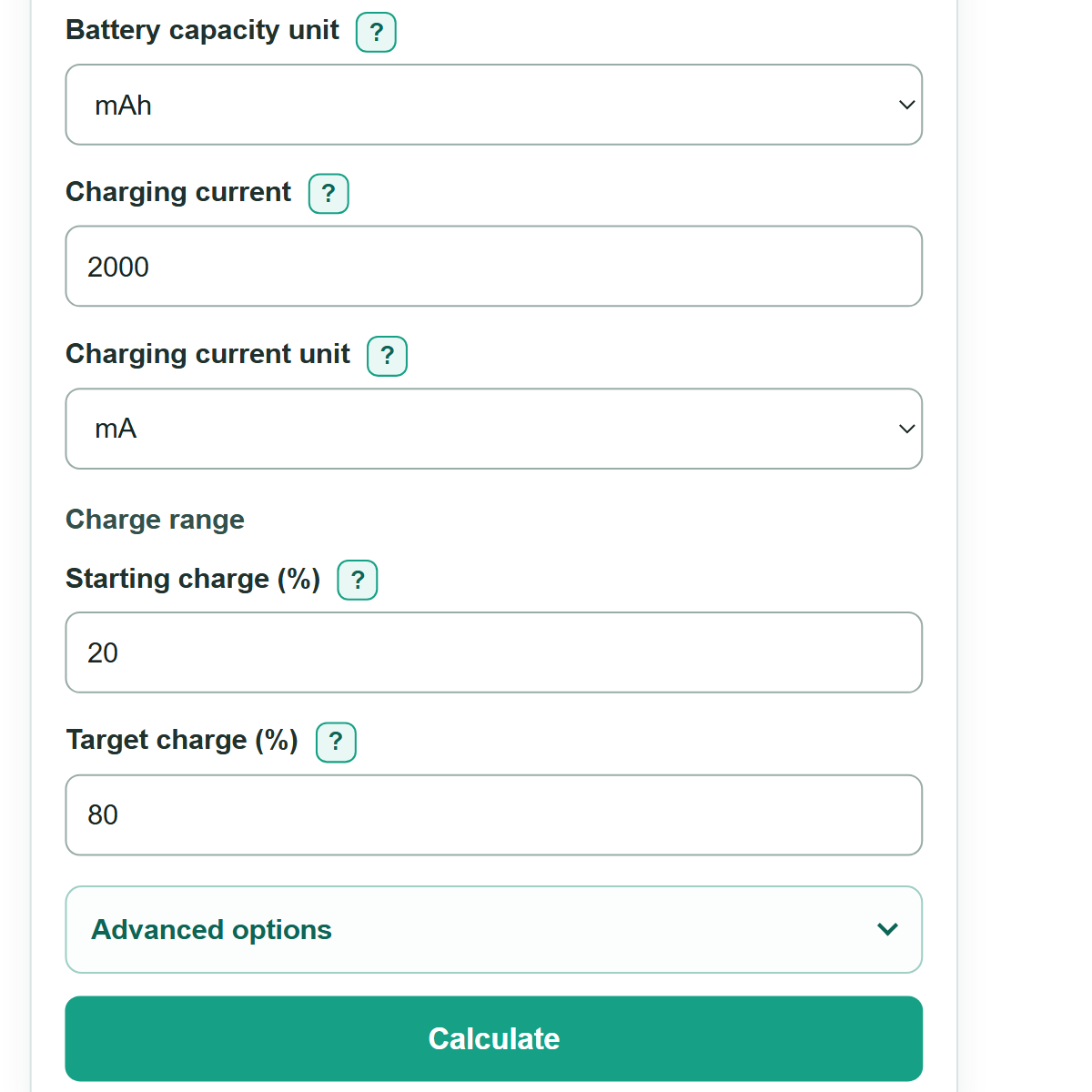
A 5,000 mAh battery charged at 2,000 mA from 20% to 80% needs 60% of its capacity, or 3,000 mAh. The ideal constant-rate time is 1.5 hours. With 80% efficiency entered, 1.5 / 0.80 = 1.875 hours, displayed as 1 hr 53 min.
Time display
Positive times of one minute or more are rounded to the nearest whole minute. A zero charge gap displays as 0 min. A nonzero result shorter than one minute shows seconds so it does not look like zero.