
Estimate voltage lost in LED strip power wires and find a wire size or max feed length that fits your drop limit.
Advanced options
Table of contents
How to use our LED Strip Voltage Drop Calculator
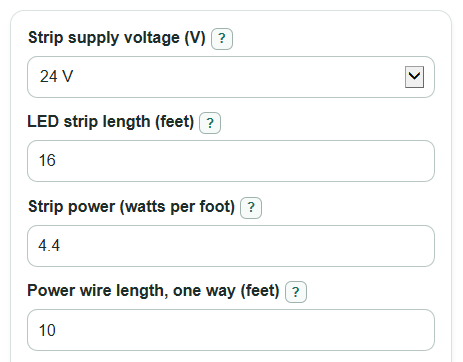
- Choose the Strip supply voltage (V), then enter LED strip length (feet) and Strip power (watts per foot) using the full-brightness strip rating.
- Enter Power wire length, one way (feet) from the power supply to the strip feed point, then choose Power wire size (AWG).
- Open Advanced options only if you want to change Allowed voltage drop (percent), model 2 Matching power feeds sharing this load, or change Number display.
- Select Calculate and compare Voltage lost as a percent with Result vs your limit.
- Sanity-check the answer: if Estimated voltage reaching the strip feed point is very low, or Power turned into heat in the feed wire seems high, try a shorter run, thicker AWG, higher strip voltage, or more matching feeds.
Definitions
Voltage drop: The voltage lost as current flows through wire resistance. Longer wire and higher current usually increase the loss [2].
Power wire length, one way (feet): The distance from the power supply to the LED strip feed point in one direction. The calculation doubles it to include the outgoing and return conductors.
AWG: American Wire Gauge, a wire size system. A smaller AWG number means a thicker wire with lower resistance.
Strip power (watts per foot): The rated power used by one foot of LED strip at full brightness.
Matching power feeds sharing this load: Equal feed wires that are assumed to split the strip current evenly.
Allowed voltage drop (percent): Your design limit for feed-wire loss compared with the strip supply voltage.
Estimated voltage reaching the strip feed point: The supply voltage minus the feed-wire voltage loss. It does not include voltage loss along the LED strip copper.
Common mistakes and quick fixes
Mistake: Entering round-trip distance in Power wire length, one way (feet).
Fix: Enter only the one-way distance from the power supply to the strip feed point; the calculator already counts the positive and return wires.
Mistake: Using watts for the whole strip in Strip power (watts per foot).
Fix: Enter watts per foot. If the strip label gives total watts, divide total watts by LED strip length (feet).
Mistake: Choosing a larger AWG number because it looks stronger in Power wire size (AWG).
Fix: Remember that a smaller AWG number is thicker wire and usually has less Voltage lost in the feed wire.
Mistake: Setting Matching power feeds sharing this load to 2 when the two feeds are different lengths or wire sizes.
Fix: Use 1 feed unless the feeds are matching well enough to share current evenly.
Mistake: Treating Smallest listed wire size that meets your limit as a safety approval.
Fix: Use it as a voltage drop planning result only; still check connector ratings, power supply ratings, wire ampacity, and local electrical rules.
Limitations & Key Assumptions / Boundary Conditions
- The result covers feed-wire voltage drop only. It does not model LED strip copper trace drop, connectors, dimmers, controllers, solder joints, or power supply sag.
- Strip current is based on the entered full-brightness Strip power (watts per foot). Real current may be lower with dimming, color changes, or LED strip power limits.
- The AWG resistance values are for copper conductors near 20 C. Aluminum, copper-clad aluminum, hot wire, or poor-quality cable can have different resistance.
- When Matching power feeds sharing this load is 2, the calculator assumes equal-length, equal-gauge feeds that share current evenly.
- Smallest listed wire size that meets your limit is limited to 10, 12, 14, 16, 18, 20, 22, and 24 AWG. If none passes, use a larger conductor than 10 AWG, shorten the run, reduce load, raise voltage, or add proper power injection.
- This is not an ampacity, fuse, fire safety, or electrical code calculator. Check wire current rating, connector rating, power supply rating, and local rules before building the circuit.
Methodology
Calculation steps
The calculator first estimates the strip load from the entered length and rated watts per foot.
total_watts = strip_length_ft * watts_per_ft
It then converts power to current using the selected Strip supply voltage (V).
load_current_a = total_watts / supply_voltage
If you choose 2 Matching power feeds sharing this load, the calculator splits the current evenly between the two matching feeds.
current_per_feed_a = load_current_a / matching_feed_count
Next it finds the resistance of the full feed loop. The factor of 2 counts both the positive wire and the return wire.
round_trip_ohms = 2 * feed_wire_length_ft * awg_ohms_per_ft
Feed-wire voltage loss uses Ohm's law: voltage drop equals current times resistance.
voltage_drop_v = current_per_feed_a * round_trip_ohms
The percent loss compares that voltage loss with the supply voltage.
drop_percent = 100 * voltage_drop_v / supply_voltage
The estimated voltage at the strip feed point subtracts the feed-wire loss from the supply voltage.
strip_input_voltage_v = supply_voltage - voltage_drop_v
Power lost in the feed wires is estimated from current squared times resistance, multiplied by the number of matching feeds.
wire_power_loss_w = matching_feed_count * current_per_feed_a^2 * round_trip_ohms
The max one-way feed length solves the same voltage drop equation for length, using your Allowed voltage drop (percent).
max_feed_length_ft = (supply_voltage * allowed_drop_percent / 100) / (2 * current_per_feed_a * awg_ohms_per_ft)
For Smallest listed wire size that meets your limit, the calculator checks 10, 12, 14, 16, 18, 20, 22, and 24 AWG and returns the thinnest listed wire that keeps the percent drop at or below your limit.
recommended_awg = largest_awg_number_that_passes_the_allowed_drop_test
Worked example
For a 24 V strip, 16 feet of strip, 4.4 watts per foot, a 10 foot one-way feed, 16 AWG copper wire, 1 feed, and a 5 percent allowed drop:
total power is 70.4 W and current is 70.4 / 24 = 2.9333 A.
Using 16 AWG at 0.004016 ohm per foot, round-trip resistance is 2 * 10 * 0.004016 = 0.08032 ohm. Voltage lost in the feed wire is 2.9333 * 0.08032 = 0.2356 V. Voltage lost as a percent is 0.2356 / 24 * 100 = 0.9817 percent, so it is within a 5 percent limit.