
Enter a Rankine temperature to find its equivalent in Kelvin, using the direct conversion with no temperature offset.
Enter an absolute temperature of 0 K or higher. A bare number uses K.
Advanced options
Table of contents
How to use our Rankine to Kelvin Converter
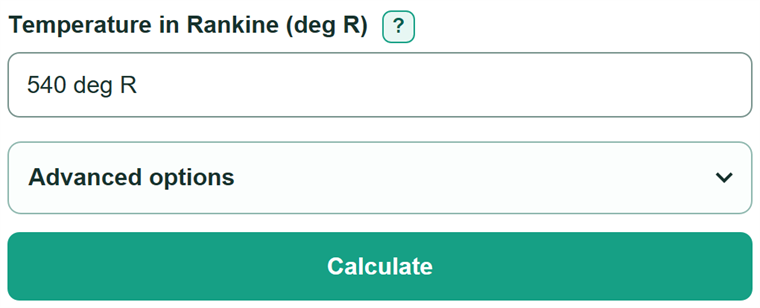
- Enter the temperature from your homework, reference, or measurement in the Temperature in Rankine (deg R) field.
- Type a number alone, or add a Rankine suffix such as R, deg R, or Rankine.
- Open Advanced options if you need a certain number of decimal places in the Kelvin answer.
- Select Calculate and copy the Temperature in Kelvin value with its K unit.
- Check the method before using the answer: 540 deg R converts to 300 K, and the temperature offset applied is 0 K.
Definitions
Rankine (deg R): An absolute temperature scale with degree steps the same size as Fahrenheit degree steps. Its zero point is absolute zero.
Kelvin (K): The SI unit for thermodynamic temperature. Write its symbol as K, without a degree sign.
Absolute zero: The zero point of an absolute temperature scale. It is 0 deg R and 0 K.
Temperature offset: A fixed amount added or subtracted in some conversions. The Rankine-to-Kelvin offset is 0 K.
Scale factor: A number that changes the size of one unit into another. This conversion uses the exact factor 5/9 K per deg R.
Common mistakes and quick fixes
Mistake: Entering a Fahrenheit temperature in the Rankine field.
Fix: Enter a value already expressed in deg R. A Fahrenheit suffix, such as F, does not match this converter.
Mistake: Adding or subtracting 459.67 during the conversion.
Fix: Multiply the Rankine value by 5/9 only. Rankine and Kelvin start at absolute zero, so the offset is 0 K.
Mistake: Typing a negative Rankine temperature.
Fix: Enter 0 deg R or higher. Rankine is an absolute temperature scale and cannot be below absolute zero.
Mistake: Using a comma as a decimal separator, such as 1,01.
Fix: Use a decimal point for decimals, such as 1.01. Use commas only for thousands groups, such as 1,000.
Mistake: Rounding the input or conversion factor too early.
Fix: Keep enough decimal places for later work, then round only where your assignment or calculation requires it.
Limitations & Key Assumptions / Boundary Conditions
- This converter accepts temperatures already expressed in Rankine. It does not directly convert Fahrenheit, Celsius, or other temperature scales.
- The Rankine input must be a finite number at or above 0 deg R. Negative values are outside the Rankine absolute-temperature scale.
- The displayed Kelvin answer is rounded to the selected decimal places, although the calculation uses the unrounded factor 5/9.
- The conversion changes units only. It does not account for measurement uncertainty, instrument accuracy, or rounding rules from a class or engineering standard.
Methodology
Direct conversion
Rankine and Kelvin are absolute temperature scales with the same zero point. Their unit sizes differ, so the conversion uses a scale factor and does not add or subtract an offset.
K = R × 5/9
K is temperature in Kelvin, and R is temperature in degrees Rankine. The calculator uses the fraction 5/9 directly instead of a shortened decimal.
Worked example
For 540 deg R, multiply 540 by 5/9 to get 300 K. As a fixed reference check, 491.67 deg R converts to 273.15 K.
540 × 5/9 = 300 K
491.67 × 5/9 = 273.15 K
Offset check
The offset is always 0 K because 0 deg R equals 0 K. Do not apply a Fahrenheit-style offset after entering a Rankine temperature.
offset = 0 K