
Convert cubic inches to fluid ounces, or use inside box or round container measurements to find the volume first.
Table of contents
How to use our Cubic Inches to Fluid Ounces Converter
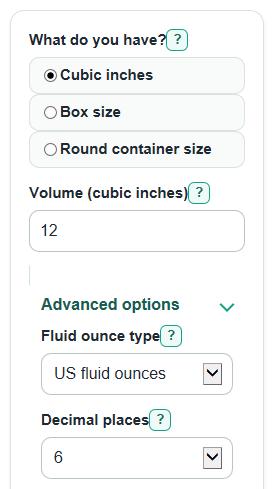
- Choose What do you have?: Cubic inches, Box size, or Round container size.
- Enter the visible measurements, such as Volume (cubic inches), Inside length (inches), or Inside diameter (inches).
- Open Advanced options only if you need Imperial fluid ounces or a different number of Decimal places.
- Select Calculate, then read Fluid ounces first and use Cubic inches used to check that the shape volume looks right.
- Sanity-check the answer: a 10 by 5 by 2 inch box is 100 cubic inches, so it should be about 55.4 US fluid ounces, not 100 fluid ounces.
Definitions
Cubic inch: A volume equal to a cube that is 1 inch long, 1 inch wide, and 1 inch tall.
Fluid ounce: A unit of volume for liquids and containers, not a unit of weight [2].
US fluid ounces: The default fluid-ounce type for this converter; 1 US gallon has 128 US fluid ounces.
Imperial fluid ounces: A different fluid-ounce type used in some UK and Commonwealth contexts; it is not the same size as a US fluid ounce.
Inside diameter: The full inside width across a round opening, measured through the center.
Cubic inches used: The in^3 volume that is converted after any box or round container calculation.
Conversion used: The multiplier in fluid ounces per cubic inch for the selected Fluid ounce type.
Common mistakes and quick fixes
Mistake: Treating Fluid ounces as weight ounces.
Fix: Use Fluid ounces only for volume; weight needs the liquid's density.
Mistake: Entering outside container measurements for Inside length (inches), Inside width (inches), or Inside height (inches).
Fix: Measure the inside space if you want the amount the container can hold.
Mistake: Using radius in Inside diameter (inches) for a round container.
Fix: Enter the full width across the opening for Inside diameter (inches); the calculator divides it by 2.
Mistake: Leaving Fluid ounce type on US fluid ounces when you need Imperial fluid ounces.
Fix: Open Advanced options and change Fluid ounce type before using the Fluid ounces result.
Mistake: Reading rounded values from Decimal places as if the hidden math was rounded too.
Fix: Decimal places only changes the display; use more digits if you need to copy Conversion used or compare results.
Limitations & Key Assumptions / Boundary Conditions
- This converter reports volume only. It does not convert to weight ounces because weight depends on the liquid density.
- Box size mode treats the container as a rectangular box with straight sides and uses inside length, width, and height.
- Round container size mode treats the container as a straight circular cylinder. Tapered bottles, rounded bottoms, and thick walls can hold less or more than the result.
- US and Imperial fluid ounces are different. Check Fluid ounce type before copying the Fluid ounces result.
- Decimal places changes displayed rounding only. The internal calculation uses full JavaScript number precision.
- Very large values can be formatted with commas, but real measuring errors may be larger than the displayed decimal detail.
Methodology
Conversion math
The default conversion uses the US liquid gallon relationship of 231 cubic inches per gallon and 128 US fluid ounces per gallon.
US fluid ounces = cubic inches * 128 / 231
That gives a US conversion factor of about 0.554112554112554 US fl oz per in^3.
If Imperial fluid ounces are selected, the converter starts with 4.54609 liters per Imperial gallon, 1000 cubic centimeters per liter, 2.54 centimeters per inch, and 160 Imperial fluid ounces per Imperial gallon.
Imperial fluid ounces = cubic inches / ((4.54609 * 1000 / (2.54^3)) / 160)
That gives an Imperial conversion factor of about 0.576744023985447 Imperial fl oz per in^3.
Shape helper math
In Box size mode, the converter first finds cubic inches from the three inside dimensions.
cubic inches = length inches * width inches * height inches
In Round container size mode, the converter treats the container as a cylinder and uses the inside diameter and height.
cubic inches = pi * (diameter inches / 2)^2 * height inches
Common units
For US fluid ounces, the breakdown uses 8 fl oz per cup, 16 fl oz per pint, 32 fl oz per quart, and 128 fl oz per gallon.
cups = US fl oz / 8; pints = US fl oz / 16; quarts = US fl oz / 32; gallons = US fl oz / 128
For Imperial fluid ounces, the breakdown uses 20 Imperial fl oz per pint and 160 Imperial fl oz per gallon.
Imperial pints = Imperial fl oz / 20; Imperial gallons = Imperial fl oz / 160
Mini example
A box with inside dimensions 10 inches by 5 inches by 2 inches has 100 cubic inches.
100 * 128 / 231 = 55.41125541125541 US fl oz
With 2 Decimal places selected, that displays as 55.41 US fl oz. The same volume is about 6.93 US cups.
Calculation choices
Blank visible fields stop the calculation with an error. Commas and spaces are stripped before parsing numbers. Negative volumes or dimensions are rejected, while zero is allowed and returns 0 fluid ounces. Hidden fields from other What do you have? choices are not used.
Sources
- NIST Guide to the SI, Appendix B.9: Factors for units listed by kind of quantity or field of science - NIST
- cubic inch-ounce (fluid US food nutrition labeling) conversion - Conversion
- Fluid ounce (US) conversions - Conversion-website
- Fluid ounce Definition & Meaning | Britannica Dictionary - Encyclopedia Britannica