
Convert cubic inches, US gallons, and Imperial gallons with a required gallon-type choice so you do not mix up the two systems.
Table of contents
How to use our Cubic Inches to Gallons Converter
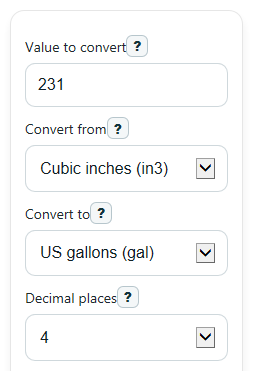
- Enter your number in Value to convert. Decimals are okay, and negative values can be used if you mean a signed change.
- Choose the starting unit in Convert from and the ending unit in Convert to. If you are using gallons, make sure you pick US gallons (gal) or Imperial gallons (gal) on purpose.
- Pick Decimal places if you want a shorter or more detailed answer, then click Calculate.
- Read Converted value first, then check If you meant the other gallon type to catch the common US-vs-Imperial mistake.
- Sanity-check the result: 231 cubic inches should equal 1 US gallon, and 277.4194327916 cubic inches should equal 1 Imperial gallon.
Definitions
Cubic inch (in3): A unit of volume based on a cube that is 1 inch long, 1 inch wide, and 1 inch tall.
US gallon: The US liquid gallon. In this converter, 1 US gallon = 231 cubic inches [1].
Imperial gallon: The British gallon. It is larger than a US gallon, so the same cubic-inch amount gives fewer Imperial gallons [2].
Converted value: The volume after changing your starting unit into the unit picked in Convert to.
Conversion factor: The number used to move from one unit to another for your exact unit pair.
Formula used: The math rule applied to your chosen direction, such as dividing cubic inches by 231 for US gallons.
Common mistakes and quick fixes
Mistake: Picking US gallons (gal) in Convert to when you really needed Imperial gallons (gal) .
Fix: Check both Convert from and Convert to , then compare the note in If you meant the other gallon type .
Mistake: Leaving Value to convert blank or typing text instead of a number.
Fix: Enter a numeric value in Value to convert , such as 231 or 2.5.
Mistake: Expecting a different answer when Convert from and Convert to are the same unit.
Fix: If both unit menus match, Converted value will stay the same because no unit change happened.
Mistake: Using too few digits in Decimal places and thinking the math is off.
Fix: Change Decimal places from 2 to 4 or 6 to see a more detailed Converted value .
Mistake: Reading Conversion factor backward.
Fix: Match the factor to your chosen direction from Convert from to Convert to ; changing the direction changes the factor.
Mistake: Thinking a negative Converted value is always invalid.
Fix: A negative result can make sense for a signed change in volume, but for an actual container size, use a positive Value to convert .
Limitations & Key Assumptions / Boundary Conditions
- This converter handles only three units: cubic inches, US gallons, and Imperial gallons.
- Results depend completely on the unit pair you choose. The tool does not guess whether you meant US gallons or Imperial gallons.
- Negative values are allowed for math, but they usually describe a signed change in volume, not a real container size.
- Displayed digits depend on Decimal places. Rounded display values can look slightly different from the full internal calculation.
- If you convert between the same unit on both sides, the value stays unchanged because no conversion is needed.
- The comparison note is mainly for cases involving cubic inches and one gallon system, where mix-ups are most common.
Methodology
How the converter works
The converter uses cubic inches as the base unit. It first changes the input into cubic inches if needed, then changes that amount into the target unit.
target = value * factor_from_in3 / factor_to_in3
Unit sizes used in the calculation:
1 US gallon = 231 in3
1 Imperial gallon = 277.4194327916 in3
1 in3 = 0.016387064 L
Direct formulas
US_gal = in3 / 231
in3 = US_gal * 231
Imp_gal = in3 / 277.4194327916
in3 = Imp_gal * 277.4194327916
Mini example
If Value to convert is 231, Convert from is cubic inches, and Convert to is US gallons, the calculation is:
231 / 231 = 1
So the Converted value is 1 US gallon. If you used Imperial gallons instead, the calculation would be 231 / 277.4194327916 = about 0.8327 Imperial gallons, which shows why gallon type matters.
Calculation choices
If the starting and target units are the same, the converter returns the original number unchanged. If the input is blank, not numeric, or not finite, it should show an error instead of guessing. Decimal display is rounded to the selected number of places, but the underlying conversion factors stay the same.
Assumptions used
The US gallon value of 231 cubic inches is treated as exact [1]. The Imperial gallon is treated as larger than the US gallon, and this converter uses 277.4194327916 cubic inches per Imperial gallon for the math [2].