
Convert pressure between bar and standard atmospheres, with an optional gauge-pressure check for readings from real equipment.
Advanced options
Table of contents
How to use our Bar to Atmospheres Converter
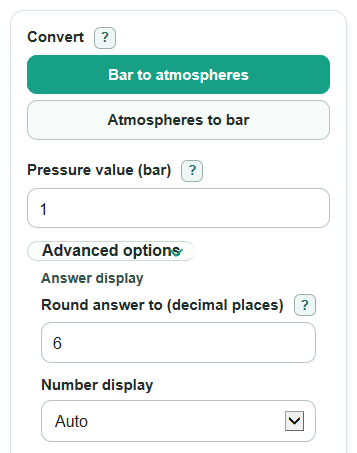
- Choose the direction in Convert: Bar to atmospheres or Atmospheres to bar.
- Enter the starting number in Pressure value. Commas and spaces are okay.
- Open Advanced options only if you need Round answer to, Number display, Pressure reading type, or Local air pressure.
- If your reading comes from a gauge, set Pressure reading type to Gauge pressure above local air so Estimated absolute pressure is shown.
- Sanity-check the result: 1 bar should be about 0.986923 atm, and 1 atm should be 1.01325 bar.
Definitions
Bar: A pressure unit equal to 100000 pascals.
Standard atmosphere (atm): A defined pressure unit equal to 101325 pascals; it is not a guess about today's weather.
Pascal (Pa): The SI pressure unit used as the shared base for the conversion.
Kilopascal (kPa): 1000 pascals, a common pressure unit in science, weather, and lab work.
Absolute pressure: Pressure measured from zero pressure.
Gauge pressure: Pressure measured above the air around you, like many equipment gauges show.
Local air pressure: The surrounding air pressure used to turn a gauge reading into an estimated absolute pressure.
Common mistakes and quick fixes
Mistake: Picking the wrong Convert direction and treating bar to atm like atm to bar.
Fix: Recheck Convert before calculating; 1 bar should convert to less than 1 atm, while 1 atm should convert to more than 1 bar.
Mistake: Entering a gauge reading in Pressure value while leaving Pressure reading type as Absolute pressure.
Fix: If the value is above local air pressure, change Pressure reading type to Gauge pressure above local air and use Estimated absolute pressure for the absolute amount.
Mistake: Using 0 or a blank value for Local air pressure when Pressure reading type is gauge.
Fix: Enter a Local air pressure greater than 0 atm; use 1 atm if you do not have a local measurement.
Mistake: Setting Round answer to outside the allowed range or rounding too much for homework.
Fix: Keep Round answer to between 0 and 10 decimal places; use 6 for a detailed check.
Mistake: Comparing Converted pressure with normal air when the reading is gauge pressure.
Fix: For gauge readings, use Estimated absolute pressure and Compared with 1 standard atmosphere because they include local air pressure.
Mistake: Reading Same pressure in pascals as the absolute pressure for a gauge input.
Fix: Same pressure in pascals follows the entered gauge amount; check Estimated absolute pressure for the pressure after local air is added.
Limitations & Key Assumptions / Boundary Conditions
- The converter uses exact fixed definitions: 1 bar = 100000 Pa and 1 standard atmosphere = 101325 Pa.
- Absolute pressure values must be zero or positive. A negative absolute pressure is physically impossible.
- Gauge pressure can be negative only if the Estimated absolute pressure is still zero or positive.
- For gauge readings, Local air pressure is whatever you enter. Real local air pressure changes with elevation and weather.
- Converted pressure is the direct unit conversion of the entered pressure amount. For gauge readings, it remains a gauge amount in the new unit.
- Same pressure in kilopascals and Same pressure in pascals follow the entered pressure amount, not the estimated absolute amount, unless the entered pressure was already absolute.
- Round answer to and Number display change how values are shown, not the exact stored math used by the calculator.
Methodology
Conversion basis
The calculator converts through pascals, the SI pressure unit. One bar is 100000 Pa [1], and one standard atmosphere is 101325 Pa [2].
atm = bar * 100000 / 101325
bar = atm * 101325 / 100000
Gauge and absolute pressure
If Pressure reading type is Absolute pressure, the converted value is also treated as absolute. If Pressure reading type is Gauge pressure above local air, the calculator first converts the gauge amount, then adds Local air pressure in the target unit for Estimated absolute pressure.
absolute_target = converted_gauge_target + local_air_pressure_target
For a bar to atmospheres gauge conversion, Local air pressure is already in atm. For an atmospheres to bar gauge conversion, Local air pressure is multiplied by 1.01325 before it is added in bar.
Extra outputs
The pascal and kilopascal outputs are based on the entered pressure amount.
pa = bar * 100000
pa = atm * 101325
kPa = Pa / 1000
The comparison output uses absolute pressure expressed in atm.
percent = (absolute_atm - 1) * 100
Mini-example
For 2 bar gauge, with Local air pressure set to 1 atm, the direct conversion is 2 * 100000 / 101325 = 1.973846533 atm. Because the reading is gauge pressure, the estimated absolute pressure is 1.973846533 + 1 = 2.973846533 atm. Compared with 1 standard atmosphere is (2.973846533 - 1) * 100 = 197.384653%.
Sources
- NIST Guide to the SI, Appendix B.9: Factors for units listed by kind of quantity or field of science - NIST
- standard atmosphere - Optimade
- Pressure Units Guide: PSI, Bar, Pascal & ATM Conversion (2026) - Hakaru
- Standard atmosphere | Pressure, Temperature, Humidity | Britannica - Encyclopedia Britannica