
Plan per-feeding and daily feed-mix volumes for 20 cattle using cracked wheat, cracked faba beans, salt, feed-grade lime, and bicarb soda.
Ingredient mix parts
Advanced options
Table of contents
How to use our Cattle Feed Mix Volume Calculator
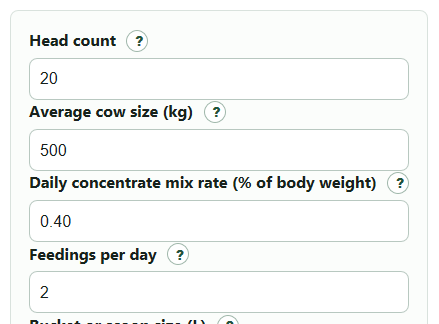
- Leave Head count at 20 or change it to scale the herd.
- Enter Average cow size (kg), Daily concentrate mix rate (% of body weight), Feedings per day, and Bucket or scoop size (L).
- Edit the five Ingredient mix parts: Cracked wheat parts, Cracked faba bean parts, Salt parts, Feed-grade lime parts, and Bicarb soda parts.
- Open Advanced options only if you have measured bulk densities for the ingredients you are scooping.
- Click Calculate feed volumes, then check that the per-feeding liters and scoops are practical for the cattle plan.
Definitions
Average cow size (kg): The average liveweight used to scale the daily concentrate mix.
Daily concentrate mix rate (% of body weight): The daily mix basis before it is split across feedings and ingredients.
Ingredient mix parts: The relative parts for cracked wheat, cracked faba beans, salt, feed-grade lime, and bicarb soda.
Bulk density (kg/L): The loose product weight in one liter, used to convert the internal weight basis to measuring volume.
Total mix volume per feeding: The combined loose volume of all five ingredients for the full herd at one feeding.
Scoops per feeding: The ingredient liters divided by Bucket or scoop size (L).
Hay ad lib: Hay is available separately as free-choice roughage; it is not included in the calculated concentrate mix volume.
Common mistakes and quick fixes
Mistake: Treating the default Ingredient mix parts as a cattle nutrition recommendation.
Fix: Replace Cracked wheat parts, Cracked faba bean parts, Salt parts, Feed-grade lime parts, and Bicarb soda parts with your approved ration.
Mistake: Leaving Average cow size (kg) at 500 when the herd is much lighter or heavier.
Fix: Enter the best average liveweight you have before calculating.
Mistake: Reading Total mix volume per day as the amount to feed each time.
Fix: Use Total mix volume per feeding for one feed and Total mix volume per day for the full day.
Mistake: Using builder's lime for Feed-grade lime parts.
Fix: Use only feed-grade limestone or calcium carbonate specified for animal feed.
Mistake: Leaving the bulk density fields unchanged when your grain, salt, lime, or bicarb product packs differently.
Fix: Measure a known liter or bucket volume, weigh it, and update the matching bulk density (kg/L).
Mistake: Assuming hay ad lib is part of the calculated mix.
Fix: Keep hay separate; this calculator only batches the cracked wheat, cracked faba beans, salt, feed-grade lime, and bicarb soda mix.
Limitations & assumptions
- This is a volume batching calculator, not a cattle ration balancer. It does not check protein, energy, fiber, mineral balance, rumen health, or safe additive limits.
- Salt, feed-grade lime, and bicarb soda can be harmful if overused. Use a ration, label direction, vet, or nutritionist to set the ingredient parts.
- The default bulk densities are planning values. Real liters can change with cracking, moisture, fines, product source, settling, and how firmly the scoop is filled.
- The daily concentrate basis uses Head count, Average cow size (kg), and Daily concentrate mix rate (% of body weight). It does not adjust for breed, lactation, pregnancy, condition, pasture, weather, or target gain.
- Hay ad lib is assumed to be available separately. The calculator does not estimate hay intake or replace roughage planning.
- All output volumes are loose measuring volumes before losses, spillage, bridging, or compaction in a mixer, tub, or feed-out system.
Methodology
Daily mix basis
The calculator first estimates the total concentrate mix from the herd size, average cow size, and chosen percent of body weight.
total_mix_kg_per_day = head_count * average_cow_weight_kg * (mix_rate_pct_bodyweight / 100)
total_mix_kg_per_feeding = total_mix_kg_per_day / feedings_per_day
Ingredient split
The five ingredient parts are added together, then each ingredient receives its share of the per-feeding mix.
total_parts = wheat_part + faba_part + salt_part + lime_part + bicarb_part
ingredient_share = ingredient_part / total_parts
ingredient_kg_per_feeding = total_mix_kg_per_feeding * ingredient_share
Volume conversion
Each ingredient weight is converted to liters using its bulk density. The calculator sums those liters for the full per-feeding volume.
ingredient_liters_per_feeding = ingredient_kg_per_feeding / ingredient_density_kg_l
total_liters_per_feeding = sum(ingredient_liters_per_feeding)
total_liters_per_day = total_liters_per_feeding * feedings_per_day
scoops_per_feeding = ingredient_liters_per_feeding / bucket_size_l
Worked example
With the defaults, 20 cattle at 500 kg and 0.40% body weight per day give 40 kg of concentrate mix per day, or 20 kg per feeding. With 70, 25, 1, 2, and 2 parts, the per-feeding volumes are about 25.00 L cracked wheat, 6.67 L cracked faba beans, 0.17 L salt, 0.29 L feed-grade lime, and 0.40 L bicarb soda, for about 32.52 L total per feeding.
Calculation choices
The calculator reports volumes, not feeding recommendations. It keeps hay outside the mix because the prompt says hay is available ad lib separately.