
Enter a mass in kilograms to find the same mass in milligrams, shown as a readable number you can copy.
This is the same mass expressed in milligrams.
Table of contents
How to use our Kilograms to Milligrams Converter
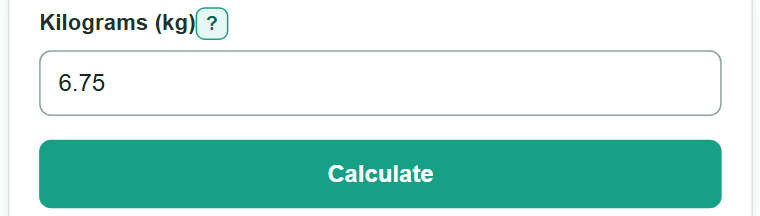
- Enter the mass in the "Kilograms (kg)" field. A number without a suffix is read as kilograms; you can also type "kg" after the number.
- Select "Calculate" to get the matching mass in milligrams.
- Copy the comma-grouped milligram value into your worksheet, record, or calculation.
- Sanity-check the size of the answer: 1 kg equals 1,000,000 mg, so converting from kg to mg moves the decimal point six places right.
Definitions
Kilogram (kg): A metric unit of mass equal to 1,000 grams.
Milligram (mg): A metric unit of mass equal to one-thousandth of a gram.
SI prefix: A prefix that changes a metric unit by a power of ten. "Kilo" means 1,000, and "milli" means one-thousandth.
Scientific notation: A compact way to write a very large or small number. For example, 1e-9 means 0.000000001.
Common mistakes and quick fixes
Mistake: Entering grams in a field that expects kilograms.
Fix: Convert the source value to kilograms first. For example, 500 g is 0.5 kg.
Mistake: Moving the decimal point three places instead of six.
Fix: A kilogram is 1,000 grams and each gram is 1,000 milligrams, so 1 kg is 1,000,000 mg.
Mistake: Using an invalid comma pattern such as "1,01".
Fix: Use commas only in thousands groups, such as "1,001", or leave commas out.
Mistake: Reading a tiny nonzero result as zero.
Fix: Keep the shown decimal digits. For example, 0.000000001 kg converts to 0.001 mg.
Mistake: Entering a negative value for physical mass.
Fix: Enter zero or a positive value. This converter does not accept negative mass values.
Limitations & Key Assumptions / Boundary Conditions
- This converter changes units only. It cannot check whether the original measurement is accurate.
- The kilogram input must be zero or positive because the page treats it as a physical mass.
- Conversion does not add measurement precision. A value rounded by a scale remains rounded after conversion.
- Check the source unit before entering a value. Packages and records may use grams, milligrams, or another mass unit.
- For very large or small values, compare the answer with the fact that 1 kg equals 1,000,000 mg to check its order of magnitude.
Methodology
Conversion method
The calculator uses the metric prefix relationship that 1 kilogram equals 1,000,000 milligrams.
milligrams = kilograms * 1,000,000
Worked example
For 6.75 kg, multiply 6.75 by 1,000,000. The converted mass is 6,750,000 mg.
6.75 kg * 1,000,000 mg/kg = 6,750,000 mg
Calculation details
The calculator keeps the numeric value during conversion, then adds commas to large whole-number groups for easier reading. Small nonzero answers stay visible as decimals instead of being shown as zero.