
Convert US tablespoons to quarts with an exact decimal, a simple kitchen fraction, and an easy cups-plus-tablespoons breakdown.
Table of contents
How to use our Tablespoons to Quarts Converter
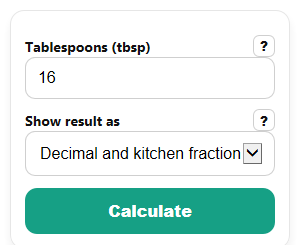
- Enter the amount in Tablespoons (tbsp). You can use whole numbers or decimals like 1.5.
- Pick a format in Show result as if you want decimals, a kitchen fraction, or both.
- Click Calculate to see Quarts, Quarts as a kitchen fraction, and Kitchen breakdown.
- Sanity-check the result: 64 tablespoons should equal 1 quart, and 16 tablespoons should equal 0.25 quarts or 1 cup.
Definitions
Tablespoon (tbsp): A small US cooking volume unit used for the input.
Quart (qt): A larger US liquid volume unit used for the main converted result.
Kitchen fraction: A rounded fraction or mixed number, such as 1/2 qt or 1 1/4 qt, that is easier to picture in cooking than a long decimal.
Kitchen breakdown: The same amount shown as cups and leftover tablespoons so it is easier to measure.
Decimal quarts: The exact converted amount written as a decimal number, such as 0.375 qt.
US customary volume: The US kitchen measurement system used by this converter for tablespoons, cups, and quarts.
Common mistakes and quick fixes
Mistake: Leaving Tablespoons (tbsp) blank and expecting a result.
Fix: Enter a number in Tablespoons (tbsp) , such as 16 or 1.5, then calculate again.
Mistake: Typing words or symbols into Tablespoons (tbsp) , such as "two" or extra text.
Fix: Use numbers only in Tablespoons (tbsp) . Decimals like 0.5 and 2.25 are fine.
Mistake: Reading Quarts as if it were cups.
Fix: Check the unit on each output. Quarts is in qt, while Kitchen breakdown shows cups and tablespoons.
Mistake: Choosing Decimal only in Show result as and then looking for a recipe-style fraction.
Fix: Change Show result as to "Decimal and kitchen fraction" or "Kitchen fraction only".
Mistake: Thinking a negative Quarts result is automatically wrong.
Fix: A negative result simply means the entered Tablespoons (tbsp) value was negative. Recheck the sign if you did not mean to subtract volume.
Mistake: Ignoring the Conversion note and mixing US kitchen units with another system.
Fix: Use the converter for US tablespoons and US quarts, and read the Conversion note to confirm the unit relationship used.
Limitations & Key Assumptions / Boundary Conditions
- This converter uses US tablespoons, US cups, and US quarts. Results can differ from UK or other tablespoon and quart definitions.
- The main conversion is exact for the unit relationship used, but Quarts as a kitchen fraction is simplified for easier reading and may be rounded to a common fraction.
- Kitchen breakdown is designed for practical measuring, so it shows cups and remaining tablespoons instead of every possible unit combination.
- Negative values are allowed as signed math conversions. In kitchen use, a negative amount usually means the input sign should be checked.
- Very large values are mathematically valid, but they may be less useful for everyday recipe measuring.
Methodology
Calculation method
The converter changes US tablespoons into US quarts using the fixed relationship 1 US quart = 64 US tablespoons.
quarts = tablespoons / 64
It also builds a kitchen-friendly view with cups because 1 US cup = 16 US tablespoons and 1 US quart = 4 US cups.
cups_total = tablespoons / 16
whole_cups = floor(cups_total)
remaining_tablespoons = tablespoons - 16 x whole_cups
Worked example
If Tablespoons (tbsp) is 16, then the quart result is 16 / 64 = 0.25 qt. The kitchen breakdown is 16 / 16 = 1 cup, with 0 tablespoons left.
16 / 64 = 0.25 qt
16 / 16 = 1 cup
16 - 16 x 1 = 0 tbsp remaining
Fraction output
Quarts as a kitchen fraction shows the same amount as a simple fraction or mixed number when that gives a clean recipe-style value. If the number does not fit a simple common fraction closely, the decimal quart value stays the most exact answer.
Assumptions and limits
This page uses US kitchen volume units, not UK units. Decimal output is the exact conversion for the unit relationship used, while the fraction output is simplified for readability. Zero is valid, and negative inputs stay negative as signed conversions instead of being forced to zero.