
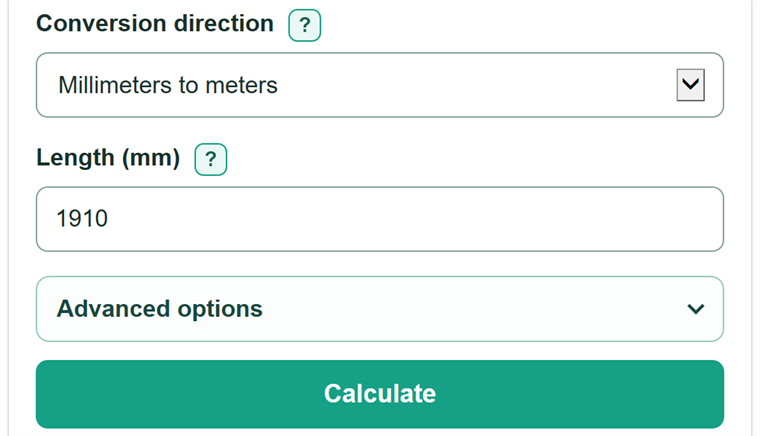
Enter a length in millimeters to get meters, or switch directions to convert meters into millimeters.
Advanced options
Table of contents
How to use our Millimeters to Meters Converter
- Choose the direction that matches the unit beside your original measurement.
- Enter one length in the labeled unit. You may use a decimal, a matching suffix such as mm, or commas in a number such as 2,500.
- Click Calculate to see the same length in the other unit.
- Check the direction note: for a positive millimeter input, the meter number should be smaller because you divide by 1,000.
- Open Advanced options only if your worksheet, drawing, or report requires a fixed number of decimal places.
Definitions
Millimeter (mm): A metric unit of linear length. One meter equals exactly 1,000 millimeters.
Meter (m): A metric unit of linear length equal to exactly 1,000 mm.
Linear length: A one-dimensional measurement, such as a line, width, height, or part thickness.
Decimal places: Digits shown to the right of a decimal point. Changing them rounds the display only.
Common mistakes and quick fixes
Mistake: Multiplying by 1,000 when changing millimeters to meters.
Fix: Divide millimeters by 1,000. For a positive input, the number in meters is smaller.
Mistake: Entering m while the field is labeled mm, or entering mm in the reverse direction.
Fix: Match any suffix to the active source label, or enter the number with no suffix.
Mistake: Using a comma as a decimal mark or typing grouping such as 1,01.
Fix: Use a decimal point for decimals and commas only for thousands groups, such as 1,000.5.
Mistake: Treating a rounded display such as 0.0 m as an exact zero.
Fix: Use Automatic display or select more decimal places when a very small measurement matters.
Mistake: Applying this conversion to square millimeters or cubic millimeters.
Fix: Use this converter for linear length only. Area and volume use different conversion factors.
Limitations & Key Assumptions / Boundary Conditions
- This conversion is for linear measurements in millimeters and meters, not square units, cubic units, or other measurement types.
- Negative values are kept for signed positions or changes in length, though a negative physical object length may not make sense.
- A fixed decimal-place choice rounds the displayed value. A small nonzero result can display as zero at low precision.
- The entered suffix, if used, must match the source unit shown for the selected direction.
Methodology
Conversion rule
The prefix milli means one-thousandth, so one meter contains exactly 1,000 millimeters.
meters = millimeters / 1000
millimeters = meters * 1000
Worked example
For 1,910 mm, divide by 1,000: 1,910 / 1,000 = 1.91 m. In reverse, multiply 1.91 m by 1,000 to get 1,910 mm.
Rounding
The conversion uses the unrounded number. Choosing decimal places changes only the displayed result; Automatic display keeps useful decimal detail and removes unnecessary trailing zeros.