
Convert knots to meters per second with clear rounding, the exact factor used, and a worked step that shows the math.
Advanced options
Table of contents
How to use our Knots to Meters per Second Converter
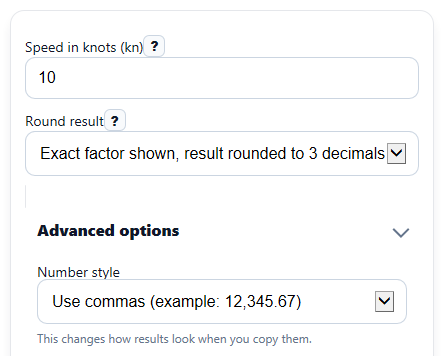
- Enter your value in Speed in knots (kn). You can use whole numbers, decimals, or pasted values with commas such as 1,250.5.
- Choose a setting in Round result based on how precise you want the displayed Speed in meters per second to be.
- If you want a different display format, open Advanced options and pick a Number style before you calculate.
- Click Calculate to see Speed in meters per second, Conversion factor used, and How the result was calculated.
- Sanity-check the answer: 1 kn is a little more than 0.5 m/s, so 10 kn should be about 5.14 m/s and 0 kn should stay 0 m/s.
Definitions
Knot (kn): A speed unit equal to one nautical mile per hour.
Meters per second (m/s): The SI speed unit that tells how many meters are traveled each second.
Conversion factor used: The fixed number multiplied by knots to get meters per second, 0.5144444444444445 m/s per kn.
Round result: The display rule for how many decimal places appear in the final Speed in meters per second.
Nautical mile: A distance of 1,852 meters exactly.[2]
Common mistakes and quick fixes
Mistake: Leaving Speed in knots (kn) blank or typing text instead of a number.
Fix: Enter a numeric value in Speed in knots (kn) , such as 10 or 12.5.
Mistake: Typing a value in miles per hour or meters per second into Speed in knots (kn) .
Fix: Make sure the input is really in knots before using the calculator, then read the converted value from Speed in meters per second .
Mistake: Thinking Round result changes the real conversion factor.
Fix: Use Conversion factor used to see the fixed factor; Round result changes only how the final answer is displayed.
Mistake: Expecting How the result was calculated to match your rounded answer digit for digit.
Fix: Read the worked step as the exact multiplication path, then use the selected Round result setting for the shown Speed in meters per second .
Mistake: Being surprised by a negative Speed in meters per second after entering a negative value in Speed in knots (kn) .
Fix: A negative result keeps the same unit conversion but shows the opposite signed direction; enter a non-negative value if you only want speed magnitude.
Limitations & Key Assumptions / Boundary Conditions
- This tool converts only from knots to meters per second. It does not convert from mph, km/h, or ft/s unless you first change your value into knots.
- The calculation uses the fixed relation 1 kn = 1 nautical mile per hour and 1 nautical mile = 1,852 meters exactly.[2]
- Rounding affects the displayed Speed in meters per second, so different Round result choices can show slightly different last digits even though the underlying conversion is the same.
- Negative inputs are allowed for signed directional math. If you only want speed magnitude, enter a non-negative value in Speed in knots (kn).
- Very large values are formatted for readability, but copied results may differ slightly from another tool if that tool rounds at a different step.
Methodology
Calculation method
The converter changes knots into meters per second by treating a knot as one nautical mile per hour, then converting nautical miles to meters and hours to seconds.
m/s = kn x (1852 / 3600)
m/s = kn x 0.5144444444444445
So each knot is a little more than half a meter per second. The Conversion factor used shows that fixed multiplier, and How the result was calculated shows your value multiplied by it.
Worked mini-example
If Speed in knots (kn) is 10, the exact conversion is:
m/s = 10 x (1852 / 3600)
m/s = 10 x 0.5144444444444445
m/s = 5.144444444444445
With Round result set to 3 decimal places, the displayed Speed in meters per second is 5.144.
Rounding rule
The calculator first finds the converted value, then rounds only the displayed result.
display value = round(exact m/s, chosen decimal places)
This means the math stays based on the exact factor even when you choose fewer decimals for easier copying.
Assumptions and limits
The method assumes the standard international nautical mile of 1,852 meters exactly.[2] It is a unit conversion only, so it does not account for current, wind, or any physical effects that may change real motion. Public weather tools also convert between knots and meters per second, but displayed tables may round values differently from this calculator.[1]