
Convert mph to m/s or m/s to mph with exact factors, adjustable rounding, and a quick plain-language explanation of the result.
Table of contents
How to use our MPH to Meters per Second Converter
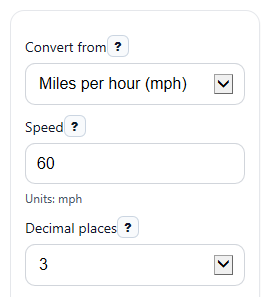
- Choose Convert from so the converter knows whether your starting value is in miles per hour or meters per second.
- Enter your number in Speed. You can use a whole number, decimal, zero, or a negative value if your class uses direction.
- Pick Decimal places to control how rounded the displayed answer should be.
- Click Calculate to see Converted speed, the exact math in Conversion used, the Exact conversion factor, and What this means.
- Sanity-check the result: if you convert from mph to m/s, the number should get smaller, and if you convert from m/s to mph, the number should get larger.
Definitions
mph: Miles per hour, a speed unit often used for road speeds in the US.
m/s: Meters per second, meaning how many meters are traveled each second.
Converted speed: The matching speed in the other unit after conversion.
Decimal places: How many digits appear after the decimal point in the displayed result.
Conversion factor: The fixed number used to switch between two units.
Exact conversion factor: The full factor used by the converter before display rounding.
Common mistakes and quick fixes
Mistake: Leaving Speed blank and expecting a result.
Fix: Enter a number in Speed , such as 60 or 10.5, then calculate again.
Mistake: Picking the wrong option in Convert from .
Fix: If your starting number is in miles per hour, choose mph. If your starting number is in meters per second, choose m/s.
Mistake: Thinking Decimal places changes the real conversion math.
Fix: Use Decimal places only to change how the Converted speed is rounded on screen.
Mistake: Seeing a negative Converted speed and assuming the converter is broken.
Fix: A negative result can be valid in physics. It means the motion is in the opposite direction if direction matters.
Mistake: Copying only the number from Converted speed and forgetting the unit.
Fix: Copy the value together with its unit, either m/s or mph, so the answer stays clear.
Mistake: Ignoring Conversion used and Exact conversion factor when checking homework.
Fix: Use those two outputs to verify whether you should multiply by 0.44704 or divide by 0.44704.
Limitations & Key Assumptions / Boundary Conditions
- This converter changes units only. It does not estimate speed from distance and time measurements.
- Rounding depends on Decimal places. Changing that setting can change the displayed value even when the exact calculation stays the same.
- Negative speeds are allowed for physics-style direction use. In everyday driving, speed is usually treated as nonnegative.
- The result is only as accurate as the number entered in Speed. If the input is rounded, the converted value is rounded from the start.
- Very large values are still converted with the same fixed factor, but displayed formatting may make long numbers harder to read quickly.
Methodology
How the conversion works
The converter uses one exact relationship between miles per hour and meters per second. If you start with mph, it multiplies by 0.44704. If you start with m/s, it divides by 0.44704.
m/s = mph x 0.44704
mph = m/s / 0.44704
Where 0.44704 comes from
One international mile is 1609.344 meters, and one hour is 3600 seconds [1]. Dividing 1609.344 by 3600 gives the exact mph-to-m/s factor.
0.44704 = 1609.344 / 3600
2.2369362920544 = 1 / 0.44704
Worked example
If Convert from is mph and Speed is 60, the exact converted value is 26.8224 m/s. With Decimal places set to 3, the displayed Converted speed becomes 26.822 m/s.
26.8224 = 60 x 0.44704
If Convert from is m/s and Speed is 10, the exact converted value is 22.369362920544 mph. With 3 decimal places, the display becomes 22.369 mph.
22.369362920544 = 10 / 0.44704
How to read the result
What this means rewrites the answer in plain words. For example, 60 mph means about 26.822 meters traveled each second. A larger m/s value means more distance covered every second.
Assumptions used
This tool assumes the standard exact factor 0.44704 for every conversion. It rounds only the displayed output, not the underlying calculation. It does not attach direction unless you enter a negative value, and it does not account for measurement error in the starting speed.