
Convert pints to cubic feet using the correct pint type so you do not mix up US liquid, US dry, and Imperial sizes.
Table of contents
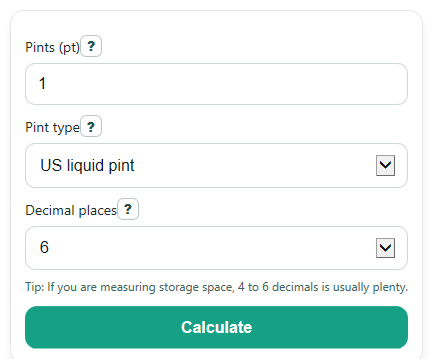
How to use our Pints to Cubic Feet Converter
- Enter the amount in Pints. You can use a whole number, decimal, zero, or a negative value if you are measuring a change.
- Choose the correct Pint type: US liquid pint for most US liquids, US dry pint for dry produce containers, or Imperial pint for UK-based measures.
- Pick Decimal places to control how much rounding you want in the displayed result.
- Click Calculate, then read Cubic feet first and use Factor used plus Pint type used to confirm the math used the right pint system.
Definitions
Pint: A unit of volume. Its size changes by system, so a pint is not always the same amount.[1]
Pint type: The system used for the conversion: US liquid pint, US dry pint, or Imperial pint.
Cubic foot: A unit of volume equal to a cube that is 1 foot long on each side.[2]
Factor used: The conversion amount in ft^3 per pt. Multiply the number of pints by this factor to get cubic feet.
1 cubic foot equals: The reverse conversion, showing how many selected pints fit in 1 cubic foot.
Decimal places: How many digits appear after the decimal point in the displayed results.
Common mistakes and quick fixes
Mistake: Leaving Pints blank or typing text instead of a number.
Fix: Enter a numeric value in Pints , such as 1, 2.5, or 10.
Mistake: Using US liquid pint when your container is a dry-measure pint basket.
Fix: Change Pint type to US dry pint before you calculate.
Mistake: Picking the wrong country system for the pint size.
Fix: Check Pint type used in the results and switch Pint type to Imperial pint if your measure is UK-based.
Mistake: Thinking Factor used is the final converted volume.
Fix: Read Cubic feet as the converted answer. Factor used is only the amount of cubic feet in 1 pint of the selected type.
Mistake: Rounding too much and then reusing that rounded result in later work.
Fix: Increase Decimal places when you need more precision, and use 1 cubic foot equals to double-check the scale.
Mistake: Treating a negative Cubic feet result like an error.
Fix: A negative result can be valid if your Pints entry represents a decrease or difference in volume.
Limitations & Key Assumptions / Boundary Conditions
- The result depends completely on the selected Pint type. Choosing the wrong pint system gives the wrong conversion even if the number of pints is correct.
- This calculator converts volume only. It does not convert weight, shipping size, or how much space an irregular object will actually use.
- Rounding from Decimal places changes display only. Stored math should stay more precise than the shown value.
- Negative values are allowed because they can represent a volume change or difference, but they do not describe a physical container size by themselves.
- Very small displayed values may look like zero if you choose too few decimal places. Increase Decimal places when precision matters.
- The reverse value 1 cubic foot equals is based on the same selected pint type and exact stored factor, so it should be used as a unit check, not as a separate measurement system.
Methodology
How the calculator works
The calculator first picks the correct pint definition from Pint type. Then it multiplies your Pints value by the matching conversion factor to get Cubic feet.
Cubic feet = Pints x factor
Factors used
US liquid pint factor = 28.875 / 1728 = 0.0167100694444444 ft^3 per pt
US dry pint factor = 33.6003125 / 1728 = 0.0194446252893519 ft^3 per pt
Imperial pint factor = 34.6789370079 / 1728 = 0.0200688292869792 ft^3 per pt
The number 1728 is the number of cubic inches in 1 cubic foot because 12 x 12 x 12 = 1728. A pint is a unit of volume, and its size differs across systems.[1] A cubic foot is also a volume unit.[1]
Reverse conversion
The result card 1 cubic foot equals is found by dividing 1 by the selected factor. This helps you verify the unit system in reverse.
Pints per cubic foot = 1 / factor
Mini example
If you enter 10 for Pints and choose US liquid pint, the calculator uses the US liquid factor.
Cubic feet = 10 x 0.0167100694444444 = 0.167100694444444
With 6 decimal places, that displays as 0.167101 ft^3. The reverse card shows about 59.844156 pt for 1 cubic foot in the same pint system.
Calculation choices
The calculator uses the full stored factor for the math and rounds only for display. That is why Factor used and 1 cubic foot equals stay consistent when you change Decimal places.
Assumptions used in the math
This tool assumes the pint definitions listed above, a fixed cubic foot of 1728 cubic inches, and straightforward unit conversion only. It does not adjust for packaging shape, air gaps, measurement error, or real-world fill level.