
Convert US liquid pints to US tablespoons or reverse, with a quick mL cross-check to help avoid common recipe unit mix-ups.
Advanced options
Table of contents
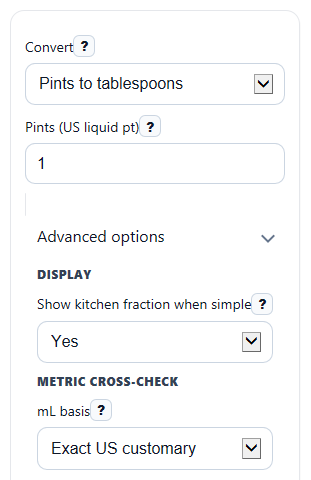
How to use our Pints to Tablespoons Converter
- Choose Convert as either Pints to tablespoons or Tablespoons to pints.
- Enter your amount in Pints (US liquid pt) or Tablespoons (US tbsp), depending on the direction you picked.
- If you want, open Advanced options and choose an mL basis or turn Show kitchen fraction when simple on or off.
- Click Calculate to see Converted amount, Same amount in mL, and the Conversion fact used.
- Sanity-check the result: 1 pint should equal 32 tablespoons, and 32 tablespoons should equal 1 pint. If your answer is far off, recheck that you used US liquid pt and US tbsp.
Definitions
US liquid pint (US liquid pt): A US volume unit used for liquids. In this calculator, 1 US liquid pint equals 32 US tablespoons.
US tablespoon (US tbsp): A standard US cooking volume unit. This page does not use UK, imperial, or metric tablespoon sizes.
mL: Milliliter, a metric volume unit. The calculator shows the same amount in mL as a cross-check.
Exact US customary: Uses exact unit relationships for the mL cross-check, such as 1 US liquid pint = 473.176473 mL [3].
FDA kitchen rounding: Uses rounded household measure values for the mL cross-check, such as 1 tablespoon = 15 mL and 1 pint = 480 mL [2].
Kitchen fraction: A simple fraction form of the result, such as 1/2 or 1 1/2, shown only when the value is close to a common recipe-style fraction.
Conversion factor: The fixed ratio used in the math. For pint to tablespoon conversion, the factor is 32 tablespoons per pint.
Common mistakes and quick fixes
Mistake: Typing a value into Pints (US liquid pt) while Convert is set to Tablespoons to pints .
Fix: Match the filled input to the selected direction. Use Pints (US liquid pt) only for pint-to-tablespoon conversion, and Tablespoons (US tbsp) only for tablespoon-to-pint conversion.
Mistake: Using a dry pint, UK pint, or another tablespoon size and expecting the Converted amount to match.
Fix: This tool uses only Pints (US liquid pt) and Tablespoons (US tbsp) . If your source uses another system, convert that unit first.
Mistake: Leaving the active input blank and expecting the calculator to treat it as zero.
Fix: Check Convert and then recalculate. Enter a real number in the visible required field before you calculate. Blank values should be corrected, not guessed.
Mistake: Thinking Same amount in mL must always match a recipe book or food label exactly.
Fix: Check mL basis . Exact US customary and FDA kitchen rounding can give slightly different metric values for the same volume.
Mistake: Expecting Easy kitchen reading to appear for every answer.
Fix: The fraction is shown only when the result lands near a simple kitchen fraction and Show kitchen fraction when simple is set to Yes .
Mistake: Ignoring a negative Converted amount or negative Same amount in mL .
Fix: Negative values are allowed mathematically, but for cooking they usually mean a typing mistake. Recheck the sign on your input.
Limitations & Key Assumptions / Boundary Conditions
- The main conversion is locked to US liquid pints and US tablespoons only. It does not convert dry pints, UK pints, imperial pints, or non-US tablespoon sizes.
- The mL cross-check can differ slightly depending on mL basis. Exact US customary and FDA kitchen rounding are both valid for their own uses, but they are not interchangeable.
- Easy kitchen reading is shown only when the result is close to a simple fraction. More awkward decimals stay as decimals instead of being forced into a messy fraction.
- Negative inputs are allowed because unit conversion math works with signed numbers, but negative volume usually does not make practical sense in cooking.
- Very small decimal differences can appear because of rounding in the displayed output, even when the underlying conversion factor is fixed.
- This tool converts volume only. It does not convert ingredient weight, density, or recipe yield.
Methodology
Core calculation
The calculator uses one fixed US kitchen relationship for the main conversion:
1 US liquid pint = 32 US tablespoons [1].
tablespoons = pints * 32
pints = tablespoons / 32
Metric cross-check
The mL result shows the same volume in metric units using the basis you choose.
mL = pints * 473.176473
mL = tablespoons * 14.78676478125
These are the exact US customary metric equivalents used for the exact basis [3].
mL = pints * 480
mL = tablespoons * 15
These are rounded kitchen values used for FDA-style household measure labeling [2].
Worked example
If Convert is set to pint to tablespoon and you enter 1.5 in Pints (US liquid pt), the main result is 48 tablespoons because 1.5 x 32 = 48.
48 = 1.5 * 32
For the exact metric cross-check, the same 1.5 pints equals 709.7647095 mL.
709.7647095 = 1.5 * 473.176473
For the FDA rounded cross-check, the same 1.5 pints equals 720 mL.
720 = 1.5 * 480
Kitchen fraction logic
If you turn on Show kitchen fraction when simple, the calculator checks whether the result is close to an easy recipe-style fraction. If it is not close enough, the fraction output stays hidden so you do not get a misleading fraction.
Assumptions and calculation choices
The visible input depends on the selected direction, and the hidden input is ignored. Blank or non-numeric required values are treated as errors, not as zero. Displayed decimals may be rounded for readability, but the conversion uses the fixed constants listed above.